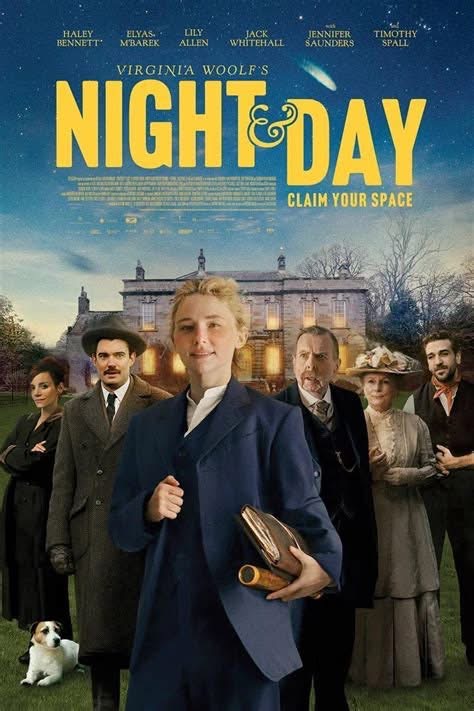
Two Virginia Woolf events will take place this week, one on Thursday, one on Friday, and both on Zoom. In the first, Maria Oliviera discusses the reception of Woolf’s A Room of One’s Own (1929) in Brazil. In the second, Amy Smith considers Woolf’s critical engagement with Platonism in her 1919 novel Night and Day.
“A Room of One’s Own in Brazil” seminar
Who:Maria Oliviera, professor, Federal University of Paraiba What: This first session of the “A Room of One’s Own Around the Globe” seminar will discuss the reception of Woolf’s 1929 polemic in Brazil. Presented in English. When: 6 p.m. CTE; noon EST on Thursday, November 20. Check your time zone. Where: On Zoom. Free and open to all. Get more details:Get the Zoom link in order to attend.
About the project: The A Room of One’s Own : Echos and circulation research project offers to take up Virginia Woolf’s landmark essay A Room of One’s Own (1929) and explore its full potential. One question it attempts to answer is what echo chambers has A Room of One’s Own opened up nearly a century after its publication?
Led by Valérie Favre (Université Paris 1 Panthéon-Sorbonne) and Anne-Laure Rigeade (Université Paris Est Créteil), this project will continue until 2029, the centenary of the publication of A Room of One’s Own, and will include seminars, a conference, and a collective publication.
“‘Dreams and Realities’: Woolf’s Revisions to Plato in Night and Day — a talk
Who:Amy Smith, associate professor of English at Lamar University and author of Virginia Wool’s Mythic Method. What: A talk for the Virginia Woolf Society of Turkey titled “‘Dreams and Realities’: Woolf’s Revisions to Plato in Night and Day. Presented in English. When: 7 p.m. Turkey time on Friday, November 21. Where: On Zoom. Free and open to all. Get more details:Register online for the event in order to attend. The Zoom link will then be provided.
About the talk: The intellectual significance of Night and Day in Woolf’s development as a writer and thinker has long been overlooked. In her talk, Amy considers Woolf’s critical engagement with Platonism in the novel, where it appears both as a genre model and as a reservoir of imagery, to which Woolf makes polyvalent references that disrupt Platonic idealism. Woolf’s active wrestling with Plato suggests that she is processing and separating from early philosophical influences just as she is from her inherited models of love, marriage, and the correct life for a woman, and also from conventional models of writing in her emerging in her modernist stories and aesthetic theory. Equally important as the aesthetic and personal revolutions Woolf makes at this moment is her philosophical revolution, and wrestling with Plato is a necessary step in her development of a unique, mature philosophy of her own.
About the book: Amy’s book, Virginia Woolf’s Mythic Method, is also now available in paperback. Use code SMITH at http://www.ohiostatepress.org for 40% off the hardcover or paperback.
Yesterday, survivors of Jeffrey Epstein, who were as young as 13 when they were first sexually abused and trafficked, released a powerful PSA that featured their childhood photos. It made the news and spread through social media.
Today, they channeled the power of their truth into a second press conference (the first was held in September) that shared their stories and announced the establishment of a national, survivor-led non-partisan political movement to expose all aspects of sexual abuse and exploitation. It made the news and spread through social media.
This afternoon — at long last — the House of Representatives voted 427-1 for a bill demanding that the Justice Department release all the Epstein files. But that did not happen until one Republican after another stepped before the mic to lie, blaming Democrats for the long delay in releasing the files and falsely claiming Republicans had wanted transparency all along.
The lone dissenter in today’s vote was far-right conspiracy theorist Republican Clay Higgins of Louisiana. Shame on him and the many Republicans, including our felon-in-chief, who worked tirelessly to keep the Epstein files under wraps.
Hours later, Minority Leader Chuck Schumer won unanimous agreement for the Senate to pass the measure as soon as it arrives in the chamber. It will then go to the felon in the White House for his signature, with the hope he does not use any further tricks to circumvent justice for women and girls.
Sexual abuse and Virginia Woolf
You might ask how any of this connects to Virginia Woolf. Here’s how.
Virginia Stephen was six years old the first time she was sexually abused. Her abuser, her half-brother Gerald Duckworth, was 18. Virginia was 13 when she was abused again, another incestuous abuse that went on until she was 29. This time, her other half-brother George Duckworth, a father figure to both Virginia and her sister Vanessa, was her abuser. He was 29 when it began and 45 when it ended.
Here are Virginia’s own words from her collection of five memoir pieces included in Moments of Being:
There was a slab outside the dining room door for standing dishes upon. Once when I was very small Gerald Duckworth lifted me onto this, and as I sat there he began to explore my body. I can remember the feel of his hand going under my clothes, going firmly and steadily lower and lower. I remember how I hoped that he would stop; how I stiffened and wriggled as his hand approached my private parts. But it did not stop. His hand approached my private parts too. I remember resenting, disliking it-what is the word for so dumb and mixed a feeling? It must have been strong, since I still recall it. This seems to show that a feeling about certain parts of the body; how they must not be touched; how it is wrong to allow them to be touched; must be instinctive. – Moments of Being, p. 69
Sleep had almost come to me. The room was dark. The house silent. Then, creaking stealthily, the door opened; treading gingerly, someone entered”. “ ‘Who?’ I cried. ‘Don’t be frightened,’ George whispered. ‘And don’t turn on the light, oh beloved.’ Beloved – and he flung himself on my bed, and took me in his arms. Yes, the old ladies of Kensington and Belgravia never knew that George Duckworth was not only father and mother, brother and sister to those poor Stephen girls; he was their lover also. – Moments of Being, p. 180
It was long past midnight that I got into bed and sat reading a page or two of Marius the Epicurean for which I had then a passion. There would be a tap at the door; the light would be turned out and George would fling himself on my bed, cuddling and kissing and otherwise embracing me in order, as he told Dr Savage later, to comfort me for the fatal illness of my father–who was dying three or four storeys lower down of cancer. – Moments of Being, p. 182
Incestuous sexual abuse and its effects on Virginia
Others have written about the effects this traumatic sexual abuse had on Virginia’s mental health, as well as her feelings about herself, her appearance, and her sexuality.
Among other things, such works speak of Woolf’s discomfort with any attention to her looks, whether it be her hat, her dress, or her body. They also speak of her own shame regarding looking at her own image in a mirror.
The looking-glass shame has lasted all my life, long after the tomboy phase was over. I cannot now powder my nose in public. Everything to do with dress-to be fitted-to come into a room wearing a new dress- still frightens me; at least makes me shy, self-conscious, uncomfortable. ‘Oh to be able to run, like Julian Morrell, all over the garden in a new dress’ I thought not too many years ago . . .
Yet this did not prevent me from feeling ecstasies and raptures spontaneously and intensely and without any shame or the least sense of guilt, so long as they were disconnected with my own body. – Moments of Being, pp. 68-9
Incestuous sexual abuse and its effects on Virginia’s writing
Virginia’s sexual abuse also influenced her writing in such novels as The Voyage Out (1915) and The Years (1937).
Remember the scene where the married Mr. Dalloway holds virginal Rachel Vinrace tightly and kisses her “passionately” against her will? (TVO 89) Recall the time Rose escapes the strange man under the lamppost who sucks his lips, makes a “mewing noise,” and starts unbuttoning his clothes? (TY, p. 29)
In both cases, the traumatized females suffer nightmares after the event.
Surviving with strength
Despite the incestuous sexual trauma Virginia suffered beginning at the age of six, she survived and went on to leave a body of work that lives on to be revered by new generations of common readers and scholars.
As Culver puts it, “Her detractors have dismissed Virginia Woolf as a pretentious snob, comfortably insulated from the ‘real world’ by her sex, her class, and her recurring illness. This is a slander that needs to be disproved. Woolf — while still a child — had to face realities so ugly they tormented her for years. But they did not conquer her. That she not only survived such violations of her integrity, but survived magnificently, argues that she was neither weak nor spineless, but remarkably strong and courageous.”
The same can be said of the thousand Epstein survivors who survive “magnificently” with remarkable strength and courage. We call on those in power to ensure they receive the full justice they have long deserved. We call on those in power to BELIEVE WOMEN.
Untucking it from below his seat and unwrapping it tenderly, he revealed his recently purchased copy of a Hogarth Press edition of To a Proud Phantom, a book of poetry by Ena Limebeer.
This 1923 edition, handset and printed by Virginia and Leonard Woolf, was his most recent purchase for his notable collection of Hogarth Press originals.
Ben’s collection of such treasures is now part of a world premiere exhibition, sponsored by the Gordon Square Society, called “Letter by Letter (From the Woolfs’ Hands): Handprinted Books by Virginia & Leonard Woolf.” The exhibit is the first to present several titles with their variant covers.
About the exhibit
For the first time in Belgium, this public exhibition brings together all 34 books hand-set, printed, bound and published in limited editions by Virginia and Leonard Woolf themselves under their Hogarth Press imprint.
These rarities in the literary and bibliophile world with their original covers and illustrations designed by Bloomsbury artists come from the collections of Ben, co-founder of the Gordon Square Society, as well as Pierre and Marie-Madeleine Coumans.
Vanessa Bell, Duncan Grant, Dora Carrington and Roger Fry are just some of the artists who created the cover designs for the highly sought after volumes.
The exhibition is complemented by the first “Bloomsbury” book and all the books published by The Omega Workshops.
Who: Sponsored by the Gordon Square Society
What: “Letter by Letter (From the Woolfs’ Hands): Handprinted Books by Virginia & Leonard Woolf” Exhibit
When: Nov. 30 and Dec. 4,5,6,7,11,12, 18, and 19 Where: The Splendid Nottebohm Room of the Hendrik Conscience Heritage Library – H. Conscienceplein 4, 2000 Antwerp Tickets:Check to see if any dates are available.
The play follows Victoria, a writer in the grip of a manic creative surge. As her obsession with Virginia Woolf deepens, fiction and reality blur — until she begins to believe she is Virginia.
Entangled in a love triangle with Mark, a restless drifter, and Leon, a sharp-witted academic, Victoria’s desires refuse easy categorization. The triangle reflects both her queerness and her fragmentation, blurring boundaries between friendship, love and obsession as she unravels in a world where ambition and mental illness collide.
Threaded loosely with Woolf’s stories and themes, the play explores bipolar disorder, identity and relationships, combining emotional intensity with humor.
Location: Barons Court, 28A Comeragh Rd, The Curtains Up Pub, London W14 9HR
If you’ll be in England this month, you have the opportunity to travel to Charleston for a special event with Mark Hussey and his new book, Mrs. Dalloway: Biography of a Novel.
The details
What: Mrs Dalloway: Biography of a Novel When: Wednesday 12 November, 7 p.m.
Celebrate the centenary of the publication of Virginia Woolf’s landmark novel Mrs Dalloway, with leading author and academic Mark Hussey as he introduces his new book, Mrs Dalloway: Biography of a Novel.
Discover the story behind the story: follow the remarkable ‘life’ of Mrs Dalloway, from its first stirrings in Woolf’s diaries, through her struggles to shape its form, to the novel’s critical reception and lasting legacy. Discover the hidden history of the novel that redefined modern literature.






 Alice Lowe
 Catherine
 Kaylee Baucom
 Leanne Oden
 Paula Maggio
 Stefano Rozzoni
 seanmcphail
 suzannebellamy1
 veronikakra
 Vara Neverow
 William Patrick Wend
 Zoe Wolstenholme


