Editor’s Note: As an introduction to the upcoming 34th Annual International Conference on Virginia Woolf: Virginia Woolf and Dissidence, set for July 4-8 at King’s College London and the University of Sussex, England, we offer the second in a series of four posts in which Leanne Oden and Serena Wong reflect on their encounters with Virginia Woolf and with Woolf scholars — dubbed Woolfians — that they met at the 33rd Annual International Conference on Virginia Woolf: Woolf, Modernity, Technology, held June 6-9 at Fresno State University.
Interactive Workshops
The whole world is a work of art – Virginia Woolf, “Moments of Being”
The interactive workshops at the 2024 Woolf conference provided a hands-on experience at the intersection of theory and practice. Conference attendees were invited to engage with Woolf’s thinking and writing in an exchange of ideas involving tactile, visual, and virtual modalities.
The two workshops highlighted in this post include the following:
- Interactive Workshop A: “A Million Hands Stitch,” a craft workshop enjoining the act of reading and the practice of stitching, and
- Interactive Workshop B: “Navigating Modernism(s) Xtended,” an exhibit of graduate work in the interest of creating virtual rooms overseen by J. Ashley Foster at Fresno State University.
Conference attendee Laura Ludtke reflected on her participation in “A Million Hands Stitch” as an active practice that she incorporated into subsequent events during the conference:
Stitching as I listened to other Woolfians share their research and work made me more attentive and attuned to the intricacies and implications of their observations. I’m grateful to have attended a conference where creative and critical practices are so purposefully imbricated.
Interactive Workshop A: “A Million Hands Stitch”
By Serena Wong, Ph.D. Candidate, University of Glasgow
“A Million Hands Stitch” was a craft workshop organized by Melissa Johnson that connected literary reading with creative practice. The workshop, as laid out in the conference booklet, promotes experimentation “with various kinds of making centered in text and textile.”

Melissa Johnson’s thread box at the “A Million Hands Stitch” workshop. Photo courtesy of Cody Vela.
An assortment of tools were offered at the workshop to approach this experiment, including felt, paper, needles, embroidery floss, scissors, a typewriter, and notably stacks of excerpted phrases and passages from Woolf’s writing.
Woolf’s words inspire
I attended the workshop with an interest in expanding the scope and thinking of my own creative practice. I had recently begun to work with pottery and ceramics to process through art Woolf’s discussions of the East, and within the exercises of this project I have come to recognize the benefits of exploring theories in creative practice via additional modes of craft.

Participants of Melissa Johnson’s “A Million Hands Stitch” workshop busy at work. Photo courtesy of Cody Vela.
Taking Johnson’s cue to create from our specific approaches to Woolf, I decided to work with a phrase that caught my eye among the stacks of prompt cards: “white plates in a sunny room.”
The phrase is found from a monologue by Susan in the third section of The Waves. “Now I am hungry. I will call my setter. I think of crusts and bread and butter and white plates in a sunny room.”
In contemplation with my conference paper about Woolf’s discourse on the chinoiserie plate, I took the liberty to suspect, in the context of the British empire’s taste for the willow pattern aesthetic, that the plates in question could be of such design.
After all, Susan’s monologue follows another visualization from Bernard about patterned plates with “Oriental long-tailed birds.” In the empire on which the sun “never” sets, crusts and bread and butter and chinoiserie plates are aligned for consumption in its sunny rooms – though the novel repeatedly gestures to a smashing of china from afar.

Serena’s finished piece from the “A Million Hands Stitch” workshop. Photo by Serena Wong.
Text and thread combine
I completed my workshop piece by typing the phrase on paper and adding to it an embroidered design with needle and thread.
There is something especially beautiful about stitching on paper. In working with so delicate a medium, the practice registers an attempt to make solid what is elusive, as with capturing words on a typewriter or framing sensations in art.
My piece thus results from a merging of my interpretations in reading, pottery painting, and stitching. A huge thank you to Johnson for hosting the wonderful craft workshop, which produced a token for me that I now have framed on my desk as a remembrance of the 2024 Woolf conference.
Interactive Workshop B: “Navigating Modernism(s) Xtended”
By Leanne Oden, Ph.D. Student, University of Rhode Island

Leanne Oden (center) with Callie Weiler of Fresno State University (right) discuss Weiler’s group project, which created an interactive virtual room in the form of a garden that interprets the works and lives of the Bloomsbury artists. Photo courtesy of Cody Vela.
I attended Interactive Workshop B: “Navigating Modernism(s) Xtended” where I had a lovely conversation with Callie Weiler about the project that she, Joseph LeForge, and Elizabeth Cardenas created as part of a graduate course with J. Ashley Foster.
Titled “The Cultivation of Love and Identity,” it created a virtual room in the form of a garden that interprets the works and lives of the Bloomsbury artists.
Reimagining Bloomsbury as a virtual garden space
Callie shared the vision for this project as outlined in the group’s abstract: “Bloomsbury’s life and love are difficult to describe in concrete terms, and it is this difficulty that necessitates a ludic reimagining of the space they created for themselves and others.
“They transcend barriers and labels to congregate as a group of individuals decisively to explore their meaning of love in its ephemeral, ungraspable form: love is a stimulating exchange, expressed with and through art, and was undefined by sexual orientation, the number, or the gender of partners engaged in romantic discourse.”
Callie walked me through the creative process step by step, starting from the readings that were assigned, choosing partners to collaborate with, identifying a topic, mocking up a storyboard, building a website, and designing the virtual room using Unreal Engine, culminating in a final paper composed by the group.
Creating the garden
The garden they created is fully interactive, allowing users to choose a path in the garden leading to a different artist. Each artist’s path is marked by an associated color.
She shared with me that the idea is to represent each color of the rainbow to emphasize the fluidity of sexuality and gender expression embraced by this group of modernist artists. Users were welcome to add to the garden, making this a truly communal, multimodal project.


Read past posts in this series
About the authors

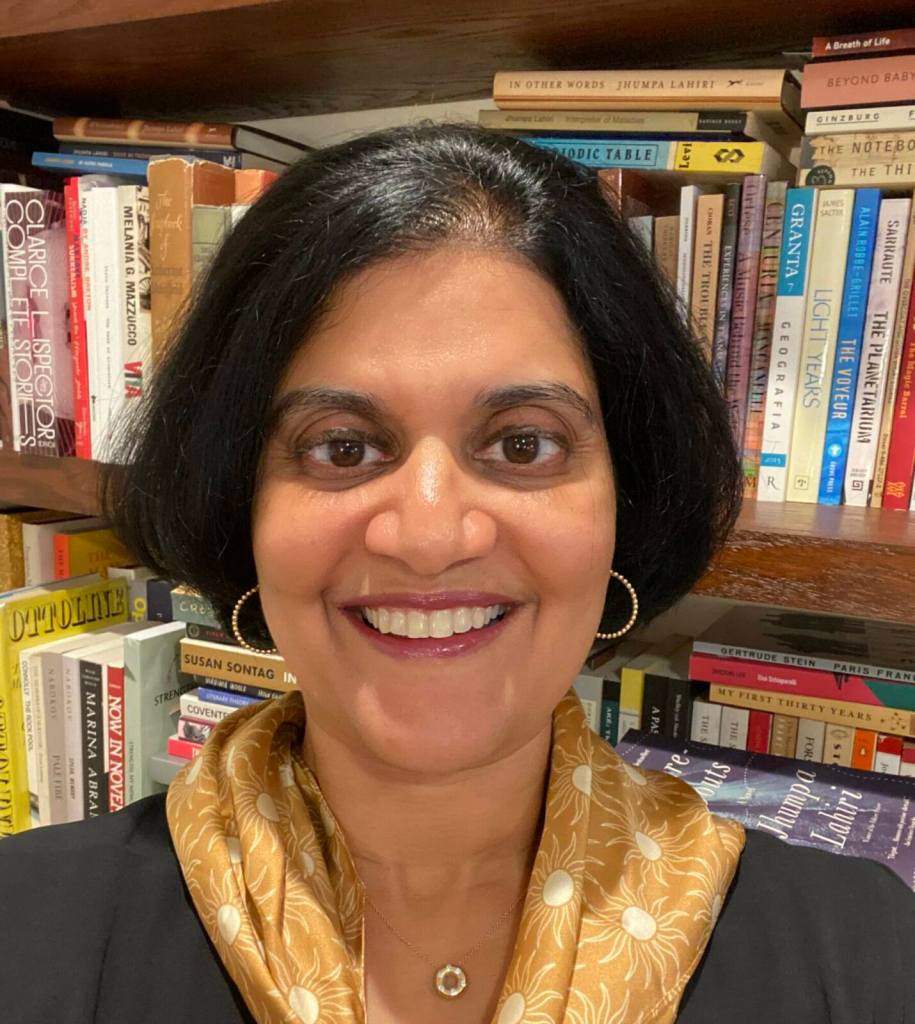
Leanne Oden
Leanne Oden is a first-year Ph.D. student and an Instructor of Record in the English Department at the University of Rhode Island. In her forthcoming research, Leanne is interested in questioning the closure narrative of the illness versus health binary as challenged through Woolf’s writing among other modernists. In her role as an educator for the University of Rhode Island, she regularly teaches ENG 110: Introduction to Literature and WRT 106: Introduction to Research Writing.

Serena Wong
Serena Wong is a Ph.D. Candidate in English Literature at the University of Glasgow. Her doctoral study situates itself at the crossroads of British modernisms and Chinese modernity, with a focus on the orientalism in Virginia Woolf’s stylistic and formal representations of China. Her research also looks at theoretical and creative studies of ornamentation, which she positions as an important dimension of orientalist thought.
Discover more from Blogging Woolf
Subscribe to get the latest posts sent to your email.




Share your thoughtsCancel reply