Feeds:
Posts
Comments

Archive for the ‘books’ Category

Hatchard’s will celebrate the publication of Maggie Humm’s new book, The Bloomsbury Photographs (2024) with a special “lantern show” at 18:30 BST on Tuesday, Oct. 22, at its shop on Piccadilly.

About the event

At the event, Maggie Humm will offer a fresh portrait of the Bloomsbury Group by showing a curated selection of the thousands of photographs that shows them in a setting of domestic intimacy. Scenes include the pastimes, children, clothes, houses, servants, pets, and holidays of the group.

According to Hatchard’s: “Several photographs are blurred as if taken in a hurried moment of time, and unguarded close-ups reflect complex personal relationships – revealing them to be more than simply documents; they are testimonies of relationships, friendships, and the significance of empathetic lives.”

About tickets and the author

Tickets are priced at £5 for members of the Virginia Woolf Society of Great Britain and Hatchard’s Reward Card holders. General admission is £10. Tickets are available online, but sales end soon.

Humm is vice-chair of the Virginia Woolf Society of Great Britain and author of many monographs about Virginia Woolf and Bloomsbury, including her novel Talland House, which is based on Woolf’s To the Lighthouse.

Hatchard’s on Piccadilly

Read Full Post »

Writers stamp themselves upon their possessions more indelibly than other people, making the table, the chair, the curtain, the carpet into their own image. – Virginia Woolf,  “Great Men’s Houses (1911)

That is the lovely quote that begins the introduction to Rooms of Their Own: Where Great Writers Write (2022)– and the fact that it was written by VirginiaWoolf adds a special boost to this post.

The book answers the question, “Where do you write?” for authors ranging from Maya Angelou to William Wordsworth — 50 in all. It describes their writing environments — from attics and studies to billiard rooms and bathtubs — in words written by Alex Johnson and illustrations in charming water colors by James Oses.

As the book blurb explains, it “explores the unique spaces, habits and rituals in which famous writers created their most notable works.”

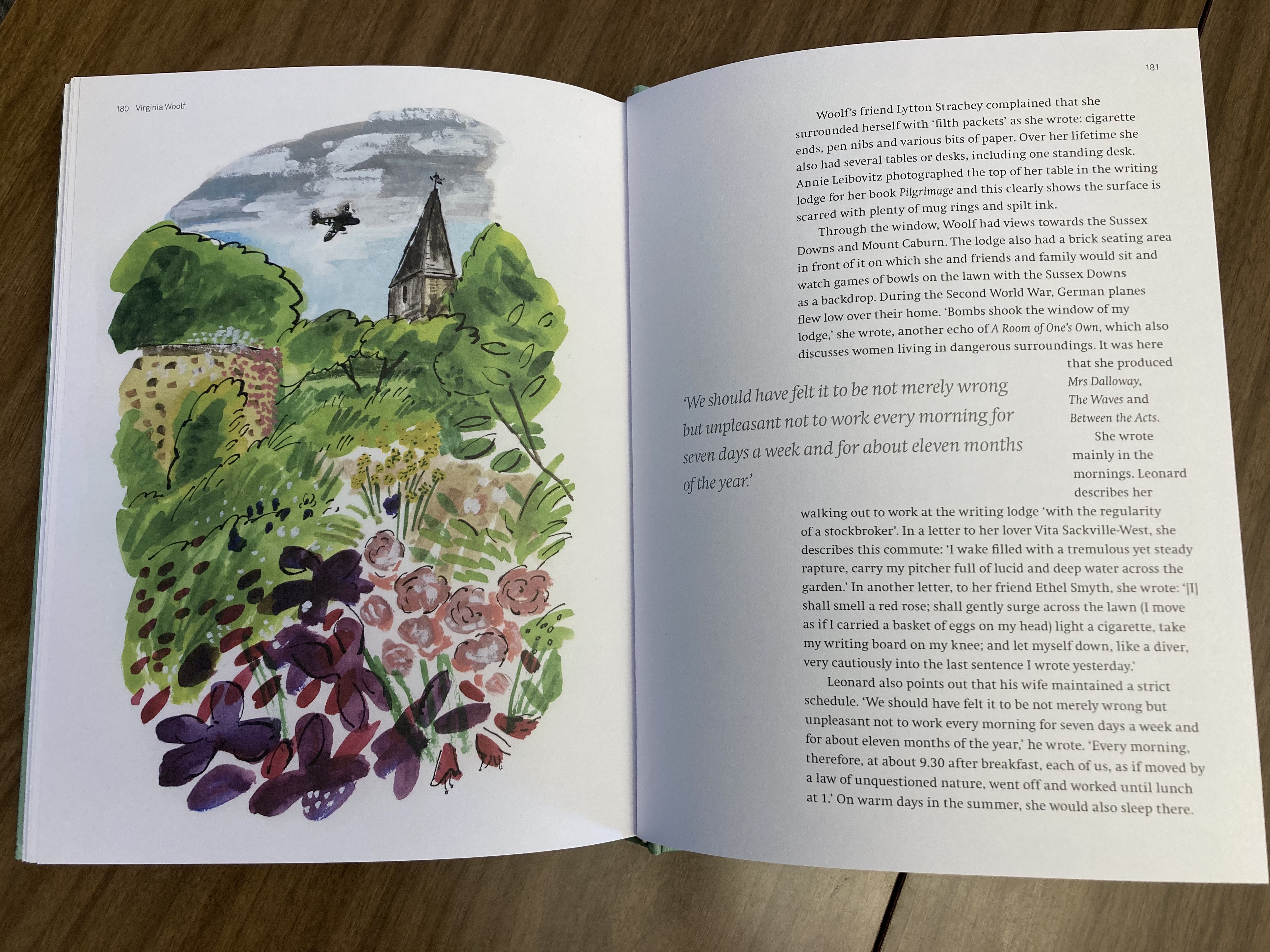
Virginia Woolf’s writing lodge at Monk’s House in Rodmell, East Sussex

In addition, it details each author’s writing methods, routines and habits, as well as their ink, paper, and pencil preferences.

It also includes information on each of the locations described, many of which are private and not open to visitors.

Of particular note to readers of Blogging Woolf are the rooms used by Woolf and Vita Sackville-West. The book covers each with a four-page spread.

The tower at Sissinghurst Castle in Kent, where Vita Sackville-West’s writing room is located.

Woolf’s, of course, depicts the interior of her writing lodge at Monk’s House, along with her view from the lodge. Vita’s shows the interior of her tower room at Sissinghurst Castle, as well as a long view of the tower exterior.

Lucky for us, both Monk’s House and Sissinghurst Castle are open to visitors.

However, as I recall my last visit to Monk’s House in July of 2019, we were not permitted inside the space where Woolf wrote in her lodge. We had to view it through a window. The photo below shows that view.

In June of 2018, I got a look at Vita’s lofty writing space in the Sissinghurst tower from a doorway, after climbing the stairway that led to it. The doorway was blocked by a grille to preserve the fragile contents within. You can see what I saw in the photo below, including just some of the room’s 2,700 books.

Despite such limitations, each is certainly worth a visit.

Virginia Woolf’s desk in her writing lodge at Monk’s House, 2019. Woolfs’ tortoiseshell glasses, as well as her folders for her manuscripts, are on the table. While the Woolfs converted an old tool shed in their garden into a writing room for Virginia in 1921, by 1934 they built this new lodge with French windows. I took this photo through a window, as entry was not permitted.

Vita Sackville-West’s writing room in the high tower at Sissinghurst Castle, 2018. It appears as it was upon her death in 1962. It is lit as a night scene to prevent damage from light and reflects the fact that Vita usually wrote by lamplight in the evening. I took this photo through a grille in the doorway at the top of the stairs, as entry was not allowed.

Virginia Woolf: A shed of one’s own, p 178-9, Virginia Woolf: A shed of one’s own, p 178-9, Rooms of Their Own: Where Great Writers Write


Virginia Woolf: A shed of her own, p. 180-81, Rooms of Their Own: Where Great Writers Write


Vita Sackville West: A room to celebrate love(s), p. 138-9, Rooms of Their Own: Where Great Writers Write

Vita Sackville West: A room to celebrate love(s), p. 140-1, Rooms of Their Own: Where Great Writers Write


Read Full Post »

Virginia Woolf’s numerous experiences with illness led her to write the essay On Being Ill, published in 1930 by the Hogarth Press. Inspired by this work and the  coronavirus, Norwegian typesetter Ane Thon Knutsen has turned her spontaneous homage to the essay into book form.

Here’s how it came about.

In March of 2020, as lockdowns due to the COVID-19 pandemic spread around the globe, Ane already had two other projects focused on Woolf under her belt — A Printing Press of One’s Own and The Mark on the Wall.

Working from her private letterpress studio at home, Ane started a third. She printed one sentence from “On Being Ill” on one sheet of paper every day. Her project ran from March 23 to Aug. 29, 2020, and she shared those pages on Instagram. She also shared her thoughts about the project with Blogging Woolf.

Through this process, she shaped a diary in response to the COVID-19 pandemic and allowed for research on pandemics by creating an artist book.

The book merges Woolf’s sentences with with my reflections on covid, pandemics, isolation, escaping reality through literature, waiting, time, art, love, protests, feminism, typesetting, printing, family, small stuff, big stuff. – Ane

The publication also contains reflections on teaching during the pandemic in the spring of 2021, along with insights and works by master’s students in graphic design and illustration at The Oslo National Academy of The Arts, using Woolf’s essay as a mirror for their own pandemic experiences.

The digital book edition

With an introduction by Mark Hussey, the book is available as a digital book edition of 150. It is now available through several independent bookshops, which are handling distribution. They include the following:

Copies will also be available at the 33rd Annual International Woolf conference in June.

Support and gratitude

The publication is supported with research funds from The Oslo National Academy of The Arts. Graphic design was done by Tiril Haug Johne and Victoria Meyer.

Ane expresses special thanks to the Oslo National Academy of the Arts Class of 2022: Araiz Mesanza, Embla Sunde Myrva, Kristine Lie Øverland Emil Holmberg Lewe, Ruth Emilie Rustad, Nicolo Groenier, her former professor Alan Mackenzie-Robinson, former president of the International Virginia Woolf Society Dr. Benjamin Hagen, the Woolf community, her husband Truls and her son Pil.

Ane Thon Knutsen in her home printshop with a volume of On Being Ill, her pandemic project originally shared on Instagram.

About Ane Thon Knutsen

Ane is internationally known for her letterpress-focused installations and artists’ books. The associate professor of graphic design at the Oslo Academy of the Arts has won numerous awards for her work. She owns and works from her private letterpress studio in Oslo.

Ane Thon Knutsen at her exhibition “Printed Works: Adaptations of Virginia Woolf” at the 32nd Annual International Conference on Virginia Woolf at Florida Gulf Coast University, Jun3 8-11, 2023.

She also debuted her installation, “Printed Words: Adaptations of Virginia Woolf,” at University Archives and Special Collections at the Florida Gulf Coast University library during the 32nd Annual International Conference on Virginia Woolf: Virginia  Woolf and Ecologies, June 8-11, 2023.

In “Printed Works,” the self-taught typesetter who has exhibited other letterpress projects and installations related to Woolf, adapted a selection of Virginia Woolf’s self-published short stories. The exhibit focused on Woolf’s poetic short stories “Blue” and “Green.” The printed pages were collected and are being stored in book form in FGCU Bradshaw Library’s Archives and Special Collections.

More coming up

In addition, Ane will display another installation, Woolf’s “Kew Gardens,” May 16 – June 11 for the 33rd International Virginia Woolf Conference. The adaptation of Woolf’s short story consists of 1,514 letterpress-printed sheets of kozo.

According to Ane, it is an “organic book allowing you to walk through the pages, like insects in a flowerbed.”


View this post on Instagram


A post shared by Ane Thon Knutsen (@anethonknutsen)

Read Full Post »

Is everything we think we know about the Dreadnought hoax wrong? Danell Jones says it is.

Jones, the author of Virginia Woolf, Race and the Dreadnought Hoax (2023) will give an illustrated online talk on “Everything You Think You Know about the Dreadnought Hoax Is Wrong.” Marielle O’Neill will lead the Q&A that follows.

Event details

What: Talk on “Everything You Think You Know about the Dreadnought Hoax Is Wrong“
Date:
Wednesday, May 15
Time: 5:30 p.m. BST
Where: Online
Cost: £6
Sponsor: Virginia Woolf Society of Great Britain
Audience: VWSGB members only. Not a member? Join here.
For more information: Contact onlinevwsgb@gmail.com

About the book — and the talk

Journalists, memoirists and others have been getting the 1910 Dreadnought hoax wrong for more than a century. Even Virginia Woolf’s 1940 talk about the hoax is rife with inaccuracies, exaggerations and misrepresentations.

The Girl Prince, published by Hurst, takes a deep dive into the famous prank, exploring the often-overlooked diversity of Virginia Woolf’s world and setting the record straight on a practical joke that has been misunderstood for 100 years.

About the author

Danell Jones is a writer and scholar with a PhD in literature from Columbia University. She is the author of The Virginia Woolf Writers Workshop; the poetry collection Desert Elegy; and An African in Imperial London: The Indomitable Life of A.B.C. Merriman-Labor, which won the High Plains Book Award for Nonfiction.


Read Full Post »

We are nearing the tail end of Women’s History Month and who better to read than Virginia Woolf?

Virginia and Leonard Woolf moved into Monk’s House in Rodmell in 1919, and as the Monk’s House guidebook states, “Books dominated the house.” During a 2019 visit, books were the first thing we saw as we entered through the back doorway. They lined the stairs to the second floor.

To that end, I have two resources that give advice on “Where to start with Virginia Woolf.”

At the starting gate with Penguin

“Are you afraid of Virginia Woolf?” asks Penguin. The publisher then advises: “There’s no need: there’s something for everyone in the Modernist writer’s back catalogue.”

The website gives a synopsis and link for seven of Woolf’s novels and/or polemics, along with links to other works related to Woolf, such as Square Haunting: Five Women, Freedom and London Between the Wars (2020).

The recommended Woolf works include the following:

At the starting gate with NYPL

The second comes from the New York Public Library. Their guide on “Where to Start With Virginia Woolf” includes a brief synopsis of each work and recommends reading them in this order:

  1. Mrs. Dalloway (1925)
  2. A Room of One’s Own (1929)
  3. To the Lighthouse (1927)
  4. The Waves (1931)
  5. Orlando (1928)

A book list of her own

Meanwhile, Woolf scholar Maggie Humm’s Twitter post two years ago on World Book Day included a list of the books Woolf liked and disliked most in 1924, 100 years ago.

Read Full Post »

« Newer Posts - Older Posts »