Feeds:
Posts
Comments

Archive for the ‘essays’ Category

Virginia Woolf’s numerous experiences with illness led her to write the essay On Being Ill, published in 1930 by the Hogarth Press. Inspired by this work and the  coronavirus, Norwegian typesetter Ane Thon Knutsen has turned her spontaneous homage to the essay into book form.

Here’s how it came about.

In March of 2020, as lockdowns due to the COVID-19 pandemic spread around the globe, Ane already had two other projects focused on Woolf under her belt — A Printing Press of One’s Own and The Mark on the Wall.

Working from her private letterpress studio at home, Ane started a third. She printed one sentence from “On Being Ill” on one sheet of paper every day. Her project ran from March 23 to Aug. 29, 2020, and she shared those pages on Instagram. She also shared her thoughts about the project with Blogging Woolf.

Through this process, she shaped a diary in response to the COVID-19 pandemic and allowed for research on pandemics by creating an artist book.

The book merges Woolf’s sentences with with my reflections on covid, pandemics, isolation, escaping reality through literature, waiting, time, art, love, protests, feminism, typesetting, printing, family, small stuff, big stuff. – Ane

The publication also contains reflections on teaching during the pandemic in the spring of 2021, along with insights and works by master’s students in graphic design and illustration at The Oslo National Academy of The Arts, using Woolf’s essay as a mirror for their own pandemic experiences.

The digital book edition

With an introduction by Mark Hussey, the book is available as a digital book edition of 150. It is now available through several independent bookshops, which are handling distribution. They include the following:

Copies will also be available at the 33rd Annual International Woolf conference in June.

Support and gratitude

The publication is supported with research funds from The Oslo National Academy of The Arts. Graphic design was done by Tiril Haug Johne and Victoria Meyer.

Ane expresses special thanks to the Oslo National Academy of the Arts Class of 2022: Araiz Mesanza, Embla Sunde Myrva, Kristine Lie Øverland Emil Holmberg Lewe, Ruth Emilie Rustad, Nicolo Groenier, her former professor Alan Mackenzie-Robinson, former president of the International Virginia Woolf Society Dr. Benjamin Hagen, the Woolf community, her husband Truls and her son Pil.

Ane Thon Knutsen in her home printshop with a volume of On Being Ill, her pandemic project originally shared on Instagram.

About Ane Thon Knutsen

Ane is internationally known for her letterpress-focused installations and artists’ books. The associate professor of graphic design at the Oslo Academy of the Arts has won numerous awards for her work. She owns and works from her private letterpress studio in Oslo.

Ane Thon Knutsen at her exhibition “Printed Works: Adaptations of Virginia Woolf” at the 32nd Annual International Conference on Virginia Woolf at Florida Gulf Coast University, Jun3 8-11, 2023.

She also debuted her installation, “Printed Words: Adaptations of Virginia Woolf,” at University Archives and Special Collections at the Florida Gulf Coast University library during the 32nd Annual International Conference on Virginia Woolf: Virginia  Woolf and Ecologies, June 8-11, 2023.

In “Printed Works,” the self-taught typesetter who has exhibited other letterpress projects and installations related to Woolf, adapted a selection of Virginia Woolf’s self-published short stories. The exhibit focused on Woolf’s poetic short stories “Blue” and “Green.” The printed pages were collected and are being stored in book form in FGCU Bradshaw Library’s Archives and Special Collections.

More coming up

In addition, Ane will display another installation, Woolf’s “Kew Gardens,” May 16 – June 11 for the 33rd International Virginia Woolf Conference. The adaptation of Woolf’s short story consists of 1,514 letterpress-printed sheets of kozo.

According to Ane, it is an “organic book allowing you to walk through the pages, like insects in a flowerbed.”

Read Full Post »

Good news: Beth Rigel Daugherty’s much celebrated 2022 book, Virginia Woolf’s Apprenticeship: Becoming an Essayist, from Edinburgh University Press will be available May 31 in paperback.

More good news: You can order it from Blackwell’s at a price of $38.82, which includes shipping to the U.S.

What’s in the book

  • The most comprehensive portrayal of Virginia Woolf’s education to date
  • Examination of the link between Virginia Stephen’s education and Virginia Woolf’s essays
  • A focus on Woolf’s nonfiction and her early work
  • Two holograph draft lectures by Virginia Stephen for the first time
  • A compilation and organization of archival material in appendices for future researchers.

According to the publisher:

This study takes up Woolf’s challenge to probe the relationship between education and work, specifically her education and her work as an essayist. It expands her education beyond her father’s library to include not only a broader examination of her homeschooling but also her teaching at Morley College and her early book reviewing. It places Virginia Stephen’s learning in the historical and cultural contexts of education for women, the working classes and writers in the late nineteenth and early twentieth century.

Part two

Rigel Daugherty is working on a follow-up volume, Virginia Woolf’s Essays: Being a Teacher. With this volume, Beth says, “I hope to clarify how her essays continue to teach and continue to encourage readers to join the literary conversation.”

About the author

Recently retired from Ohio’s Otterbein University, Beth Rigel Daugherty taught modernist English literature, Virginia Woolf, and Appalachian and Native American literature, along with many thematically focused writing courses, for 36 years.

Her plenary talk at the 31st Annual International Conference on Virginia Woolf, “On the Ethics of Teaching: Virginia Woolf’s Essays,” received accolades from everyone who heard it.

Rigel Daugherty fell in love with Virginia Woolf and her essays while at Rice University and has been presenting and publishing on both ever since. Her peer-reviewed articles have appeared in edited collections; editions of the “How Should One Read a Book?” holograph draft and Woolf’s fan letters in Woolf Studies Annual; and, with Mary Beth Pringle, the Modern Language Association teaching volume on To the Lighthouse.

Beth Rigel Daugherty (at far left), Leslie Hankins and Diane Gillespie presented a panel on “Portraying and Projecting Age, Ageism, and Activism” at the 19th Annual International Conference on Virginia Woolf, with its theme of social justice, at the University of Mount Saint Joseph in Cincinnati in June of 2019.

Read Full Post »

Virginia Woolf wrote hundreds of essays during her lifetime. The total varies from “nearly 600” (Fernald 160) to “640,” (Rigel Daughtery 9) so it can be difficult to locate just the right essay when needed. For that reason,  sometimes a slim collection of Virginia Woolf essays that focus on a specific topic is just the thing.

Here are two.

On freedom

The first is part of a 27-volume Vintage Mini collection, a Vintage Classic published by Penguin/Random House. Titled Liberty, it includes selections from A Room of One’s Own (1929), The Waves (1931), and the essays “Street Haunting” and “How Should One Read a Book.”

Here begins the freedom of the mind, or rather the possibility that in the course of time the mind will be free to write what it likes – jacket quote from Liberty (2018)

On the visual arts

The second is the twentieth volume in the ekphrasis series published by David Zwirner Books in 2021 and is a collection of Woolf’s writings on the visual arts.

Titled Oh, to Be a Painter!, the volume begins with an introduction by Claudia Tobin and includes Woolf’s longest essay on painting, “Walter Sickert: A Conversation” (1934), alongside shorter essays and reviews, including “Pictures and Portraits” (1920) and “Pictures” (1925).

References:

Fernald, Anne E. “A Feminist Public Sphere? Virginia Woolf’s Revisions of the Eighteenth Century.” Feminist Studies 31:1 (2005): 158-182.

Daugherty, Beth Rigel. “The Transatlantic Virginia Woolf: Essaying an American Audience.” Virginia Woolf Miscellany 76 (2009): 9-11.


Read Full Post »

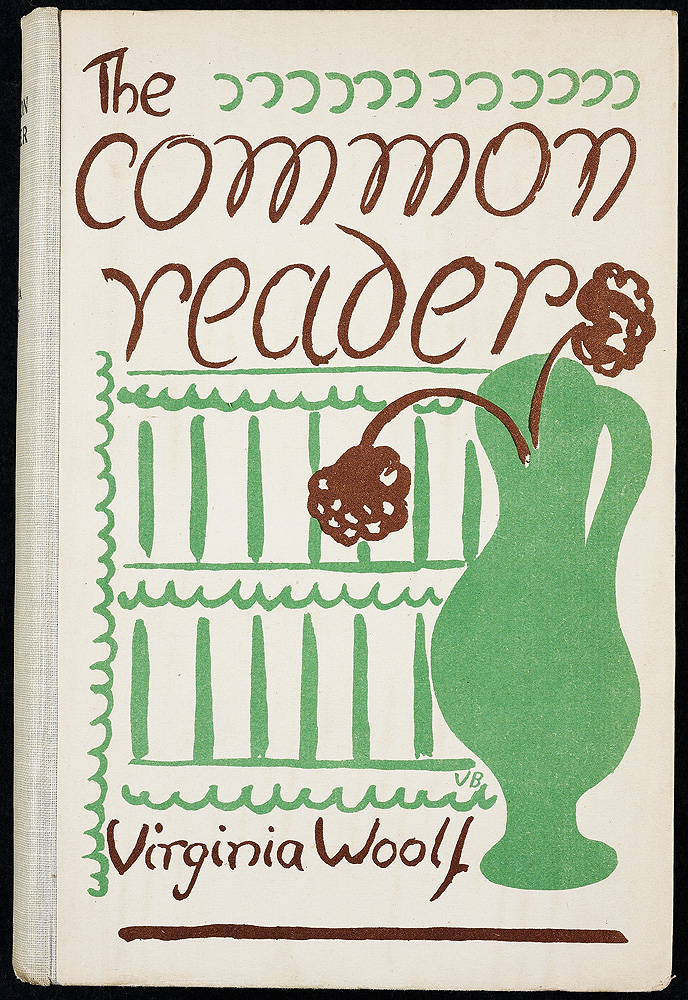
The Common Reader, Virginia Woolf’s book of essays published in 1925 with a jacket design by her sister Vanessa Bell, was provisionally titled Reading.

In it, she planned to revise some of her previously published essays and add some new ones, according to Mark Hussey in Virginia Woolf A to Z. Among its most important essays are “On Not Knowing Greek,” “Modern Fiction,” and “How It Strikes a Contemporary.”

One hundred years ago today, in her Sept. 5, 1923, diary entry, Woolf fills the half hour before dinner with her thoughts about beginning to write her book of collected essays:

A cold douche should be taken (& generally is) before beginning a book. It invigorates; makes one say “Oh all right. I write to please myself,” & so go ahead. It also has the effect of making me more definite & outspoken in my style, which I imagine all to the good. At any rate, I began for the 5th but last time, I swear, what is now to be called The Common Reader; & did the first page quite moderately well this morning. After all this stew, its odd how, as soon as I begin, a new aspect, never all this 2 or 3 years thought of, at once becomes clear; & gives the whole bundle a new proportion. To curtail, I shall really investigate literature with a view to answering certain questions about ourselves–Characters are to be merely views: personality must be avoided at all costs. I’m sure my Conrad adventure taught me this. Directly you specify hair, age, &tc something frivolous, or irrelevant, gents the book –Dinner! – Diary 2, 265.

Read Full Post »

I can’t take credit for these non-fiction Woolf sightings. That goes to Benjamin Hagen, president of the International Virginia Woolf Society, who posted them on Facebook.

From Ann Patchett

First comes Ann Patchett’s “Eudora Welty: An Introduction,” in which Patchett describes her encounters with Welty in writing and in person.

It begins with Woolf and with Welty’s foreword to To the Lighthouse (1927) and leads into a reflection on first encounters and later returns.

The piece is included in These Precious Days, a 2021 collection of Patchett’s essays.

From Brian Dillon

Second is critic and essayist Brian Dillon’s “Vagueness” in Affinities, just out in paperback (2023), which includes a chapter on the proto-modernist photographs of Julia Margaret Cameron, Woolf’s Victorian great-aunt.

Hagen wrote that he was “Surprised to find this lengthy essay on Julia Margaret Cameron, which begins with her stunning photograph of Julia Jackson (later Stephen), Virginia Woolf’s mother. Woolf gets some attention here too.”

Thanks for being on the lookout, Ben.

Ben Hagen’s Aug. 6, 2023, Woolf sightings Facebook post, complete with photos of pertinent pages from the two books he mentions.

Read Full Post »

Older Posts »