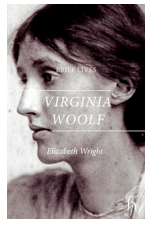
Hesperus Press will publish two Woolf titles on Oct. 28, On Fiction, a collection of her essays, and Brief Lives: Virginia Woolf by E. H. Wright.
On Fiction is billed as a unique collection of lesser known essays on reading and story telling. Included are essays articulating Woolf’s views on Jane Austen, the Brontës and George Eliot.
According to the publisher, Wright’s new biography “sheds light on the life and writing of one of the foundational authors of twentieth-century British and European fiction and explodes some of the commonly held myths.” Hesperus says Wright scoured Bloomsbury Group letters, Woolf’s diaries and papers to “illuminate Woolf’s mind.
Hesperus is also the publisher ofA Boy at the Hogarth Press by Richard Kennedy, a book I have at the top of my to-read pile. It’s right under To the River by Olivia Lang.
I marvel at well-crafted essays. Virginia Woolf was a master, of course, right up there with Montaigne, whose name is most identified with the form. Lately, though, I’ve been absorbed with the work of contemporary work, personal essays in particular. E.B. White is one of the reigning champions of the genre, but my current favorite is Anne Fadiman.
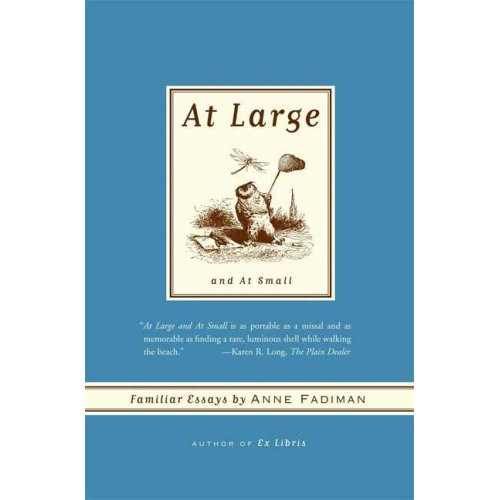
I’d read a couple of her essays in Best American Essays collections and went looking for more. I wasn’t surprised to find that she’s a Woolf enthusiast. Her first collection, Ex Libris, is subtitled Confessions of a Common Reader—the homage makes her affinity pretty clear. She loves books and in these personal essays she writes about them lovingly, intimately, humorously. My favorite is the first one, “Marrying Libraries,” in which she talks about the true test of love and commitment: after five years of marriage, she and her husband decide to merge their books and bookshelves, their “mutually quarantined Melvilles.”
I identified with her in “Insert a Caret,” about compulsive proofreading, how misspellings and punctuation errors jump out at her from restaurant menus. In “Eternal Ink,” she writes about pens as muses and fall-guys, citing Woolf’s proclivity to do the same. (Woolf: “What am I going to say with a defective nib?”)
I read her newer collection with a combination of awe and envy—these are the kinds of essays I’d like to write. The works in At Large and At Small (Confessions of a Literary Hedonist) are what Fadiman calls “familiar essays,” personal essays with a larger scope. Each one has a broad focus—butterflies, Charles Lamb, ice cream, and sleep patterns to name a few—that she researches thoroughly but brings home with personal experience.
Essays, she says, “provide for the writer a chance to move into the sort of leisurely, slightly hedonistic mode that, in the 21st century, has become a luxury.” They are “pools of opportunity to stop, and sit, and slow down, and think.”
Fadiman claims Woolf as one of her two favorite essayists (the other is E.B. White). Woolf, along with Coleridge and Lamb, would be guests at her ideal dinner party. “Virginia and I would be the centre of attention,” she says.
Publication of the hardcover volume means that all of Woolf’s essays are available as an entire collection for the first time.
A review of that volume is now posted on The Independent’s website. Written by Michèle Roberts, it describes the volume as “beautifully and expertly edited by Stuart N. Clarke” and praises the intelligence and diversity of this collection of essays.
The Scotsmanreviewed the book more than a month ago. Reviewer Jane Shilling praised Woolf’s beautiful writing and her ability to write “tenderly about the humble, the overlooked, the unknown.”
The Irish Times published a review on April 2. In it, author Eve Patten focuses on Woolf’s honing of her essay writing technique.
I just treated myself to the new 2009 edition of The Best American Essays. I’m often left speechless at the incredible diversity of work as well as the brilliance, cleverness, wit and pathos of individual selections.
The first essay in the collection, “Taking a Reading” by Sue Allison, starts with, “A yard, a pace, a foot, a fathom. How beautiful the language of measurement is…,” and ends a mere page later, reiterating her point: “A ream is a lot of paper, sold and purchased blank. Written on, it’s a book.”
John Updike and Cynthia Ozick offer insightful pieces about writers. And Brian Doyle, in “The Greatest Nature Essay Ever,” speaks of the perfect essay as having an ending that provides “a shot of espresso hope.” Wow!
In her editorial introduction, Mary Oliver champions the form. In the essay, she says, “what we receive is not didactic, not even, sometimes, totally believable, but the soul-felt truth from the individual perspective of someone deft in the craft of expression. The essay is not the world of Middlemarch, of Mrs. Dalloway going out to buy the flowers—it is neither less nor more, but different.”
Her reference to Mrs. Dalloway struck me as an irony in that she’s using Woolf the novelist to talk about what the essay is not, and yet Woolf was such a prolific and masterful essayist herself. One only has to revisit “Street Haunting” or “On Re-Reading Novels,” to name just two that come to mind, to recognize that she takes her place among the greats from Montaigne and Samuel Johnson to E. B. White and Joan Didion.
Anyone wondering when The Essays of Virginia Woolf,Volume VI will be out in print may be interested in the following news from editor Stuart N. Clarke.
Volume VI is currently in the hands of the Random House copy-editor, and the estimated publication date is January 2011.
There will be an Appendix in Volume VI of Additions and Corrections to Volumes I–V, mainly restricted to identifying sources of ‘recalcitrant’ quotations and listing errors in Woolf’s texts.