Of all the personal essays I’ve written, the one that’s nearest and dearest to my heart has just been published. It’s about the origin of my going-on-25-years history with Virginia Woolf. More than just a fascination with an author or adoption of a muse or mentor, it was the start of what has become the most fulfilling time of my life, and it led to my own writing.
“Pilgrimage” is just released at Bloom, a literary site devoted to authors whose first major work was published when they were age 40 or older. Woolf isn’t one of those authors, but I am. The particular call that I responded to was for essays about a book or author that served as inspiration, so it’s fitting all the way around
Two other essays about other aspects of my Woolfian explorations were previously published:
“Elvis Standing By,”the story of our Rodmell connection–other than Virginia Woolf–was published in Eclectica Magazine in the April/May 2011 issue.
“Cornish Pasty,” the St. Ives chapter, appeared in in Phoebe Journal, Fall 2012.
Virginia Woolf begins her 1926 essay, ‘On Being Ill,’ with a doozy of a sentence.
So begins an essay by my San Diego writing colleague, Tom Larson, “Writing While Ill: Pathography, Then & Now” in Shenandoah, the literary journal of Washington & Lee University. He then quotes Woolf’s lengthy sentence, the first of a three-page, 21-sentence paragraph, so that readers can “behold Woolf’s lapidary craftsmanship . . . a stunningly stylized lead, rich in Proustian intricacies of phrasal singing and delayed cadence.”
He draws on Woolf’s essay, noting the likelihood that she wrote it after she had recovered from that particular bout of illness and the fact that it doesn’t discuss her ailments themselves. Woolfremarks that, “Illness makes us disinclined for the long campaigns that prose exacts;” in other words, writers in the throes of illness don’t feel well enough to write. Larson contrasts the illuminating vision of “On Being Ill” with Woolf’s more immediate but less-poetic responses to her daily condition in her diaries, and moves into his thesis by asking: “How do we make sense of language’s expression of the body (Woolf’s diary) and literature’s avoidance of the body (Woolf’s essay)?”
Cover of Illness As Metaphor
While neither Woolf nor Susan Sontag, in Illness as Metaphor, write about their own illness–significant as it was–in exploringthe topic, now we find ourselves in “the age of pathography, a virulent subset of memoir,” a term first used in 1988 by Joyce Carol Oates when describing biographies whose authors overemphasize the seedier aspects of their subjects’ lives, and now applied to the present plethora of illness and tragedy memoirs.
Tom Larson is not new to Virginia Woolf or the topic of memoir, which has made him both a resource and a stumbling block for me. His 2007 book, The Memoir and the Memoirist, explores the genre both past and present. He differentiates between autobiography and memoir, citing Woolf’s “I now and I then” perspective from “A Sketch of the Past.”
I was considering a paper on Woolf and memoir for a Woolf conference until I read Tom’s book and realized that I couldn’t add much to what he had already said. Now, in this eloquent essay, he develops his ideas further.
Lowe describes the British journal as playing on “Woolf’s snooty but tongue-in-cheek essay in which she castigates ‘middlebrow’ as ‘the bloodless and pernicious pest who comes between’ the highbrow and the lowbrow, ‘the bane of all thinking and living.'”
Lowe writes that “the editors seek to reclaim it as a positive concept, calling Woolf’s own essays middlebrow, so I consider myself in good company on their pages.”
My ongoing search for literary magazines as potential vehicles for my essays yielded a captivating title this past year: Middlebrow. How could any Woolfian resist?
Established in the U.K. in 2010, as best I can tell, the journal’s vision starts with an attention-getting quote from Susan Sontag: “Art is seduction not rape.” The editor, Harriet Williams, elaborates: “A highbrow quotation, it’s true, but nevertheless one that aptly sums up the point of our magazine. Middlebrow is a magazine dedicated to the principles of art for enjoyment.”
But wait a minute. Whence this praise? Virginia Woolf, in her essay, “Middlebrow,” castigates it as “the bloodless and pernicious pest who comes between” the highbrow and the lowbrow, “the bane of all thinking and living.” She ends her essay by saying that “If any human being, man, woman, dog, cat, or half-crushed worm dares call me ‘middlebrow’ I will take my pen and stab him, dead.”
But the fearless Ms. Williams stands firm in defense of her journal and its place in the world of art. She seeks to reclaim the positive connotations of the term “middlebrow,” claiming it as the best of both worlds, “the intelligence of the highbrow and the guilty enjoyment of the lowbrow things we all like but pretend we don’t.”
She even dares to poke at Woolf in damning praise: “Virginia Woolf’s own essays are middlebrow, despite her hatred of the word and style, and let her come and stab me if she wants to. While they deal with so called highbrow subjects, they are insightful, clear, concise, even funny.”
The current issue includes an essay about Abraham Lincoln–surely a middlebrow himself–and another on writer’s block (do we get it because it exists, or does it exist because we get it?). It’s been said that the U.S. is or was a society of mostly middlebrows / middle class (buried within the so-called 99 percent under the wing of the Occupy movement). So as a middlebrow Woolfian, I’m delighted to see the banner flying boldly. I’ll be even happier if they publish one of my pieces.
On Father’s Day, it seems fitting to recall that Leslie Stephen, Virginia Woolf’s father, played a key role in his younger daughter’s life.
Virginia and Leslie Stephen
As the author of the Dictionary of National Biography, he served as a role model for Virginia’s scholarly habits. As an avid reader and writer, he encouraged Virginia’s intellectual curiosity by allowing her to read books at will from his extensive library. As an outdoors-man and a mountaineer, he led her outdoors on long walks, a habit that was to stay with her throughout her life.
But as Woolf admits in her personal writing as well as through her depiction of Mr. Ramsey in To the Lighthouse, her father had a negative side as well. He was a difficult man to deal with, particularly for the women in his family.
In her biography of Woolf, Hermione Lee describes Stephen’s impact on his women this way: “The women in [Leslie Stephen’s] life . . . took the brunt of his sense of failure, his appeals for reassurance and his anxieties about money. The letters to Julia are sodden with the kinds of demands for reassurance which Mr. Ramsay is always making. Leslie, unlike Mr. Ramsay, knew he was doing it, but couldn’t stop himself. It provided (as To the Lighthouse brilliantly demonstrates) a form of sexual gratification: ‘I have a hideous trick of making myself out miserable in order to coax a little sympathy out of you, because I enjoy being petted by you so much’” (73).
As a result, Mr. Ramsey comes off as a brusque, arrogant, demanding and didactic figure in To the Lighthouse, But as the father figure viewed through the eyes of his wife and children, Woolf also portrays him with sympathy and affection. She shows him as a man shaped by his culture and stuck in the patriarchal mold it has made for him. As such, he is unable to dip or bend to accommodate the needs of his wife and children.
The same kind of ambivalence can be seen in Woolf’s writing about her father. In her essay “Leslie Stephen,” published by the Hogarth Press in The Collected Essays of Virginia Woolf, she describes him as a scholar, a writer and a mountaineer. She also describes him as a father who delighted in amusing his children by cutting paper into the shapes of animals and recounting his adventures on the trail, while worrying about their safety if they were a minute late for dinner. Yet she does not shirk from detailing his anger or impatience with guests who stay too long or family members who spend too freely.
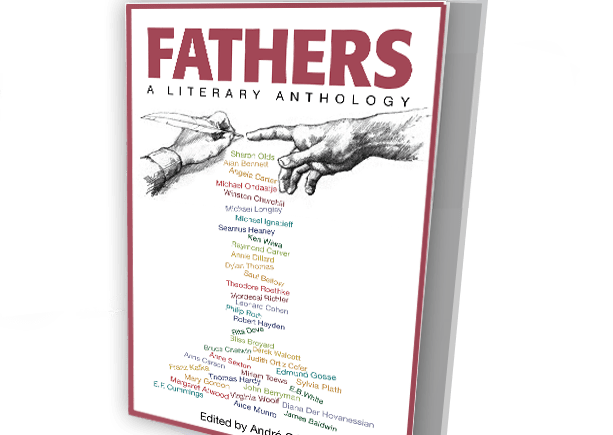
This essay and another by Woolf titled “Edmund Gosse” are included in an anthology well-suited for today. Titled Fathers: A Literary Anthology,” it is edited by André Gérard and includes essays and poems from literary legends about their fathers. It was published by Patremoir Press last year. The work of Alice Munro, Margaret Atwood, Doris Lessing, Alison Bechdel and Sylvia Plath are included, to name just a few.