Feeds:
Posts
Comments

Woolf on Proust

This week a member of the VWoolf Listserv asked for resources she could peruse regarding Virginia Woolf and Marcel Proust. As usual, list participants came quickly to the rescue. Here are some of the resources they shared:

From Anne Fernald:

“There is a lovely scene in the closing pages of the first section of vol. 1 of Proust of watching Japanese paper flowers unfold in water. It’s a scene that I think Woolf drew on, more than the madeleine–especially, say in Peter Walsh’s memories of Sally’s flowers at Bourton.

“More generally, Proust shared Woolf’s fascination with parties. Like Woolf, he was a serious, contemplative writer who took seriously the kinds of social foibles that might unfold at a party like the one Clarissa Dalloway gives. Knowing that Woolf read Proust while writing Dalloway is helpful: I imagine that his example fortified her sense that the topic, flimsy in the wrong hands, had possibilities for greatness.

“Woolf’s diaries, Hermione Lee, Sallye Greene, and Nicola Luckhurst might all be places to comb for more.”

Articles and books shared by several list members:

  • Pericles Lewis. “Proust, Woolf, and Modern Fiction.” Romanic Review. 99:1
  • Cheryl Mares, “‘The Burning Ground of the Present: Woolf and Her Contemporaries.”  Virginia Woolf and the Essay. Eds. Beth Rosenberg and Jeanne Dubino. NY: St. Martin’s Press, 1997. 117-36.
  • “Reading Proust: Woolf and the Painter’s Perspective.” The Multiple Muses of Virginia Woolf. Ed. Diane Gillespie. University of Missouri Press, 1993. 58-89.
  • “Woolf’s Reading of Proust.” Reading Proust Now. Eds. Mary Ann Caws and Eugene Nicole. Peter Lang, 1990.
  •  J. Hillis Miller writes of Proust and the party in Mrs. Dalloway in Fiction and Repetition.
  • Emily Delgarno has a chapter on “Proust and the Fictions of the Unconscious” in her Virginia Woolf and the Migrations of Language

And quotes from Woolf on Proust shared by two on the list:

Last night I started on Vol 2 [Jeunes Filles en Fleurs] of him (the novel) and propose to sink myself in it all day. [. . . ] But Proust so titillates my own desire for expression that I can hardly set out the sentence. Oh if I could write like that! I cry. And at the moment such is the astonishing vibration and saturation and intensification that he procures?theres something sexual in it?that I feel I can write like that, and seize my pen and then I can’t write like that. Scarcely anyone so stimulates the nerves of language in me: it becomes an obsession. But I must return to Swann” – Letter to Roger Fry, 6 May 1922 (Letters II 525)

My great adventure is really Proust. Well–what remains to be written after that? I’m only in the first volume, and there are, I suppose, faults to be found, but I am in a state of amazement; as if a miracle were being done before my eyes. How, at last, has someone solidified what has always escaped–and made it too into this beautiful and perfectly enduring substance?  One has to put the book down and gasp. The pleasure becomes physical–like sun and wine and grapes and perfect serenity and intense vitality combined. Far otherwise is it with Ulysses. – Letter to Roger Fry, 3 October 1922 (Letters II 565-6)

The Aviator’s Wife reads Woolf

The Aviator’s Wife by Melanie Benjamin is a fictional account of Anne Morrow Lindbergh, whoaviator's wie chose for much of her life to sacrifice her own interests in order to be “the aviator’s wife.”

In the novel, the Lindberghs attend a reception at which Amelia Earhart is present.  Anne Morrow Lindbergh is an accomplished pilot in her own right, but Earhart dismissed AML in the following exchange as a mere wife, “a sweet little thing:”

“That’s a very pretty frock.” Her voice sounded brighter, more musical; more suited to the nursery than to the airfield.

“Thank you.”

“Tell me, Anne, have you ever read A Room of One’s Own?”

I gasped, then laughed out loud. Was she serious? I could see by the earnest look on Amelia Earhart’s face that she was.

“Excuse me?” I asked politely.

“Virginia Woolf’s latest. You should read it sometime. It was written for someone like you.”

…I smiled up at the Great Aviatrix, so earnestly boyish, so fiercely alone.

“Thank you for the suggestion, Amelia. I’m always looking for something new to read, you know. I had no idea you were so well read.”

Apparently this exchange, or something close to it, really took place. In fact Anne Morrow Lindbergh knew Woolf’s work well. Her 1955 Gift from the Sea has been compared to A Room of One’s Own and is in part a response to it, adopting and developing many of the same ideas in her ruminations. While women need to have time to themselves, she adds that, “Solitude alone is not the answer to this; it is only a step toward it, a mechanical aid, like the ‘room of one’s own’ demanded for women, before they could make their place in the world. … The room of one’s own, the hour alone are now more possible in a wider economic class than ever before. But these hard-won prizes are insufficient because we have not yet learned how to use them.”

Cover via Amazon

She later cites a passage from The Waves, saying “I always liked that Virginia Woolf hero who meets middle age admitting: ‘Things have dropped from me. I have outlived certain desires …’” and goes on to quote from Bernard’s monologue in her own reflections on aging.

It comes full circle, as Woolf read Mrs. Lindbergh too. In 1932, after the trauma of their son’s kidnapping and death, the Lindberghs rented Long Barn from Harold Nicolson and Vita Sackville-West to get away from the publicity. Nicolson later visited them when they’d moved back to the U.S. and brought Woolf a copy of AML’s book, North to the Orient, in which she mentions reading The Years. In a diary entry in August 1935, Woolf considers writing about “Mrs L.”

Aug. 16 is the submission deadline for papers for Virginia Woolf and the Common(wealth) Reader: Selected Papers from the Twenty-Third Annual Conference on Virginia Woolf

Helen Wussow, of Simon Fraser University and the conference organizer, will edit the volume. Clemson University Digital Press will publish it.

Here are the details:

The editor seeks papers that explore Virginia Woolf’s interactions with/influence on Commonwealth writers, the issues of common wealth, discussions of wealth and gender, colonialism and gender, imperialism, politics, and a host of other related topics.

Papers adapted from conference presentations may engage with discussions carried on by Virginia Woolf, Leonard Woolf, and other members of their circle on issues of class, economics, and education.

Papers may read Virginia Woolf as a member of the British Commonwealth, later the Commonwealth of Nations.  Papers may also explore the implications of these themes and others upon disciplinary, institutional, social, or cultural contexts.

Papers should be 2,500-3,000 words, including notes and bibliographies, and should follow the MLA Style Manual for internal citation and works cited.

Any inquiries should be addressed to Helen Wussow at hwussow@sfu.ca

Submissions should be sent as .docx or .rtf files to: hwussow@sfu.ca

As an adolescent, Patrick Stewart was my hero because of his role as Captain Jean-Luc Picard on Star Trek: The Next Generation. I can go on for paragraphs about it, but it would be nothing you haven’t read before from other boys who grew up as science fiction enthusiasts.

My point for bringing up Stewart is his moving response to a woman’s question about domestic violence at a convention recently. Watch it here: 

There are so many things to deconstruct and to focus on in this video, but what I found the most moving was the connection Stewart made to his father’s violence being connected to the shell shock he experienced as the result of World War II. Stewart goes on to discuss how men were supposed to just suck it up and be tough.

My mind immediately snapped to Septimus Warren Smith and how he changed upon coming home from World War I.

When I teach Mrs. Dalloway, which I have had the pleasure to do twice, sometimes my students have a hard time connecting to Septimus’ plight in the novel. They relate to Clarissa or Sally or sometimes both. Or the occasional dissenter finds neither particularly pleasurable, but many find difficulty with Septimus. They understand shell shock is like what we call post traumatic stress disorder, but many students choose not to focus their discussions, papers or research on Septimus. The second time I taught Mrs. Dalloway, this became very noticeable.

In the future, I am going to show them this video of Stewart talking about his own father. I think there is a real teachable moment there to make the connections better if they consider what he is saying in relation to what happens to Septimus in the novel or in their own lives.

Also, it is a means for bringing the novel into a modern context, which is an important part of my pedagogy. I think it is worth investigating.

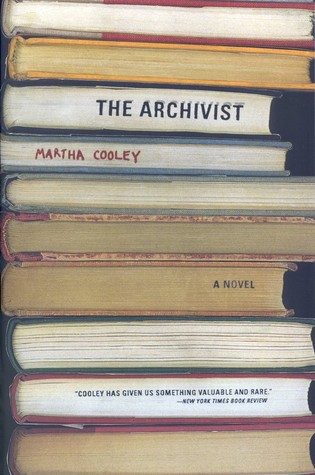
Meandering through the bounteous bookshelves of a writer friend in Seattle for whom I was recently house-sitting, I zeroed in on The Archivist, a 1998 novel by Martha Cooley.

The story revolves around a cache of letters from T.S. Eliot to Emily Hale that Hale bequeathed to a university library (unnamed in the novel) in 1965, with the stipulation that they not be opened until 2020. This is true; the letters are at Princeton, sealed until 2020. The archivist’s wife is a poet, and they share an interest in Eliot. After her death he takes the university position right around the time of the bequest and meets a graduate student who is interested in the letters.

Eliot’s work weaves in and out, as do issues of Jewishness, war atrocities, conversion, and identity. Eliot’s life with and abandonment of his first wife Vivienne comes into it but not so much their London milieu, with a few exceptions, including this:

Roberta (the student) to Matthias (the archivist):

I was just remembering how Virginia Woolf once said Eliot was sordid and intense. Did you know that when he was still married to Vivienne, he occasionally wore face powder when they went to dinner parties? Can you imagine? I guess he couldn’t resist the temptation to dramatize his suffering—God knows Vivienne wore hers on her sleeve.

English: T. S. Eliot, photographed one Sunday afternoon in 1923 by Lady Ottoline Morrell (Photo credit: Wikipedia)

Of course I had to see if that was accurate (Woolf’s description, not the face powder) and found it in Woolf’s Diary, Nov. 12, 1934, about a performance of Eliot’s uncompleted verse drama, “Sweeney Agonistes”: “The acting made more sense than the reading but I doubt that Tom has enough of a body & brain to bring off a whole play: certainly he conveys an emotion, an atmosphere: which is more than most: something peculiar to himself; sordid, emotional, intense—a kind of Crippen, in a mask: modernity & poetry locked together.”

Seems to me she’s talking more about the play and his approach to it than Eliot himself. While she does implicate Eliot’s character and craft with her curt observations, the quote, out of context, strikes me as a bit too convenient for Cooley, the Woolf citation too dishy to resist. Still, it was a fascinating novel.