In less than two weeks, a Google alert for “Virginia Woolf” netted the following links. To view more examples of Woolf spotting online that I have collected during the past few years, visit the Woolf sightings page.
On “Middlebrow”, New Yorker (blog) For our purposes, it’s important to note two key figures in the middlebrow debate:Virginia Woolf, who denounced middlebrows for missing the intrinsic value . . .
Chapman’s Odyssey, By Paul Bailey, Independent Virginia Woolf, for example, is referred to primarily as “not much of a listener”. Chapman’s Odyssey is a rewarding curiosity of a book, though hard to . . .
We Need a Hero, The East Hampton Star Then, working on her dissertation at the University of Cologne, she realized when she read Virginia Woolf’s “A Room of One’s Own” that, as she had surmised . . .
Please Your Shelf, Our Muses, Ourselves: Why Women Like Me Run Away From Home, Huffington Post (blog) After all, novelist Virginia Woolf proclaimed that every woman needs a room of one’s own to do so. But Susan and I are so exhausted by the time we arrive at . . . Continue Reading »
Virginia Woolf will be on stage in New York City next month.
The revival ofRoom, a production based on Woolf’s writing that the New York Timesdescribed in 2002 as “a theatrical representation of the writer’s mind, an abstraction painted with theater’s animated tools,” will be at the Julia Miles Theater for 16 performances March 12-27.
Harvested from a lifetime of Virginia Woolf’s writing, Room traces the movement of a creative spirit in exquisite crisis, an artist in a pressure cooker of articulation who seeks room to move, room to breathe, and room to imagine.
As the NYT put it, “one of the strengths of Room is that it focuses neither on polemics nor personal tragedy but rather on gathering the many strands of Woolf’s formidable intellect into a messy, resonant coherence.”
The L.A. Times raved about the production, saying, “Ellen Lauren’s masterly economy of movement, combined with Anne Bogart’s unerring compositional sense, is breathtaking.”
The production is presented by the Women’s Project and SITI Company. It is directed by Anne Bogart, adapted by Jocelyn Clark and stars Ellen Lauren.
It will be on stage Tuesdays and Wednesdays at 7 p.m., Thursdays-Saturdays at 8 p.m. and Sundays at 3 and 7:30 p.m.
Exceptions: Matinee only–no 7:30 show–on Sunday March 13.
Bogart and Lauren will be available for a post-performance discussion on March 22 and March 23.
The Julia Miles Theater is located at 424 West 55th Street, just west of Ninth Avenue. Tickets, priced at $60-$75, are on sale at Telecharge.com or call 212-239-6200. A group rate of $25 per ticket is available for groups of more than nine.
While tackling Intermodernism and the works of Virginia Woolf during graduate school, one of the questions I pondered often was the existence of a distinctive political art in 1930s Great Britain and the role of class and gender privilege throughout.
Two forms of narrative art seem to emerge from the time period. The first can be identified as “the propaganda of privilege.” Middle to upper class writers like F. R. Leavis and George Orwell offer insight into the lives of the British from a position of gender and class status. It is true that both Orwell and Leavis sincerely want to improve the lives of their fellow citizens. What becomes problematic for both writers is that same common person’s own voice being denied, translated via a privileged writer, or subjugated to a small whisper.
The other style of narrative art which comes out of 1930s Great Britain is what I have referred to as “the Intermodernist Other.” A careful examination of the Intermodernist period allowed a refreshing amount of writers from outside the privileged, elitist, circles that Leavis and Orwell come from to be brought into the foreground. Writers like Virginia Woolf, and others like Storm Jameson and Mulk Raj Anand, for example, are writing from an underprivileged status due to ethnicity or gender. These writers offer keen insight into the lives of the underprivileged, such as the women of Great Britain in the war against fascism for Woolf to make their case. Continue Reading »
A bit of a book snob, I suppose, I tend to shy away from the bestsellers, but a novel about a Sussex village—how could I resist? I put it on reserve at the public library some months ago and forgot about it until last week when I was notified that it was being held for me at my local branch.
I read it in a couple of sittings, charmed from beginning to end. Delightful and well written, it’s a contemporary novel of manners, an adult romance founded on a love of literature, a morality tale against racism and greed, all set in the East Sussex countryside, Virginia Woolf’s beloved landscape.
And of course, as I read it I couldn’t help thinking about Woolf and her life in Rodmell, about my own times there, brief tastes of village life, walks on the downs and to the coast, lunches at charming country pubs.
Like Woolf, Major Pettigrew is a walker who observes the colors and the smells around him, even on frequently traveled terrain. He loves the stroll down the hill from his house to the village center of Edgecombe St. Mary: “Behind him, the hills swelled upward into the rabbit-cropped grass of the chalk downs. Below him the Weald of Sussex cradled fields full of late rye and the acid yellow of mustard.”
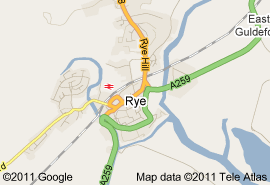
While Edgecombe St. Mary and its neighboring villages are fictional, a reference to the Romney Marsh was a clue that it was set in the area around Rye (known as Tilling to all of us Mapp and Lucia fans). Simonson indeed grew up in that region, which she describes, on her website, as “literary country.” She credits the heritage of Henry James at Lamb House in Rye, Kipling’s Bateman’s at Burwash, and Virginia Woolf at Monk’s House in Rodmell as a great inspiration.
Woolf doesn’t make an appearance in the novel by name, but she’s there in spirit. While the Major and Mrs. Ali bond over Kipling, I can imagine them reading and exchanging impressions about To the Lighthouse.
Vanessa and Virginia, a new play about Virginia Woolf based on the eponymous novel by Susan Sellers, will be on stage at 7:30 p.m. Feb. 11 and 12 at the Byre Theatre at the University of St. Andrews in Scotland.
Written by Elizabeth Wright, the play includes original music and is peformed before a backdrop of projected images inspired by Vanessa Bell’s paintings.
It has been invited to Poland, Germany, Greece and across the UK for performances in theatre spaces, at literary conferences and at site-specific locations. It began touring in France last September and will be on the road until September of this year.
Sellers‘ novel provides a fictional account of the sibling rivalry between Virginia Woolf and the painter Vanessa Bell. She is a member of the at St. Andrews’ School of English.
Susan Sellers
A book signing at 6:45 p.m. in the foyer of the theater will preceed the play. A question and answer session with director Emma Gersch, the playwright and the cast will follow it.
The next day, a Virginia Woolf symposium will be held to mark the publication of a new edition of Virginia Woolf’s writing by Cambridge University Press, according to Blogging Woolf reader Kathleen Dixon Donnelly.
The symposium will be held in the School of English, Lawson Lecture Room, Kennedy Hall, The Scores, from 10:30 a.m. to 4:30 p.m. It will include talks on:
the relevance of Virginia Woolf for the 21st century
Nicole Kidman in The Hours and
creating the stage play Vanessa and Virginia.
Members of the school’s Literary Society and Feminist Society can obtain discounted tickets. Visit the Byre Theatre website for more details on performances and tickets.
Watch a preview of the play and an interview with the director. Read more about the novel, including a review by Alice Lowe, a frequent contributor to Blogging Woolf.