A recent query to the VWoolf Listserv asked for sources regarding Virginia Woolf and Anton Chekhov. Here is a compilation of the responses that were sent round, along with several notes of my own:
Roberta Rubenstein’s Virginia Woolf and the Russian Point of View (Palgrave Macmillan, 2009). Rubenstein herself wrote to say that her work includes a full chapter on Woolf’s response to Chekhov as well an appendix that includes her own transcription of Woolf’s unpublished review, “Tchekhov on Pope.” “The review, written in 1926, was ostensibly of a new edition of Pope’s “Rape of the Lock” but is as much about Woolf’s interest in Chekhov and the Russian influence as it is about Pope’s poem,” Rubenstein wrote. See the Google preview.
Christine Froula’s “‘The Play in the Sky of the Mind’: Dialogue, ‘the Tchekhov method’ and Between the Acts‘” in Woolf Across Cultures (Pace UP, 2004)
Karen Smythe’s “Virginia Woolf’s Elegaic Enterprise” in NOVEL: A Forum on Fiction. Duke UP 26:1 (Autumn, 1992), pp. 64-79
Anthony Domestico’s “The Russian Point of View” on The Modernism Lab at Yale University. Domestico is a graduate student in English at Yale.
Darya Protopopova’s “Virginia Woolf and the Russians: Readings of Russian Literature in British Modernism,” doctoral thesis at Oxford University. The author is an alumnus of Oxford’s New College, and Hermione Lee supervised her work. See more information from Darya in her comment below.
Virginia Woolf and Bloomsbury, an unannotated database of more than 28,000 records compiled and updated since the early 1970s, although Stuart N. Clarke, who compiled the database, wrote that it did not supply much more of significance on the topic.
Woolf herself wrote “The Russian Point of View,” in which she offers her assessments of three Russian writers: Chekhov, Dostoevsky and Tolstoy. The essay can be found in The Essays of Virginia Woolf. Ed. Andrew McNeille. Vol. 4. London: Hogarth, 1994. 181-189.
In Translations from the Russian, Woolf and S.S. Koteliansky translated three works: Stavrogin’s Confession and the Plan of the Life of a Great Sinner, Tolstoi’s Love Letters and Talks with Tolstoi. This volume was edited by Stuart N. Clarke and includes an introduction by Laura Marcus.
Ilana Simons' Woolf painting as it appears on Flickr
Ilana Simons, sent out an invite to a Jan. 14 gallery opening in Chelsea featuring the work of 11 visual artists and her own stitching series, “Let Me Self Soothe Without Self-Harm.”
I live too far away to attend, but I’m wondering if any Blogging Woolf readers stopped by last Friday. The exhibit included Simons’ most recent painting of Woolf.
Simons has painted Woolf before. On paper plates, in fact. Two Woolf portraits are included in Simons’ collection of 50 portraits of authors on plates, which she created one summer using 99-cent tubs of acrylics.
Björn Kohlström told Blogging Woolf that interest in Virginia Woolf has slowly but steadily increased in Sweden during the last few years.
As a result, several things have happened. His biography of Woolf, the first book about Woolf written in Swedish, according to Kohlström, was recently published. And a variety of Woolf’s work is available in Swedish as well.
All 10 of her novels are out, along with a translation of her diary called Moments of Freedom, and some of her essays. However, Kohlström says the translations of several of the novels are rather old — The Years dates from 1942 and Jacob’s Room from 1927.
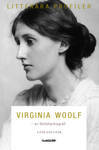
Kohlström’s book, Virginia Woolf. En författarbiografi, is part of a series called Profiles in Literature. His is the first. Later volumes will cover Dostoevsky, Camus, Kafka and many Swedish authors.
I did discover another Swedish connection to Woolf — a blog titled A Room of My Own. And after this post was published, Kohlström spread the news of this post on his blog.
Artist McKenna Kemp has designed clean, fresh book jackets for three of Virginia Woolf’s stream of consciousness novels.
The white jackets feature simple typography. Their graphics — in yellow, grey and green — highlight the interior narrative aspect of the novels, as well as the focus of each. The artist says her covers for Mrs. Dalloway, To the Lighthouse and The Waves also recognize the much earlier dust jacket designs by Vanessa Bell.
Kemp designed the jackets last April as a creative, rather than a commercial, project.
If you are interested, you can follow McKenna Kemp’s work on the Behance Network, which showcases the work of creative professionals, according to its website.
Shortly thereafter I read a New Yorker piece about the same subject, except that author Julia Felsenthal reframed the argument as a possible justification for e-books. Such books would be, she argues, “a cost-effective, eco-friendly, and disposable alternative to cloth-bound volumes.”
Felsenthal, too, quoted Cuddy-Keane. She also described a 1927 radio discussion between Leonard and Virginia Woolf concerning the question “Are Too Many Books Written and Published?” The scripted discussion, Virginia’s first of three on the BBC, was broadcast on 15 July 1927. In it, Leonard argues in favor of hand-made books, criticizes the mass appetite for popular fiction and laments the death of quality.
Virginia Woolf, publishing and democracy
Free Woolf e-texts
Virginia took a more democratic approach to book publishing. In her diary entry of 2 October 1932, she wishes for “a system that did not shut out.” If one must have a system, Woolf believes that system should be inclusive of all individuals and all ideas (Cuddy-Keane 57).
Cuddy-Keane also describes Woolf’s visit to the Lewes library in October 1940, which Woolf notes in her diary by saying she “was glad to see [her book] Common Reader all spotted with readers at the Free Library” (108). Woolf wanted readers to use her books and engage with her writing. The idea that her book of essays was dotted with spots pleased her, as they indicated that people felt comfortable with the physical book—and perhaps with her ideas as well.
In Radio Modernism: Literature, Ethics, and the BBC, 1922-1938 (2006), Todd Avery points out that Virginia counters Leonard’s argument that publishing has become “shoddy” by maintaining that such shoddiness was a necessary result of increased literacy, which actually resulted in a more egalitarian world (53).
Avery discusses the way Virginia Woolf’s participation in mass media broadcasts made it possible for her to cross the boundary between high and mass culture. For Woolf, mass media created common ground, just as public libraries did. Both are places of freedom where readers and thinkers of all classes and all interests could find the resources they needed to expand their thinking, then engage in active intelligent literary discourse.
Democratic readership delivered in paperback and wireless versions
Woolf thought books should be as cheap and as easy to purchase as a pack of cigarettes, according to Avery (54). Ten years later, in 1935, Penguin had the same idea — and began selling quality paperbacks at sixpence apiece, the price of a pack of smokes.
Two years ago, in response to the recession and the company’s 75th anniversary, Penguin launched its “Popular Penguins” classic titles series in Australia, New Zealand and India. Priced at AU$9.95 per hard copy, the series includes Woolf’s A Room of One’s Own (1929) and To the Lighthouse (1927).
Cigarette prices in NYC
I think Woolf’s philosophy of democratic inclusiveness can be applied to the world of e-books today. The $9.99 standard price for a digital best-seller on Amazon.com is nearly identical to the price of a Popular Penguin, and both are less than the $11 price of a pack of cigarettes in New York City, for example.
In some cases — in some of the best cases — e-books are free. From Amazon, iTunes, Barnes and Noble and other sources, Woolf classics such as The Voyage Out, Night and Day and Jacob’s Room can be downloaded at no cost. Other volumes of Woolf’s work are priced low — from 99 cents for Monday or Tuesday to $9.99 for A Writer’s Diary.
You don’t necessarily need a dedicated electronic reading device to read digital books either. You can download free apps to read e-books on your laptop, desktop, and/or smart phone. These include iBooks, the Kindle app, the NOOK app and others.
News for gadget geeks and book lovers
Virginia Woolf screensaver on the Kindle
I have a Kindle, which I love, so I am tuned in to e-book and e-reader discussion. So is the New York Times, which reported this week that e-readers were under many Christmas trees this season. The Times postulated that “possibly hundreds of thousands of people are expected to download books on the e-readers that they receive as Christmas gifts.”
The popularity of e-books has grown this year. They now make up 9 to 10 percent of trade-book sales, and publishers are predicting that digital sales may be 50 to 100 percent higher in 2011.
However, please don’t despair if you are not a person who loves the look of sleek high-tech gadgets. The Times also reported that some companies are specializing in making high-tech goods look retro-charming. A manual typewriter is reconfigured for use as a U.S.B. keyboard. A landline handset is connected wirelessly to a cell phone using bluetooth technology. A slim new MacBook is zipped inside a case that looks like a vintage leather-bound book.
And do be encouraged by the fact that many high quality books are available digitally. The Cuddy-Keane book I mentioned above is available electronically in at least four languages. What’s more, an e-book will never be out of stock.