Comic Dan Wilbur says he is sick of reading. To remedy that, he has come up with a blog called Better Book Titles, which proposes titles that he claims makes some books less intimidating and more appealing.
For example, he has renamed Virginia Woolf’s Mrs. Dalloway — A Quaint Midafternoon Panic Attack. That title prompted a tiny brief smile on my part. Others, however, caused me to laugh out loud in shock. You’ll see what I mean when you take a look at his outrageous revision of James Joyce’s Ulysses.
You can watch a slide show of the other titles he proposes.
Virginia Woolf and Edward Gorey. I know something about both. But I did not know there was a connection between them until now.
It turns out that Gorey, known for his charmingly off-kilter stories and illustrations, created illustrations for the 1985 edition of Virginia Woolf’s play Freshwater: A Comedy. Woolf’s farce about her famous great-aunt Julia Margaret Cameron was her only work for the stage.
First performed in 1935 for one of the Bloomsbury Group’s theatrical evenings, Woolf’s lone play was later produced in New York. It is still being staged today, although not everyone appreciates its wit and humor.
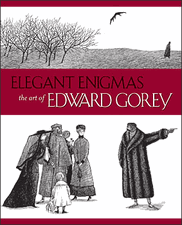
Gorey, of course, is still popular, perhaps thanks to his animated credits for the PBS show “Mystery.” An exhibit of his work, “Elegant Enigmas: The Art of Edward Gorey,” opens today at the Orlando Museum of Art in Orlando, Fla., and will run through Oct. 31.
A catalog of the exhibit, which contains 175 reproductions, is also available. And you can shop for all sorts of thrilling items at the Edward Gorey House Store in Yarmouthport, Mass. One of my favorites is a set of note cards titled “Neglected Murderesses.”
A year or so after the war…it cannot be said that it is war…it cannot be said that it is war, it cannot be said that it is peace, it can be said it is postwar.
Stevie Smith The Holiday
While I was working on my master’s degree at Monmouth University, my favorite course was Dr. Kristin Bluemel’s seminar on intermodernism. Not surprisingly, intermodernism is a term coined by Dr. Bluemel for the, arguably, pretty neglected years between between the two world wars (although Intermodernism cannot only be defined by time).
During this time, novels, memoirs, and essays are being written by writers as varied as George Orwell, Storm Jameson, Dorothy Richardson, Stevie Smith, and Stella Gibbons. Virginia Woolf certainly could, and I would argue, be claimed as an intermodernist writer (we read Three Guineas, and I used it to write my seminar paper, working towards defining an intermodern sex-gender system using Woolf alongside Phyllis Bottome’s anti-fascist, feminist, novel The Mortal Storm).
In her book, and during our seminars, she argued the writers of this time period fashioned their work and reflected on the emotions of a nation in the aftermath of World War I. Readers of Woolf certainly see this influence in Three Guineas and, especially, Mrs. Dalloway.
Intermodernist writing was often focused on the working and middle classes, socialist and/or “radical” political leanings, and a more “middlebrow” writing style. Often, these writers are somehow “othered” based on their sexuality, ethnicity, or lack of class privilege.
In George Orwell & The Radical Eccentrics, Bluemel argues that these writers are “grounded in the experiences of England’s working-class and ‘working middle-class’ cultures” which do not fit into the same categories that popularized, privileged writers like W.H. Auden, T.S. Eliot, and James Joyce do (Bluemel 2). Their writing attends to politics, whether the domestic life in Woolf or Bottome’s novels, the working class of Orwell’s The Road To Wigan Pier, or the caste system of Mulk Raj Anand’s Untouchable.
Critics have struggled to place many of these writers within the canon. Many, like Woolf, share some aspects of the modernist aesthetic, but cannot truly be prescribed to that label. Intermodernism isn’t quite just a time period that begins and ends between the wars, but more a style of socially conscious writing and discourse shared amongst writers of varying ethnicities, genders, levels of privilege, and politics. Many of these writers, Woolf included, have drifted in and out of the canon, fates after their death attached to those outside of academia.
Bluemel continues the discussion of this fascinating literary period in the new anthology she edited Intermodernism: Literary Culture in Mid-Twentieth-Century Britain, which brings together leading scholars on the period to further discuss the merits of the period. If the Blogging Woolf community is interested, I have plenty more to say about Intermodernism.
The set includes the German-born French photographer’s portraits of noted authors, including Virginia Woolf. Among the photos is one said to picture Woolf’s writing desk. This is not the same desk photo posted on Flikr by Renaud Camus that I wrote about two years ago.
Freund‘s book Gisele Freund, Photographer, published in the United States in 1985, includes 205 black and white and color photographs that document her 50-year career. Now out of print, it includes photo documentation of the popularity of Hitler among German students in the 1930s and the Depression in England.
It also includes portraits of Leonard and Virginia Woolf, Walter Benjamin, Paul Valery, Colette, James Joyce, George Bernard Shaw, , Jean-Paul Sartre, Simone de Beauvoir, Samuel Beckett, Tennessee Williams, John Steinbeck, Robert Lowell and Mary McCarthy. Many photos are accompanied by Freund’s personal notes and reminiscences.
Next I prowled for some non-fiction related to Woolf. There were shelves and shelves full of Harold Bloom’s literary criticism, but not a single volume devoted to Woolf. Nor were there any Woolf letters, diaries or biographies.
Feeling a bit desperate, I paused in front of the cookbooks. And for a moment, I got excited. I thought I had a Woolf sighting in my grip.
The Book Lover’s Cookbook: Recipes Inspired by Celebrated Works of Literature, and the Passages That Feature Them was in front of me. It must include Boeuf en Daube, I thought.
With much anticipation, I flipped to the index. Again, I was disappointed. Woolf, Virginia was not listed.
In an attempt at recovery from my dismay, I turned to Amazon. Here are the cookbooks I found that include dear Virginia in one way or another:
Literary Feasts: Recipes from the Classics of Literature by Barbara Scrafford includes a section on To the Lighthouse.
The Book Club Cookbook by Judy Gelman, Vicki Levy Krupp includes a recipe for Britta’s Crab Casserole from Michael Cunningham’s The Hours.