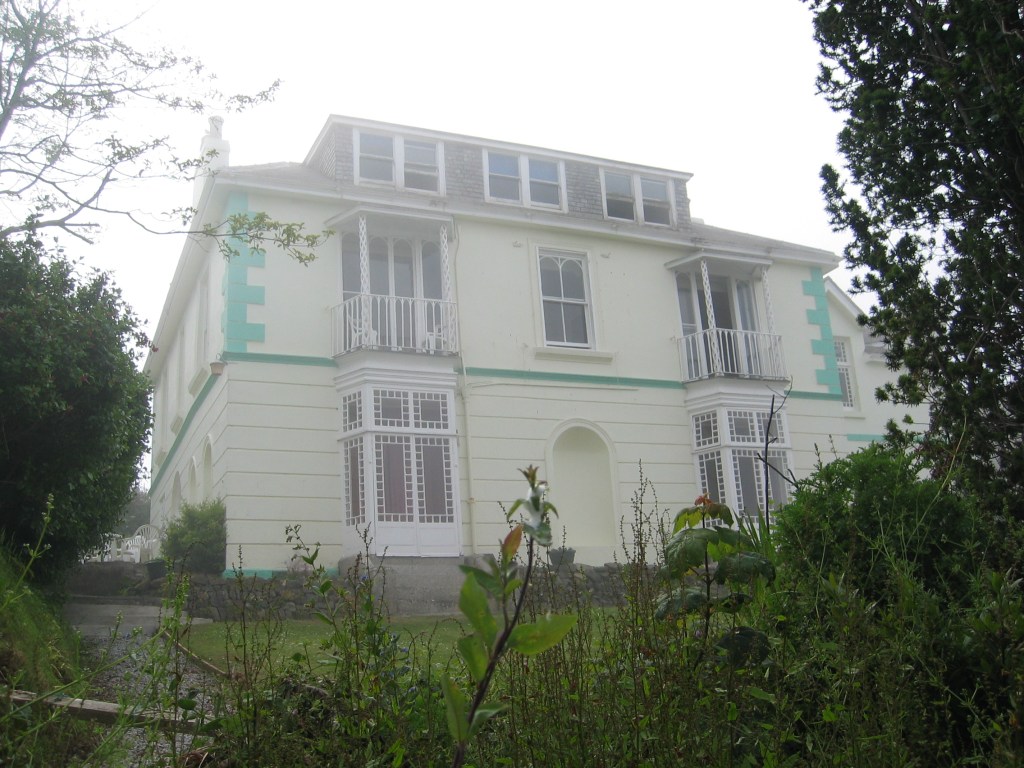
It was taken by her aunt, the celebrated photographer Julia Margaret Cameron.
Bids are expected to fall between £1000-£1500.
Read the full story and view the photo on the BBC Web site.
It was taken by her aunt, the celebrated photographer Julia Margaret Cameron.
Bids are expected to fall between £1000-£1500.
Read the full story and view the photo on the BBC Web site.
Posted in Julia Margaret Cameron, Julia Stephen, photography | Tagged Julia Jackson, Julia Margaret Cameron, Julia Stephen, Virginia Woolf's mother photograph | Leave a Comment »

Reading the Skies in Virginia Woolf
Two Bloomsbury Heritage monographs, including one of my own, will debut at Woolf and the City, the 19th Annual International Conference on Virginia Woolf — and a third is in progress.
Cecil Woolf Publishers of London is the publisher.
The monographs making their first appearance at the June 4 to 7 conference at Fordham University — and afterward — are:

Virginia Woolf: A Musical Life
Reading the Skies saw its first incarnation as a paper written for a graduate class taught by geology professors Dr. Alison J. Smith and Dr. Donald F. Palmer in the Master of Liberal Studies program at Kent State University. The class, which focused on the impact of climate change from the time of the Little Ice Age to the present, required that we write a weather-related paper.
I was an English major, not a science major, as an undergraduate, so I immediately searched for a literary connection. I did not have far to look.

How Should One Read a Marriage?
One of our texts was Briane Fagan‘s The Little Ice Age: Prelude to Global Warming 1300-1850. In it, he describes the frost fairs held on the River Thames during the years of the Little Ice Age. In a flash, I thought of Woolf’s descriptions of Orlando and Sasha skating feverishly across the Thames in her 1928 novel Orlando.
From there, I was on the hunt for anything written about Woolf and weather. Amazingly enough, I found nothing. Thus began my own study and analysis.
In Reading the Skies, I explore Woolf’s characteristically English fascination with the vagaries of the nation’s weather and its effect on culture. I also discuss weather’s influence on Woolf and her writing, including her theories about the role weather could and should play in fiction. Finally, I discuss how she carried out her theories in three of her novels, Mrs. Dalloway, To the Lighthouse and Orlando.
I invite you to pick up a copy of Reading the Skies and Virginia Woolf: A Musical Life at the Woolf conference at Fordham for the special conference price of $9. They — along with other monographs in the Bloomsbury Heritage Series — will be available at Cecil Woolf’s book display near the registration table in the Lowenstein Plaza Lobby. Here is the full conference schedule.
Then stay tuned to Blogging Woolf for news about the publication of How Should One Read a Marriage? We will announce its availability here.
Posted in 19th Annual Internatinal Conference on Virginia Woolf, books, Cecil Woolf Publishers, Leonard Woolf | Tagged Bloomsbury Heritage Series, Brian Fagan, Cecil Woolf Publishers, Dr. Alison Smith, Dr. Donald Palmer, Drew Patrick Shannon, Emilie Crapoulet, Paula Maggio, Reading the Skies in Virginia Woolf, Virginia Woolf a Musical Life, Woolf and the City | 1 Comment »

But that is just what the novel did for Nika Zupanc. It allowed the young Slovenian product designer to imagine a kitchen hot plate that does not look like one. Her mini hot plate looks like a woman’s powder compact instead. And in honor of the novel that inspired it, the hot plate is named “Mrs. Dalloway.”
The “Mrs. Dalloway” mini hot plate was part of the I Will Buy Flowers Myself exhibit on display at Salon del Mobile Milan 2009 in April. It was inspired by the stories of some of the most famous female literary heroines, according to Zupanc.
Other items in the surreal collection, which was introduced by a giant polka-dotted doll house, include a Lolita lamp, a Scarlet table and tray, the Unfaithful Feather Duster and the Silent Brotherhood of Slightly Arrogant Cradles.
Posted in commodification, Mrs. Dalloway | Tagged commodification, Mrs. Dalloway, Nika Zupanc | 2 Comments »

Blithe is the creator of the blog Julia Hedge’s Laces, and this week she e-mailed Blogging Woolf to share her post about a recent visit to the Bruce Peel Special Collections Library at the University of Alberta.
While there, Blithe was awed by their exhibit of Hogarth Press books. She praises the exhibit itself, which is titled “Woolf’s Head Publishing: The Highlights and New Lights of the Hogarth Press” and is available until May 28. But she also praises the exhibit’s catalogue and recommends contacting the exhibit site to enquire about purchasing one.
You can read her interesting and detailed post, “An Exhibit of Woolf’s Own,” here.
Posted in books, Hogarth Press | Tagged Bruce Peel Special Collections Library, Hogarth Press, Julia Hedge's Laces, Woolf blog, Woolf's Head Publishing: The Highlights and New Lights of the Hogarth Press | 1 Comment »

The Woolf plate and its setting, one of 39 included in Chicago’s ground-breaking iconic feminist work of art, is ripe with symbolism.
It features a three-dimensional plate formed to look like a blooming flower with seeds in the center. According to Chicago, the plate itself symbolizes Woolf’s belief in unrestricted expression and the fecundity of her creative genius.
Beneath the plate, a thin chiffon fabric runner symbolizes Woolf’s fragile mental state, while underneath that, a stitched and painted light beam glows, symbolizing To the Lighthouse.
For more details about the symbolism of Woolf’s plate, go here. You can also find her friend Ethel Smyth’s plate here.
And if you are like me and have never seen Chicago’s masterpiece in person, you can view it online here as a long-term installation in the Elizabeth A. Sackler Center for Feminist Art in the Brooklyn Museum.
Take Our PollPosted in art, art exhibits, Woolf online | Tagged Judy Chicago, The Dinner Party, Virginia Woolf plate, Woolf art | 7 Comments »