Feeds:
Posts
Comments

Posts Tagged ‘books’

Writers stamp themselves upon their possessions more indelibly than other people, making the table, the chair, the curtain, the carpet into their own image. – Virginia Woolf,  “Great Men’s Houses (1911)

That is the lovely quote that begins the introduction to Rooms of Their Own: Where Great Writers Write (2022)– and the fact that it was written by VirginiaWoolf adds a special boost to this post.

The book answers the question, “Where do you write?” for authors ranging from Maya Angelou to William Wordsworth — 50 in all. It describes their writing environments — from attics and studies to billiard rooms and bathtubs — in words written by Alex Johnson and illustrations in charming water colors by James Oses.

As the book blurb explains, it “explores the unique spaces, habits and rituals in which famous writers created their most notable works.”

Virginia Woolf’s writing lodge at Monk’s House in Rodmell, East Sussex

In addition, it details each author’s writing methods, routines and habits, as well as their ink, paper, and pencil preferences.

It also includes information on each of the locations described, many of which are private and not open to visitors.

Of particular note to readers of Blogging Woolf are the rooms used by Woolf and Vita Sackville-West. The book covers each with a four-page spread.

The tower at Sissinghurst Castle in Kent, where Vita Sackville-West’s writing room is located.

Woolf’s, of course, depicts the interior of her writing lodge at Monk’s House, along with her view from the lodge. Vita’s shows the interior of her tower room at Sissinghurst Castle, as well as a long view of the tower exterior.

Lucky for us, both Monk’s House and Sissinghurst Castle are open to visitors.

However, as I recall my last visit to Monk’s House in July of 2019, we were not permitted inside the space where Woolf wrote in her lodge. We had to view it through a window. The photo below shows that view.

In June of 2018, I got a look at Vita’s lofty writing space in the Sissinghurst tower from a doorway, after climbing the stairway that led to it. The doorway was blocked by a grille to preserve the fragile contents within. You can see what I saw in the photo below, including just some of the room’s 2,700 books.

Despite such limitations, each is certainly worth a visit.

Virginia Woolf’s desk in her writing lodge at Monk’s House, 2019. Woolfs’ tortoiseshell glasses, as well as her folders for her manuscripts, are on the table. While the Woolfs converted an old tool shed in their garden into a writing room for Virginia in 1921, by 1934 they built this new lodge with French windows. I took this photo through a window, as entry was not permitted.

Vita Sackville-West’s writing room in the high tower at Sissinghurst Castle, 2018. It appears as it was upon her death in 1962. It is lit as a night scene to prevent damage from light and reflects the fact that Vita usually wrote by lamplight in the evening. I took this photo through a grille in the doorway at the top of the stairs, as entry was not allowed.

Virginia Woolf: A shed of one’s own, p 178-9, Virginia Woolf: A shed of one’s own, p 178-9, Rooms of Their Own: Where Great Writers Write
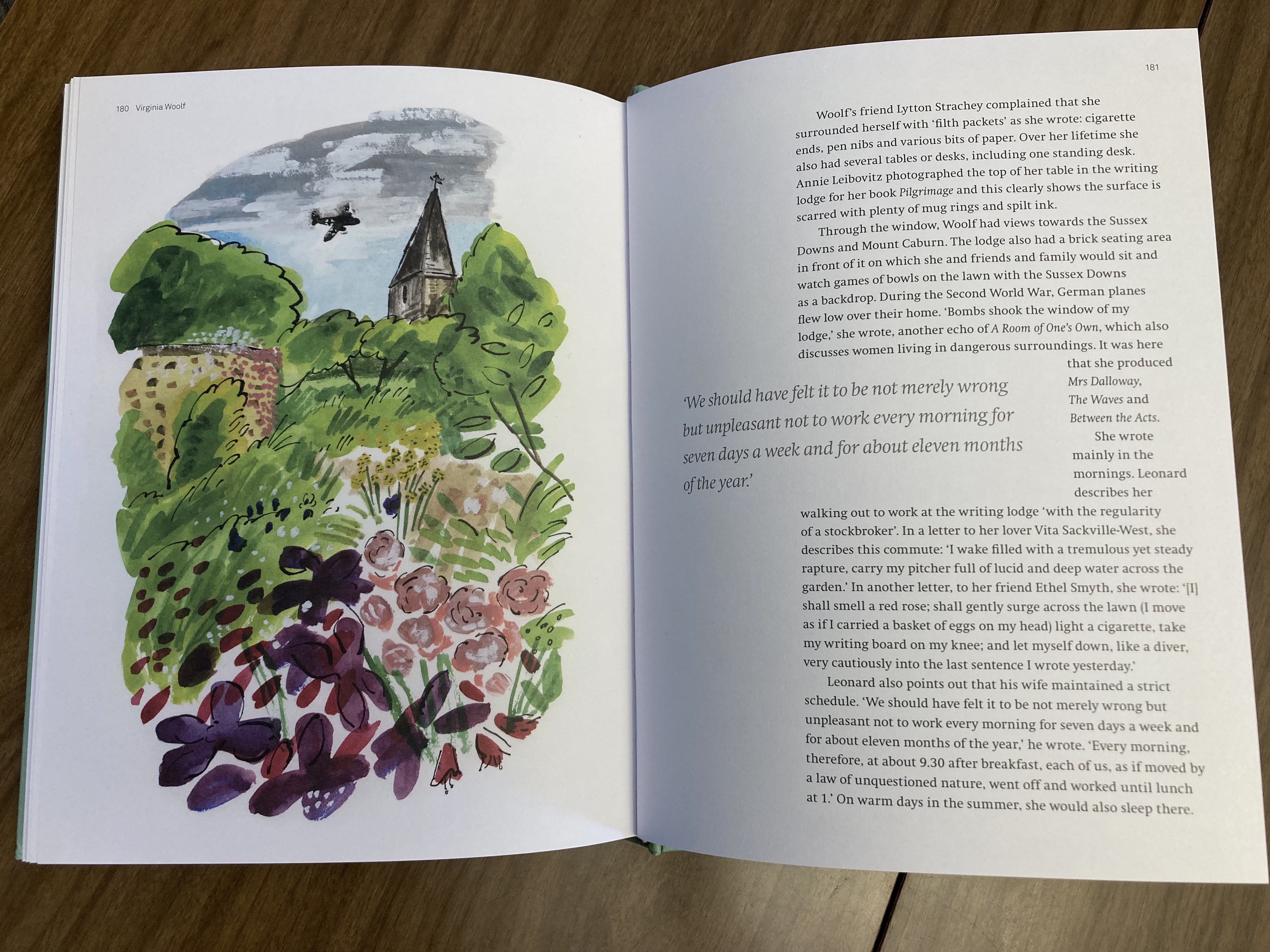


Virginia Woolf: A shed of her own, p. 180-81, Rooms of Their Own: Where Great Writers Write


Vita Sackville West: A room to celebrate love(s), p. 138-9, Rooms of Their Own: Where Great Writers Write

Vita Sackville West: A room to celebrate love(s), p. 140-1, Rooms of Their Own: Where Great Writers Write


Read Full Post »

Is everything we think we know about the Dreadnought hoax wrong? Danell Jones says it is.

Jones, the author of Virginia Woolf, Race and the Dreadnought Hoax (2023) will give an illustrated online talk on “Everything You Think You Know about the Dreadnought Hoax Is Wrong.” Marielle O’Neill will lead the Q&A that follows.

Event details

What: Talk on “Everything You Think You Know about the Dreadnought Hoax Is Wrong“
Date:
Wednesday, May 15
Time: 5:30 p.m. BST
Where: Online
Cost: £6
Sponsor: Virginia Woolf Society of Great Britain
Audience: VWSGB members only. Not a member? Join here.
For more information: Contact onlinevwsgb@gmail.com

About the book — and the talk

Journalists, memoirists and others have been getting the 1910 Dreadnought hoax wrong for more than a century. Even Virginia Woolf’s 1940 talk about the hoax is rife with inaccuracies, exaggerations and misrepresentations.

The Girl Prince, published by Hurst, takes a deep dive into the famous prank, exploring the often-overlooked diversity of Virginia Woolf’s world and setting the record straight on a practical joke that has been misunderstood for 100 years.

About the author

Danell Jones is a writer and scholar with a PhD in literature from Columbia University. She is the author of The Virginia Woolf Writers Workshop; the poetry collection Desert Elegy; and An African in Imperial London: The Indomitable Life of A.B.C. Merriman-Labor, which won the High Plains Book Award for Nonfiction.


Read Full Post »

We are nearing the tail end of Women’s History Month and who better to read than Virginia Woolf?

Virginia and Leonard Woolf moved into Monk’s House in Rodmell in 1919, and as the Monk’s House guidebook states, “Books dominated the house.” During a 2019 visit, books were the first thing we saw as we entered through the back doorway. They lined the stairs to the second floor.

To that end, I have two resources that give advice on “Where to start with Virginia Woolf.”

At the starting gate with Penguin

“Are you afraid of Virginia Woolf?” asks Penguin. The publisher then advises: “There’s no need: there’s something for everyone in the Modernist writer’s back catalogue.”

The website gives a synopsis and link for seven of Woolf’s novels and/or polemics, along with links to other works related to Woolf, such as Square Haunting: Five Women, Freedom and London Between the Wars (2020).

The recommended Woolf works include the following:

At the starting gate with NYPL

The second comes from the New York Public Library. Their guide on “Where to Start With Virginia Woolf” includes a brief synopsis of each work and recommends reading them in this order:

  1. Mrs. Dalloway (1925)
  2. A Room of One’s Own (1929)
  3. To the Lighthouse (1927)
  4. The Waves (1931)
  5. Orlando (1928)

A book list of her own

Meanwhile, Woolf scholar Maggie Humm’s Twitter post two years ago on World Book Day included a list of the books Woolf liked and disliked most in 1924, 100 years ago.

Read Full Post »

Good news: Beth Rigel Daugherty’s much celebrated 2022 book, Virginia Woolf’s Apprenticeship: Becoming an Essayist, from Edinburgh University Press will be available May 31 in paperback.

More good news: You can order it from Blackwell’s at a price of $38.82, which includes shipping to the U.S.

What’s in the book

  • The most comprehensive portrayal of Virginia Woolf’s education to date
  • Examination of the link between Virginia Stephen’s education and Virginia Woolf’s essays
  • A focus on Woolf’s nonfiction and her early work
  • Two holograph draft lectures by Virginia Stephen for the first time
  • A compilation and organization of archival material in appendices for future researchers.

According to the publisher:

This study takes up Woolf’s challenge to probe the relationship between education and work, specifically her education and her work as an essayist. It expands her education beyond her father’s library to include not only a broader examination of her homeschooling but also her teaching at Morley College and her early book reviewing. It places Virginia Stephen’s learning in the historical and cultural contexts of education for women, the working classes and writers in the late nineteenth and early twentieth century.

Part two

Rigel Daugherty is working on a follow-up volume, Virginia Woolf’s Essays: Being a Teacher. With this volume, Beth says, “I hope to clarify how her essays continue to teach and continue to encourage readers to join the literary conversation.”

About the author

Recently retired from Ohio’s Otterbein University, Beth Rigel Daugherty taught modernist English literature, Virginia Woolf, and Appalachian and Native American literature, along with many thematically focused writing courses, for 36 years.

Her plenary talk at the 31st Annual International Conference on Virginia Woolf, “On the Ethics of Teaching: Virginia Woolf’s Essays,” received accolades from everyone who heard it.

Rigel Daugherty fell in love with Virginia Woolf and her essays while at Rice University and has been presenting and publishing on both ever since. Her peer-reviewed articles have appeared in edited collections; editions of the “How Should One Read a Book?” holograph draft and Woolf’s fan letters in Woolf Studies Annual; and, with Mary Beth Pringle, the Modern Language Association teaching volume on To the Lighthouse.

Beth Rigel Daugherty (at far left), Leslie Hankins and Diane Gillespie presented a panel on “Portraying and Projecting Age, Ageism, and Activism” at the 19th Annual International Conference on Virginia Woolf, with its theme of social justice, at the University of Mount Saint Joseph in Cincinnati in June of 2019.

Read Full Post »

Virginia Woolf wrote hundreds of essays during her lifetime. The total varies from “nearly 600” (Fernald 160) to “640,” (Rigel Daughtery 9) so it can be difficult to locate just the right essay when needed. For that reason,  sometimes a slim collection of Virginia Woolf essays that focus on a specific topic is just the thing.

Here are two.

On freedom

The first is part of a 27-volume Vintage Mini collection, a Vintage Classic published by Penguin/Random House. Titled Liberty, it includes selections from A Room of One’s Own (1929), The Waves (1931), and the essays “Street Haunting” and “How Should One Read a Book.”

Here begins the freedom of the mind, or rather the possibility that in the course of time the mind will be free to write what it likes – jacket quote from Liberty (2018)

On the visual arts

The second is the twentieth volume in the ekphrasis series published by David Zwirner Books in 2021 and is a collection of Woolf’s writings on the visual arts.

Titled Oh, to Be a Painter!, the volume begins with an introduction by Claudia Tobin and includes Woolf’s longest essay on painting, “Walter Sickert: A Conversation” (1934), alongside shorter essays and reviews, including “Pictures and Portraits” (1920) and “Pictures” (1925).

References:

Fernald, Anne E. “A Feminist Public Sphere? Virginia Woolf’s Revisions of the Eighteenth Century.” Feminist Studies 31:1 (2005): 158-182.

Daugherty, Beth Rigel. “The Transatlantic Virginia Woolf: Essaying an American Audience.” Virginia Woolf Miscellany 76 (2009): 9-11.


Read Full Post »

« Newer Posts - Older Posts »