Feeds:
Posts
Comments

Posts Tagged ‘essays’

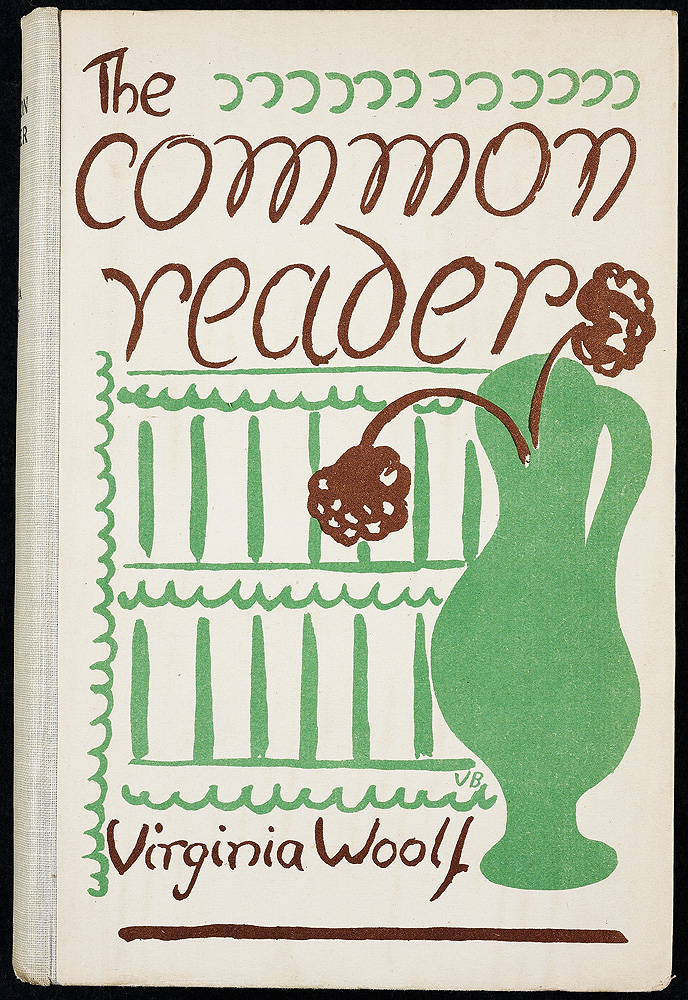
The Common Reader, Virginia Woolf’s book of essays published in 1925 with a jacket design by her sister Vanessa Bell, was provisionally titled Reading.

In it, she planned to revise some of her previously published essays and add some new ones, according to Mark Hussey in Virginia Woolf A to Z. Among its most important essays are “On Not Knowing Greek,” “Modern Fiction,” and “How It Strikes a Contemporary.”

One hundred years ago today, in her Sept. 5, 1923, diary entry, Woolf fills the half hour before dinner with her thoughts about beginning to write her book of collected essays:

A cold douche should be taken (& generally is) before beginning a book. It invigorates; makes one say “Oh all right. I write to please myself,” & so go ahead. It also has the effect of making me more definite & outspoken in my style, which I imagine all to the good. At any rate, I began for the 5th but last time, I swear, what is now to be called The Common Reader; & did the first page quite moderately well this morning. After all this stew, its odd how, as soon as I begin, a new aspect, never all this 2 or 3 years thought of, at once becomes clear; & gives the whole bundle a new proportion. To curtail, I shall really investigate literature with a view to answering certain questions about ourselves–Characters are to be merely views: personality must be avoided at all costs. I’m sure my Conrad adventure taught me this. Directly you specify hair, age, &tc something frivolous, or irrelevant, gents the book –Dinner! – Diary 2, 265.
Read Full Post »

Save Friday, April 28, at 3 p.m. ET for the Woolf Salon Project No. 24: On Wonder.

Organizers from the International Virginia Woolf Society say, “Grab your favorite unicorn horn, your box of grubs, your strange silks and seabeasts, your astrolabe and ambergris, your magic glasses full of emerald light and blue mystery as we join guest hosts Angela Harris and Eret Talviste for a discussion of two Woolf essays, “The Elizabethan Lumber Room” (1925) and “Sir Thomas Browne” (1923).”

Where to find the readings

  • “The Elizabethan Lumber Room” appears in the First Common Reader and is available online.You can also find it in The Essays of Virginia Woolf, Vol. 4: 1925-1928, pp. 53–61.
  • “Sir Thomas Browne”—originally published in the Times Literary Supplement —appears in The Essays of Virginia Woolf, Vol. 3: 1919-1924, on pp. 368–72. It is also available via Dropbox.

Check your time zone

Time Zone conversions:

12 p.m. PT (Los Angeles)
3 p.m. ET (New York)
4 p.m. Brasilia
8 p.m. BST (London)
9 p.m. CEST (Paris)
5 a.m. AEST Saturday 4/29 (Sydney)

Salons typically run about two hours, and the event will be recorded for later viewing for members of the International Virginia Woolf Society.

How to join

Anyone can join the group, which usually meets on one Friday of each month via Zoom and focuses on a single topic or text. Just contact woolfsalonproject@gmail.com to sign up for the email list and receive the Zoom link.

Background on the Salon

The Salon Conspirators — Benjamin Hagen, Shilo McGiff, Amy Smith, and Drew Shannon — began the Woolf Salon Project in July 2020 to provide opportunities for conversation and conviviality among Woolf-interested scholars, students, and common readers during and beyond the COVID-19 pandemic.

Read Full Post »

The Woolf Salon usually meets monthly on Zoom. Anyone can join the conversation.

After a four-month hiatus, the Woolf Salon Conspirators have announced that they are  starting up the 2023 Woolf Salon Project with Woolf Salon No. 23: “The Lives of the Obscure.”

Where and when

The discussion will take place on Zoom Friday, Feb. 17, at 3 p.m. ET (New York). Other time zones are listed below, but please double check them!

2 p.m. CT (Chicago)
12 p.m. PT (Los Angeles)
5 p.m. Brasilia
8 p.m. GMT (London)
9 p.m. CET (Paris)
11 p.m. MSK (Moscow)
7 a.m. AEDT Saturday (Sydney)

The essay and where to find it

The 23rd salon will feature a rich conversation about Woolf’s essay (from The Common Reader [1925]), “The Lives of the Obscure.”

You’ll find the essay in any copy of The Common Reader, in Vol. 4 of The Essays of Virginia Woolf (pp. 118–45), and on Project Gutenberg.

How to join

Anyone can join the group, which usually meets on one Friday of each month via Zoom and focuses on a single topic or text. Just contact woolfsalonproject@gmail.com to sign up for the email list and receive the Zoom link.

Background on the Salon

The Salon Conspirators — Benjamin Hagen, Shilo McGiff, Amy Smith, and Drew Shannon — began the Woolf Salon Project in July 2020 to provide opportunities for conversation and conviviality among Woolf-interested scholars, students, and common readers during and beyond the COVID-19 pandemic.

Read Full Post »

Literary audiobook supplier Spiracle offers three of Virginia Woolf’s short works at no cost. You can listen to them at the links below.
  • The Mark on the Wall,” read by Saffron Coomber. First published in 1917 with Leonard Woolf’s story “Three Jews” in the collection Two Stories.
  • On Being Ill,” read by Saffron Coomber. First published in 1926 in magazines in both the UK and US. Four years later, the Hogarth Press published a slightly revised version as a stand-alone volume. It was the first volume the Woolfs hand set and printed in 11 years.
  • How It Strikes a Contemporary,” read by Diana Quick. First published in 1922 in The Times Literary Supplement. It was later published by the Hogarth Press in The Common Reader (1925).

Spiracle also offers five Woolf novels as audiobooks at prices ranging from £10-£15: The Voyage Out, Night and Day, Jacob’s Room, Mrs. Dalloway, and To the Lighthouse.

Read Full Post »

Interested in Virginia Woolf’s essays? Wondering how the lessons from her essays apply to teaching and learning? Then you won’t want to miss Beth Rigel Daugherty’s talk, “Learning and Essaying: From Adeline Virginia Stephen to Virginia Woolf” on Oct. 10, the 2022 International Virginia Woolf Society Fall Lecture.

The event will run from 1–2:30 p.m. ET (New York). See timezone adjustments below, but please doublecheck the times:

10–11:30 a.m. PT (Los Angeles)
2–3:30 p.m. (Brasilia)
6–7:30 p.m. BST (London)
7–8:30 p.m. CEST (Paris)
[Oct 11] 2–3:30 a.m. JST (Tokyo)
[Oct 11] 4–5:30 a.m. AEDT (Sydney)

Members of the International Virginia Woolf Socity will receive a Zoom link for this event closer to the date. If you are not a member, you can join now.

Learning and Essaying

In her talk, Beth will guide viewers through her newly published book, Virginia Woolf’s Apprenticeship: Becoming an Essayist, from the Edinburgh University Press and preview her sequel, Virginia Woolf’s Essays: Being a Teacher.  With the follow-up volume, Beth says, “I hope to clarify how her essays continue to teach and to encourage readers to join the literary conversation.”

Get a taste of Beth’s book, as well as her talk, in this interview posted on EUP’s website.

About Beth

Recently retired from Ohio’s Otterbein University, Beth Rigel Daugherty taught modernist English literature, Virginia Woolf, and Appalachian and Native American literature, along with many thematically focused writing courses, for 36 years.

Her plenary talk at the 31st Annual International Conference on Virginia Woolf, “On the Ethics of Teaching: Virginia Woolf’s Essays,” received accolades from everyone who heard it.

Beth fell in love with Virginia Woolf and her essays while at Rice University and has been presenting and publishing on both ever since. Her peer-reviewed articles have appeared in edited collections; editions of the “How Should Read a Book?” holograph draft and Woolf’s fan letters in Woolf Studies Annual; and, with Mary Beth Pringle, the Modern Language Association teaching volume on To the Lighthouse.

Beth Rigel Daugherty (at far left), Leslie Hankins and Diane Gillespie presented a panel on “Portraying and Projecting Age, Ageism, and Activism” at the 19th Annual International Conference on Virginia Woolf, with its theme of social justice, at the University of Mount Saint Joseph in Cincinnati in June of 2019.

Read Full Post »

« Newer Posts - Older Posts »