Editor’s Note: Woolf scholar Kristin Czarnecki contributed this post about her creative experience with Mrs. Dalloway and erasure poetry.
A year or so ago, on the recommendation of a friend, I bought Sarah J. Sloat’s Hotel Almighty, a book of erasure poems born from Stephen King’s novel Misery. Each page bears not only Sloat’s erasures but also her beautiful, evocative art and collages.
I read it repeatedly and became curious about the potential of erasure poetry. As Sloat says in her introduction to Hotel Almighty, “The form leaves room for chance.”
 I suspected the form was something I’d enjoy, and as I so often do, I turned to my shelves of Woolf books for inspiration.
Right away, my eye went to the Eastern Press edition of Mrs. Dalloway I’d found years ago in a Lexington, Kentucky, bookstore. It was bound in genuine leather in a glorious, saturated shade of green, my favorite color, and I snapped it up.
And there it sat on a shelf for years until, in a fit of purging, I brought it to Half-Price Books to see what I could get for it in trade. Not much, but I easily let it go, confident it would wind up with someone who would appreciate it.
A book returns
Fast forward a few months, when an English major at the college where I was teaching stopped by my office one afternoon. She and her girlfriend had taken several classes with me, including modern British literature, which of course had Mrs. Dalloway on the syllabus.
That day in my office, she reached into her bag, drew out a book, and proudly handed me the Eastern Press edition of Mrs. Dalloway I’d recently given away.
“We found this at Half Price Books!” she said, “And we knew we had to get it for you.”
I was deeply moved by the gesture and thought, “Well, I’m clearly meant to have this book.”
I kept it in my campus office, and when my husband and I moved across the country, it of course came with us.
Having fun with Mrs. Dalloway
Looking at the book recently, I began to wonder how I might do justice to
Woolf’s words, to my students’ thoughtful gift, and also to the physical thing. I wondered how it might manifest into a different type of aesthetic object, and I wondered if I might fall under Woolf’s spell once again if I approached her writing in a different way.
Since leaving academia nearly four years ago, I’d been losing interest in Woolf, a sad and unsettling experience I hoped was only temporary.
“Mostly, I set out to have fun,” Sloat writes towards the end of her introduction to Hotel Almighty. I set out to do the same when creating erasure poetry from Mrs. Dalloway.
I sought combinations of words that would reflect Woolf’s concerns in the novel, like the vagaries of time and fluctuating relationships. Sometimes, I sought to counteract the unbearable sadness on the page, like Septimus Warren Smith’s suicidal despair. Sometimes, I tried not to overthink it and just remain alert to any words or phrases that might jump out.
I decided to create 51 erasures, Clarissa Dalloway’s age in the novel.
Adding art to the words
As for the art, some of the erasures called out for a particular color or striking color combination. For a few, I wanted strips of paper to cover all but the circled words. For added visual interest, I cut out some of my drawings and paintings from other notebooks and pasted them in.
I appreciate anew, or differently now, her writing to a rhythm, her threading of specific motifs throughout the novel, her aversion to verbs (!), and her insights into the multitudes of human experience.
The process of running a paint brush, colored pencils, or pastel crayons across the lines, a repetitive and meditative action, found me absorbing and thinking about words I hadn’t singled out.
Selecting from among Woolf’s words and adorning them with art made for a unique and enjoyable creative experience. I appreciate anew, or differently now, her writing to a rhythm, her threading of specific motifs throughout the novel, her aversion to verbs (!), and her insights into the multitudes of human experience.
I like to believe we created these erasures together. And, it’s nice to have her back.
About the author

Kristin Czarnecki at the 2019 Annual International Conference on Virginia Woolf held at Mount St. Joseph University in Cincinnati, Ohio.
Kristin Czarnecki taught English in Georgetown, Kentucky, for many years and is now executive director of the Rockport Art Association & Museum in Rockport, Massachusetts. A former president of the International Virginia Woolf Society, she has published literary criticism in Woolf Studies Annual, Journal of Feminist Scholarship, Journal of Modern Literature, the CEA Critic, College Literature, and Journal of Beckett Studies as well as in edited volumes. She is also the author of two memoirs: Encounters with Inscriptions (Legacy Book Press, 2024), about the books inscribed and given to her by her parents over the years, and The First Kristin: The Story of a Naming (Main Street Rag, 2020), about the experience of being named after a deceased sibling. Her chapbook, Sliced, was published by dancing girl press & studio in 2023. Her next book, My Moomin Memoir: Reflections on Tove Jansson’s Classic Tales, is forthcoming from Legacy Book Press.
Erasure poems from Mrs. Dalloway by Kristin Czarnecki

The Sunlight by Kristin Czarnecki

The Dear Boy by Kristin Czarnecki

The Shaggy Dog by Kristin Czarnecki

She Made the Drawing Room by Kristin Czarnecki
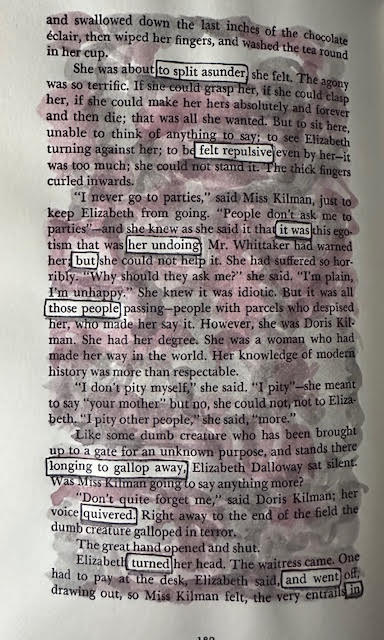
To Split Asunder by Kristin Czarnecki





 Alice Lowe
 Catherine
 Kaylee Baucom
 Leanne Oden
 Paula Maggio
 Stefano Rozzoni
 seanmcphail
 suzannebellamy1
 veronikakra
 Vara Neverow
 William Patrick Wend
 Zoe Wolstenholme


