If you’ll be in England this month, you have the opportunity to travel to Charleston for a special event with Mark Hussey and his new book, Mrs. Dalloway: Biography of a Novel.
The details
What: Mrs Dalloway: Biography of a Novel When: Wednesday 12 November, 7 p.m.
Celebrate the centenary of the publication of Virginia Woolf’s landmark novel Mrs Dalloway, with leading author and academic Mark Hussey as he introduces his new book, Mrs Dalloway: Biography of a Novel.
Discover the story behind the story: follow the remarkable ‘life’ of Mrs Dalloway, from its first stirrings in Woolf’s diaries, through her struggles to shape its form, to the novel’s critical reception and lasting legacy. Discover the hidden history of the novel that redefined modern literature.
At 100 years old, Virginia Woolf’s 1925 novel Mrs. Dalloway is a must-read for all of us living in today’s technological world, according to New York Times critic A.O. Scott.
In “100 Years Ago, Fictional Londoners Looked Up. They Saw Our Present Day,” published yesterday in the Times, Scott focuses on an early scene in the novel to make his point. He features the airplane that captures the attention of a cross-section of Londoners as Clarissa walks to “buy the flowers [for her party] herself.”
Scott writes: “Near the beginning of “Mrs. Dalloway,” an ordinary day is disrupted by a technological intrusion. More than a century later, we might relate to this kind of thing, even if we’re more likely to be distracted by the pings and chirps of our portable screens. A sky-writing airplane, quaint as it may seem at first glance, brings us news of our current situation — about how we think, how we interact and how we experience reality.”
It is a timely column and worth a read. Plus, the animated airplane graphics are clever and fun to watch.
Return to the novel
But Scott’s focus on technology as a distraction — while interesting — is narrow. It leaves out other approaches, such as one noted in a comment by Scott Paradis from Flint, Michigan:
“Skywriting as an advertising medium began in the UK in 1922. A few years before, Londoners were watching the sky for bombers–Zeppelins by night and Gothas by day–despite air raid warnings to take shelter. In this scene they’re marking the change from mortal danger to commercial trivia.”
Scott’s approach also fails to mention the context surrounding the airplane sighting, a context that actually would have added support to his argument — and something I was happy to note when his article prompted me to reread the first 25 pages of Woolf’s text.
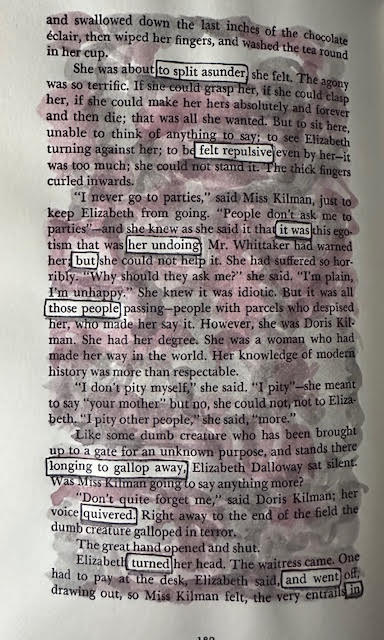
Just before the skywriting airplane appears (MD 20), Woolf describes everything coming to a standstill when a motor car erupts in a “violent explosion” that sounds like “a pistol shot” (13-14).
The sound causes passers-by to stop and stare. Rumors then circulate about the passenger in the car, someone with “a face of the very greatest importance,” prompting everyone to “look at the motor car” (14-15). The crowd speculates: Was it the prime minister? Was it the Prince of Wales’? Was it the Queen?
The motor car and its possibly royal passenger captures Clarissa’s attention, as well as her imagination. She muses:”It is probably the Queen . . . The Queen going to some hospital; the Queen opening some bazaar” (17).
As the car glides across Piccadilly, it continues to attract the attention of everyone from men of means “with their hands behind the tails of their coats” to “[s]hawled Moll Pratt with her flowers on the pavement” to a crowd of poor people gathered at the gates of Buckingham Palace (18-19).
The shift
But when the people in the crowd hear the sound of the airplane, their attention shifts from the car and its supposedly royal passenger to the airplane “letting out white smoke from behind . . . making letters in the sky!” (20).
I find this change of focus interesting. Londoners, who moments before were focused on a car on the street in front of them that they guessed was carrying royalty, suddenly shift their attention from the monarchy to the airplane above their heads. They then speculate about what commercial message it is writing in the sky.
Thus, they move their focus from traditional royalty, something with which they are familiar, to commercialized technology, something rather new to them. Both, however, keep them guessing. No one knows for sure who is in the car or what is written in the sky.
Scott and I — and the more than 160 readers who have already commented on his article — have only grazed the surface of these few pages of Mrs. Dalloway. As always in Woolf’s writing, there is much more to uncover by close reading.
Woolf readers at one of the exhibit and bookseller tables at the 34th Annual International Conference on Virginia Woolf.
Roughly 350 scholars from around the globe have gathered at the University of Sussex for the 34th Annual International Conference on Virginia Woolf. And coming from the United States, this year’s topic could not be more timely: Woolf and Dissidence.
As an American living under the destructive regime now ruling my country, I hoped that I and my compatriots would be greeted with empathy and understanding by those we met at this conference in England.
I was not disappointed. I and others from the U.S. have been embraced more warmly than ever by the students, common readers and scholars from around the world who have arrived in Falmer, the English town on the outskirts of Brighton, where the University of Sussex is located.
The universal question
Time for talk during a conference break.
Whether from Turkey, Korea, Brazil, Italy, Austria, Belgium, Norway, Canada or the UK, our fellow humans and Woolfians share our disappointment in the country I call my home.
And they almost universally ask the question we Americans have been asking ourselves since last November: “How did this happen?”
Sadly, we have no definitive answer. All we can offer are conjectures, theories, and speculations.
Dangerous words
Notice how I am writing here. I am choosing my words carefully. I am not saying exactly what I mean. Instead, I am offering hints. Instead, I am writing in a kind of code.
Why? I am afraid. Not so afraid that I will be silent, because, as Audre Lorde said, “Your silence will not protect you.”
But afraid enough to edit myself, to avoid publishing words on the web that might bring attention from the thought police. After all, I would like to get back into the country of my birth.
Clarissa Dalloway’s dangerous world
Which brings me to one of the best things I heard at the conference so far: Fordham University Professor Anne Fernald’s keynote presentation titled “Dangerous Days: A Century with Clarissa Dalloway.”
In it, she talked about the dangers we face in our current political climate and the dangers Clarissa faced in Woolf’s 1925 novel. Clarissa lost her sister at a young age. She lived through the Great War. She survived the influenza pandemic.
Woolf describes Clarissa’s feelings this way:
She had a perpetual sense, as she watched the taxi cabs, of being out, out, far out to sea and alone; she always has the feeling that it was very, very dangerous to live even one day. (MD 8)
I now understand that quote. And I recognize — once again — that Woolf’s words always apply.
Anne Fernald gives her keynote address, “Dangerous Days: A Century with Clarissa Dalloway.”
Harchards new edition of Mrs. Dalloway filled one of the shop’s windows.
Dalloway Day celebrations are taking place across the globe this month, as Virginia Woolf’s novel Mrs. Dalloway marks its centenary. Today I have a report from Dalloway Day in London, held June 28 at one of my favorite London bookstores, Hatchards in Piccadilly.
The event, held in collaboration with the Virginia Woolf Society of Great Britain, featured two panels. The first was led by Maggie Humm and featured Maggie Gee, author of Virginia Woolf in Manhattan and Michelle de Kretser, author of Theory and Practice.
The second included Vara Neverow, editor of the Virginia Woolf Miscellany, interviewing Mark Hussey about his new book, Mrs Dalloway: Biography of a Novel. Sarah Hall facilitated the question and answer period.
A book signing was then followed by champagne, sweets, and live music as Mrs. Dalloway’s Party got into full swing.
The three books by the authors on the first panel.
Michelle de Kretser reads a passage from her new novel while Maggie Humm looks on.
Standing to project Virginia’s voice, Maggie Gee reads from her novel.
Maggie Gee and Michelle de Kretzer sign their books.
Vara Neverow, Mark Hussey and Sarah Hall are ready for their panel at Hatchards.
It was a sell-out crowd for the Dalloway Day event at Hatchards.
Live music from the 1930s and ‘40s added to the ambience.
Guests at Mrs. Dalloway’s party came from near and far — London, Boston, Antwerp, Italy, Germany, and more.
Even though all but the evening party is sold out, I want to get this event on the record. In collaboration with the Virginia Woolf Society Great Britain, Hatchard – Piccadilly will present an afternoon of events to celebrate DallowayDay 2025, the centenary celebration of Mrs. Dalloway.
Date and time: Starts on Saturday, 28 Jun 2025, 11:30 a.m. BST Location: London – Hatchards – Piccadilly, 187 Piccadilly London W1J 9LE United Kingdom
The schedule
11:30 a.m. – 12.30 p.m.: A Bloomsbury Walk
Guided by Clara Jones, author of Virginia Woolf: Ambivalent Activist, we will haunt and saunter in the streets and squares of Virginia Woolf’s beloved Bloomsbury.[Please note: the walk is available only for those with All Day Tickets.]
2 – 3 p.m.: In Conversation with Maggie Gee and Michelle de Kretser.
Hatchards bookshop on Piccadilly will hold an in-conversation with authors Michelle de Kretser and Maggie Gee on Virginia Woolf in the 21st century chaired by Maggie Humm, author of Talland House and The Bloomsbury Photographs.
Michelle de Kretser is one of Australia’s most celebrated writers, renowned for bending fiction, essay and memoir into exhilarating new shapes to explore the boundaries between life and art. In her new novel, Theory & Practice, we meet a young woman newly arrived in Melbourne to research the novels of Virginia Woolf. In bohemian St Kilda, she meets artists, activists, students – and Kit. He claims to be in a ‘deconstructed’ relationship, and they become lovers. Meanwhile, a dismaying discovery throws her work on ‘the Woolfmother’ into disarray.
Amongst novelist Maggie Gee’s glittering oeuvre, key to the conversation is Virginia Woolf in Manhattan in which bestselling author Angela Lamb travels to New York to pursue her passion for Woolf, whose manuscripts are held in a private collection. When a bedraggled Virginia Woolf materialises among the bookshelves, Angela is soon chaperoning her troublesome heroine as the latter tries to grasp the internet and scams bookshops with ‘rare signed editions’. And when Virginia insists on them flying to Istanbul, she not only finds a Turkish admirer, but steals the show at an International Conference on – Virginia Woolf!
4 – 5 p.m.: The Biography of Mrs Dalloway with Mark Hussey and Vara Neverow
For the second panel of the afternoon, the program will mark the centenary of Mrs Dalloway’s publication by welcoming Mark Hussey to discuss his new book Mrs Dalloway: Biography of a Novel in conversation with Vara Neverow.
In her diary, Virginia Woolf wrote that she wanted her new novel ‘to give life & death, sanity & insanity… to criticise the social system, & to show it at work, at its most intense.’
In conversation with Vara Neverow, managing editor of the Virginia Woolf Miscellany and former president of the International Virginia Woolf Society, Mark Hussey discusses how Virginia Woolf achieved this creative ambition: from the first stirrings that appeared in her diary through to the struggle she had in moulding and developing characters and storyline. Once published, Mrs Dalloway was recognised almost immediately as a major development in prose fiction, and Mark traces its remarkable legacy through one hundred years to the present day. Sarah Hall, VWSGB Publicity Officer and Co-Editor of the Virginia Woolf Bulletin, will chair the panel.
5 p.m. onwards: Mrs Dalloway’s Party
There are a few tickets left for this party to celebrate publication of The Hatchards Library edition of Mrs Dalloway with a glass of wine and live jazz with Wayne McIntyre and guests showcasing a repertoire from the 1920s.