Writers stamp themselves upon their possessions more indelibly than other people, making the table, the chair, the curtain, the carpet into their own image. – Virginia Woolf, “Great Men’s Houses (1911)


That is the lovely quote that begins the introduction to Rooms of Their Own: Where Great Writers Write (2022)– and the fact that it was written by VirginiaWoolf adds a special boost to this post.
The book answers the question, “Where do you write?” for authors ranging from Maya Angelou to William Wordsworth — 50 in all. It describes their writing environments — from attics and studies to billiard rooms and bathtubs — in words written by Alex Johnson and illustrations in charming water colors by James Oses.
As the book blurb explains, it “explores the unique spaces, habits and rituals in which famous writers created their most notable works.”

Virginia Woolf’s writing lodge at Monk’s House in Rodmell, East Sussex
In addition, it details each author’s writing methods, routines and habits, as well as their ink, paper, and pencil preferences.
It also includes information on each of the locations described, many of which are private and not open to visitors.
Of particular note to readers of Blogging Woolf are the rooms used by Woolf and Vita Sackville-West. The book covers each with a four-page spread.

The tower at Sissinghurst Castle in Kent, where Vita Sackville-West’s writing room is located.
Woolf’s, of course, depicts the interior of her writing lodge at Monk’s House, along with her view from the lodge. Vita’s shows the interior of her tower room at Sissinghurst Castle, as well as a long view of the tower exterior.
Lucky for us, both Monk’s House and Sissinghurst Castle are open to visitors.
However, as I recall my last visit to Monk’s House in July of 2019, we were not permitted inside the space where Woolf wrote in her lodge. We had to view it through a window. The photo below shows that view.
In June of 2018, I got a look at Vita’s lofty writing space in the Sissinghurst tower from a doorway, after climbing the stairway that led to it. The doorway was blocked by a grille to preserve the fragile contents within. You can see what I saw in the photo below, including just some of the room’s 2,700 books.
Despite such limitations, each is certainly worth a visit.

Virginia Woolf’s desk in her writing lodge at Monk’s House, 2019. Woolfs’ tortoiseshell glasses, as well as her folders for her manuscripts, are on the table. While the Woolfs converted an old tool shed in their garden into a writing room for Virginia in 1921, by 1934 they built this new lodge with French windows. I took this photo through a window, as entry was not permitted.
Vita Sackville-West’s writing room in the high tower at Sissinghurst Castle, 2018. It appears as it was upon her death in 1962. It is lit as a night scene to prevent damage from light and reflects the fact that Vita usually wrote by lamplight in the evening. I took this photo through a grille in the doorway at the top of the stairs, as entry was not allowed.

Virginia Woolf: A shed of one’s own, p 178-9, Virginia Woolf: A shed of one’s own, p 178-9, Rooms of Their Own: Where Great Writers Write
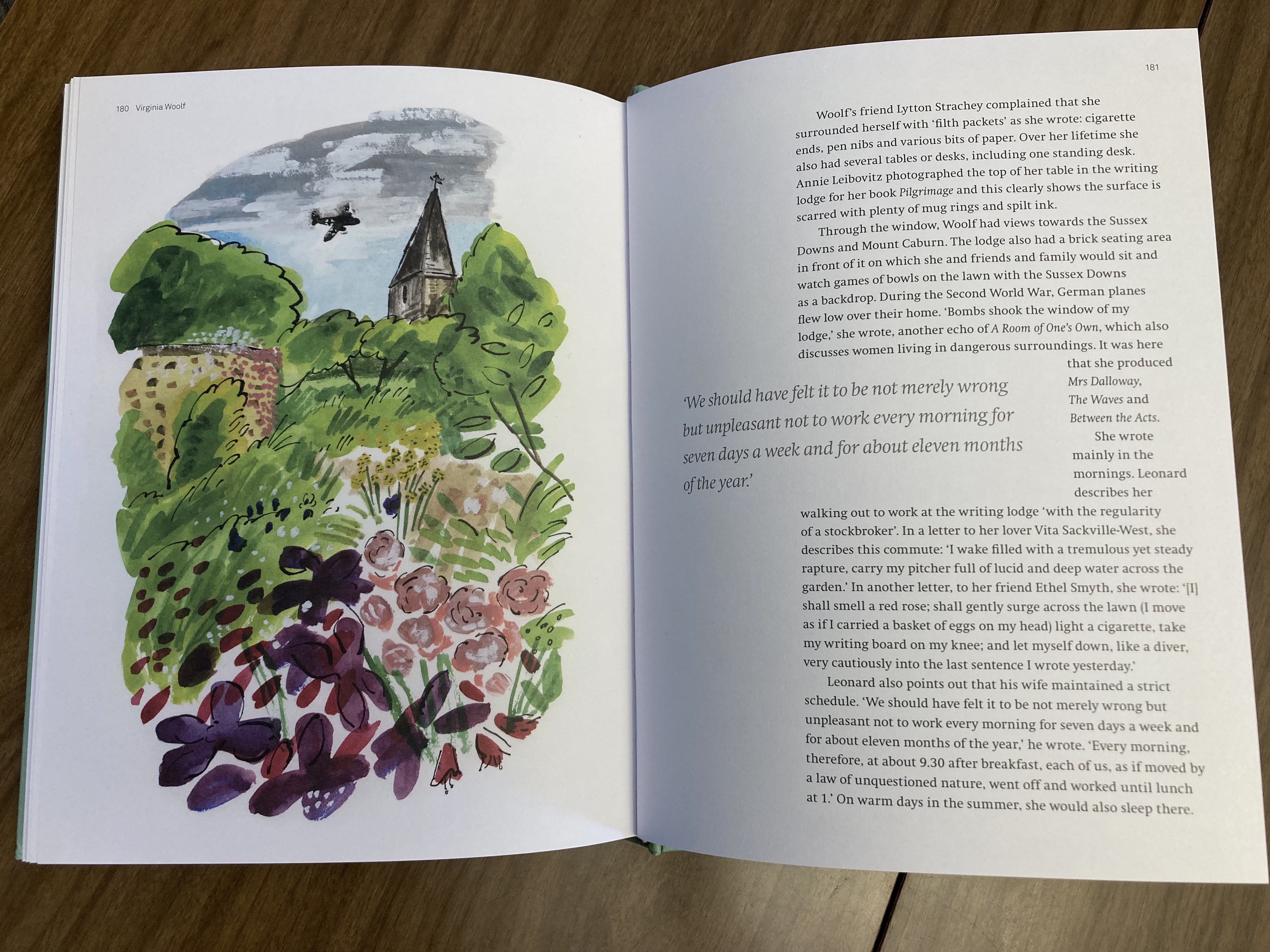
Virginia Woolf: A shed of her own, p. 180-81, Rooms of Their Own: Where Great Writers Write

Vita Sackville West: A room to celebrate love(s), p. 138-9, Rooms of Their Own: Where Great Writers Write

Vita Sackville West: A room to celebrate love(s), p. 140-1, Rooms of Their Own: Where Great Writers Write