Feeds:
Posts
Comments

Archive for July, 2011

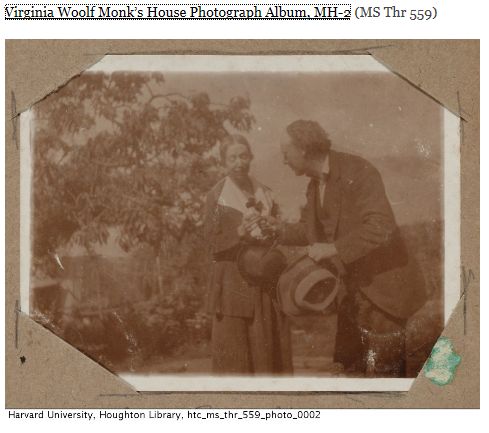
Screen shot of one digitized album photo

What an age we live in. So many resources for the study of Virginia Woolf and her work are available online, and now we have another. The Monk’s House photograph albums, which include more than 1,000 photos taken by Virginia Woolf, Vanessa Bell and others, have been digitized by Harvard University library staff.

The digitized material now available online includes all the images in Virginia Woolf’s photo albums, numbered one through six, that Frederick R. Koch gave to Harvard’s Houghton Library in 1983. They include the 1,000 photos in Maggie Humm’s 2006 book Snapshots of Bloomsbury: the Private Lives of Virginia Woolf and Vanessa Bell.

Snapshots of Bloomsbury

In the albums are snapshots taken by Woolf and her friends and family, including portraits and scenic landscapes of their homes and travels. Virginia and Vanessa were avid photographers, using a portable Kodak to shoot their pictures. They also developed their photos, printed them and mounted them in albums.

Vara Neverow tracked down the URLs  for each album and asked Blogging Woolf to post them. And Stuart N. Clarke advises that you can find corrections and additions to the descriptions of the Greek photos in Martin Ferguson Smith’s, “Virginia Woolf’s Second Visit to Greece,” English Studies, XCII, 1 (2011), 55-83.

Please see the right sidebar under the heading “Digital Archives” for links to all five Monk’s House albums.

Read Full Post »

The writer must get into touch with his reader by putting before him something which he recognises, which therefore stimulates his imagination, and makes him willing to co-operate in the far more difficult business of intimacy. And it is of the highest importance that this common meeting-place should be reached easily, almost instinctively, in the dark, with one’s eyes shut.

Biljana Dojcinovic (2nd from left) at her May press conference

Biljana Dojčinović has published a book on Virginia Woolf and modernism, the first written originally in the Serbian language.

Titled Susreti u tami: Uvod u čitanje Virdžinije Vulf (Encounters in the Dark: Introduction to Reading Virginia Woolf), it is published by Beograd. The title comes from a paraphrase of the Woolf quote from her essay “Character in Fiction” that is included above.

According to Dojčinović, her study puts Virginia Woolf  in the context of modernism as a global(ized) movement.

“The beginning of 20th century was marked by the new ways of defining and using concept of tradition, as well as by new understanding of the notion of subject,  as divided and paralyzed self, all the way from Serbia to China,” she wrote to Blogging Woolf.

“Seen in this context, Virginia Woolf’s both fictional and essayistic work demands a specific approach, a combination of close reading and cultural studies, including feminist and gender theories, so that the role of the reader, Woolf`s modernist views and their importance for understanding poetics of Henry James, as well as  concepts of engramic poetics and performative history, can be grasped.”

For more on Woolf’s global popularity, as well as available translations of her work, read High-tech methods help gauge Virginia Woolf’s popularity.

Read Full Post »

A week’s worth of Woolf sightings, just 13, here. Michael Holroyd’s A Book of Secrets, which explores the passion between Virginia Woolf, Vita Sackville-West and Violet Trefusis may deliver a steamy summer read. See #7. Then scroll down to #11 and listen to a song that mentions Woolf’s suicide. Again.

  1. ‘Last Summer’ evokes fond memories with lyrical craftwork, UT The Daily Texan
    It’s Virginia Woolf’s stream-of-consciousness style that gets to the core aesthetic of
    Virginia, Violet, Vita and passion

    Friedberger. She doesn’t evoke much through heavy narratives or bombastic music. Instead, she writes about her surroundings to bring up moods and uses music as

  2. Canonizer’s Feast, Brooklyn Rail
    Beckett “became a strong fourth with Joyce, Proust, and Kafka as the masters of prose fiction in the 20th century, transcending Thomas Mann, Joseph Conrad, DH Lawrence, Virginia Woolf, and William Faulkner.” “The poets of my generation of the highest
  3. Remarkable Person: Arlene K. Hoffman, Chicago TribuneA: I guess it would be Vita Sackville-West and Virginia Woolf, because I related to them the most. It was, like, about me. A: The Grateful Dead, but I like country music as well. The most
    comforting thing for me from growing up to this very moment has
  4. Harry Potter and the book snobs, Herald Scotland
    Ms Virginia Woolf could never be trash – though I’ll give you an argument – while spy fiction, or SF, or any airport pulp, was “clearly” garbage. Even while wading through my James Joyce – and I mean the lot, “pomes” and all – I had a problem with that
  5. Talkingbooks: Sehba Sarwar, DAWN.com
    There are many inspiring authors: Julia Alvarez, Ismat Chughtai, Sandra Cisneros, Edwidge Danticat, Mahmoud Darwish, Faiz Ahmed Faiz, Gabriel Garcia Marquez, Toni Morrison, Patti Smith, Leo Tolstoy, Virginia Woolf… The list is endless.
  6. Your child, the modernist, Boston Globe
    The writers we now call modernists-TS Eliot, for example, James Joyce, Virginia Woolf, Ezra Pound-often aimed for shock or surprise. They created their most famous poetry and fiction, during the first decades of the 20th century,
  7. The book is not dead, it’s just shape-shifting, The Guardian
    A distinguished example is Michael Holroyd’s A Book of Secrets, an enthralling study of the passionate interactions among Virginia Woolf, Violet Trefusis and Vita Sackville-West. In an arresting manoeuvre, Holroyd …
  8. With a Kindle, no one can see the Mills & Boon cover, Telegraph.co.uk
    She would read a Virginia Woolf one day and a Jackie Collins the next. Intrigued, I picked up her Collins from the sun lounger, but after a few pages I had to stop, because it was making me feel ill. One grinding cliché after another.
  9. Granta on “The F Word”: VS Naipaul not included, Montreal Gazette (blog)
    A clearheaded, socially rooted comment on women’s practical ability to clear the space required to write, with echoes of Virginia Woolf’s A Room of One’s Own—the contrast with Naipaul’s crabby superiority couldn’t be more stark, or more refreshing.
  10. Before the beginning was silence, Calcutta Telegraph
    Damaris refers to Evie as a “man-woman”, resonating with Virginia Woolf’s “androgyny”.
    They communicate for the first time through an act of mime — again, a performance in silence — where Evie enacts a “statue of herself”. The feminist search for an
  11. Juana Ghani, Salt Lake City Weekly
    She mentions “The Incredible Sadness of Sonia,” a haunting melody based somewhat on Virginia Woolf’s suicide, with references to Alice in Wonderland. “But there’s more to the story than just that—that is where the hyperbole comes in.
  12. Review of Sandra Park’s ‘If You Live in a Small House’, Hyphen Magazine (blog)
    Much like the characters in a Virginia Woolf novel, haunted by memories of WWI, Park’s characters exist as ghosts, drifting past each other without comprehending. “As in most crowded homes, people learned how to draw the shade, looking and seeing
  13. Going places — literally, Hindustan Times
    Over three years s/he will have to take nine papers that cover canonical authors of mainly British literature – Chaucer, Shakespeare, Dickens, TS Eliot, Virginia Woolf etc. But s/he will also be exposed to literatures from other times and other parts

Read Full Post »

how many moments like this are buds on the tree of life. Flowers of darkness they are, she thought.   – Mrs. Dalloway 29

Word on the street — or should I say, word on the list — is that The Tree of Life is a must-see for Virginia Woolf fans.

Common readers Mark Scott and Melanie White recently saw the film, which was written and directed by Terrence Malick. Afterward, White emailed the VW Listserv with this advice: “see it, if you’re in the mood for a long, slow, beautiful film.”

She said she and Scott both thought the film was very “`Woolfian’ in that it’s storytelling focused on feelings, told in a series of vignettes of small moments — moments of being.”

White — and critics — praise the film for its gorgeous imagery, its lack of traditional, linear narrative structure and its fluid use of time, Woolfian traits to be sure. But in general, the reviews are mixed.

The Guardian reviewer said it took him more than one viewing to understand particular sections of the film, and he complained that the film was both sublime and “shockingly cheesy.”

NPR described the film as “astonishing in some spots, almost incoherent in others” with “the throb of poetry in every frame.”

And Joanna Connors, wrote in Sunday’s Plain Dealer that one must translate the eloquent words used by film reviewers in order to understand why a large percentage of average moviegoers hate this film and why a substantial portion of the audience booed it at the screening.

For example, what NPR means by calling the film poetic is: “I don’t have a clue what the movie is trying to say, so please don’t email me to ask. It’s poetry, OK? It’s supposed to confuse you,” according to Connors.

Of course the film won the most prestigious prize at the Cannes Film Festival in May, and Brad Pitt, as the male lead, is universally praised for his work in the role.

If I can find Tree of Life playing at a theater near me, I will take White’s advice and see it. If you already have, post your thoughts in the comments section below. Meanwhile, watch the trailer.

Read Full Post »

Jewelry designed by Delfina Delettrez

Blogging Woolf is on summer time, which means the time between Woolf sightings is growing longer.

Here are nearly two weeks worth, including one, number 35, in which jewlery designer Delfina Delettrez says Virginia Woolf is one of five famous women she would like to see model her work, which is described as surreal, luxurious and not for the weak of heart.

  1. An Unfinished Woman, Albany Times Union
    As we discuss Virginia Woolf’s A Room of One’s Own, I survey the faces of these 20-something-year-olds, my classmates, and think to myself, “Are you kidding me? You think dorm life is hard? Try finding a room of your own at MY house!!” Perspective.
  2. The Humble Life of Phillip Greenlief, East Bay Express
    An avid cinephile with a keen eye for visual arts and a masters degree in English lit from the University of Southern California, he’s recorded albums investigating Virginia Woolf (Ashley
    Adams’ fierce Flowers for Mrs. Dalloway), Robert Rauschenberg,
  3. Peace, quiet and wind-swept solitude in Scotland’s highlands, Monsters and Critics.com
    ‘Miles and miles of lavender-coloured solitude,’ is how novelist Virginia Woolf described the
    Highlands in her notebook during a visit in 1938. Short, chilly summers and long
    winters with lots of snow – the climate in the Highlands has made the
  4. “God forgive me for my sins — but I can really write”: Irmgard Keun, Anita , Bookslut
    Speculating on the tenacity of the injustice, Prose commented, “Perhaps the problem is that women writers tell us things we don’t want to hear — especially not from women,” and cited Virginia Woolf’s assessment: Women have served all these centuries
  5. Trapped in a Room as the World Explodes, New York Times
    Virginia Woolf published “A Room of One’s Own” in 1929. Why, all these years later, do the
    portrayals of women trapped in rooms decidedly not their own keep coming? Why
    are so many of them written by women? This is not to say that,
  6. The modern novel and the New Atheism, ABC Online
    My second example is from Virginia Woolf’s novel, To the Lighthouse. There is an interesting moment in that book when Mrs Ramasy, sitting thinking, looks out of the window towards the lighthouse. A phrase comes into her head: “We are in the hands of
  7. Mo’ Betta Meta: Amid the clutter, Internet spawns exciting new forms of online , CultureMap Houston
    Embedded cross the water from 1925 to 1939, Flanner wrote not only about society, scandals and political upheavals, but also the new forms of art, including the experimental writing of Ernest Hemmingway, James Joyce, and Virginia Woolf.
  8. What’s New 2 July 2011 Inside Higher Ed (blog)
    She’s also had an essay, “Bloomsbury and Biographies of Erotic Life,” published in the most recent issue of Virginia Woolf Miscellany, and a review essay in the most recent Woolf
    Studies Annual. Lee Skallerup Bessette has created a new series on her
  9. The rise and rise of the great British shed, Telegraph.co.uk
    Virginia Woolf, Rudyard Kipling and Dylan Thomas all swore by their sheds, as did Benjamin Britten, whose potting shed at Horham, Suffolk, is now a Grade II listed building, one of 50 such places of special interest nominated by English Heritage.
  10. The Greek authorities try to terrorise, but they are terrified, The Guardian
    the problem, as the author rightly points out, is that this monster (which by the way reminds me of Virginia Woolf’s locution in Three Guineas) of neoliberalism stipulates the rules of the game and if Greece wants to remain part of what may ostensibly
  11. The Hours by Michael Cunningham, The Guardian
    It was Virginia Woolf’s working title for the work that eventually became Mrs Dalloway. She thought of calling it “The Hours” because it is a circadian novel, its events taking place during a single day, and the times of day giving it its structure.
  12. Writer With a Cause, Wall Street Journal
    In 1932, she published the first book-length study of Virginia Woolf. She was respectful of Woolf’s artistry but concluded that Woolf’s work was too rarefied for most readers. This judgment did not prevent the Hogarth Press, run by Leonard and Virginia
  13. House of Exile by Evelyn JuersThe Literateur
    Virginia Woolf succumbs to writer’s block; Nelly succumbs to substance abuse; essayist and playwright Erich Mühsam succumbs to death at Oranienburg (murder framed as suicide). Of course we are well versed in the atrocities and cultural suffocation of
  14. House of Exile by Evelyn Juers – review, The Guardian
    For another, the biographical element, while centred on the double nucleus of the brothers Heinrich and Thomas Mann, reaches at will for figures as far apart in space, time and human typology as Linnaeus and Goebbels, Kant and Virginia Woolf,
  15. For the Moment, Chronogram
    For the concert Ethel will perform “Present Beauty,” a program “celebrating the concepts of presence and continuity” and highlighted by the quartet’s new arrangement of Phillip Glass’s score to The Hours, the 2002 film based on Virginia Woolf’s
  16. Et cetera – non-fiction reviews, The Guardian
    The rest of the collection sees a psychoanalytic reading of Peter Pan, an intriguing defence of Sylvia Plath’s notorious poem “Daddy”, and interesting interventions on Eliot-on-Hamlet, Virginia Woolf, Freud, Melanie Klein, and Israel-Palestine (with
  17. Summer reading list, The Christian Century (blog)
    My church’s book group will discuss Middlemarch in September, so I’m planning to reread that long novel by George Eliot–“one of the few British novels written for grownups,” said Virginia Woolf. I remember the character of Dorothea Brooke,
  18. Paris Is So Yesterday, Huffington Post (blog)
    There was Impressionism, the rise of the novel, Stravinsky, Virginia Woolf, Collette — all simultaneously combusting. No contest! It is what captures the imagination — the dream of one
    artist inspiring another, the dream of open doors and the key
  19. Freedom for Frida Kahlo, The Guardian
    The Dinner Party (1974-79); a huge table laid for an elaborate feast, each place was set for a woman whose cultural contribution had not, in Chicago’s view, been fully acknowledged – Elizabeth I, Emily Dickinson, Virginia Woolf, Georgia O’Keeffe,
  20. Where Silicon Valley Meets Emerging Market Entrepreneurs, Forbes (blog)
    She likens the Endeavor Summit to Virginia Woolf’s A Room of One’s Own. “It is a place where you can play around with ideas, experiment, and renew your drive.” It is also a place they’re looking forward to connecting with the world’s greatest business
  21. Here Be Dragons: Mt. Pilatus in Switzerland, Part 2, Huffington Post (blog)
    A German traveler in 1785 wrote, “What struck me most in Switzerland among the curiosities of nature were those horrid structure the Alps.” Sir Leslie Stephen, the pioneering mountaineer and biographer, and father of novelist Virginia Woolf and painter
  22. Against Essays About Reviews That Have No Corresponding Set of Virtues, Reluctant Habits
    In quoting Virginia Woolf’s 1939 essay, “Reviewing,” Gumport fails to understand that Woolf was condemning a scenario whereby sixty reviewers at once assured the reader that some book was a masterpiece, while pointing out that the reviewer’s position
  23. All about real life, Malaysia Star
    The Myth Of The Lazy Native, got published; his relationship with editors; his connection to prominent English author and essayist Virginia Woolf; why he liked Italian film director of
    “spaghetti Westerns” fame, Sergio Leone, and Russian writers;
  24. The Hours by Michael Cunningham, The Guardian
    Michael Cunningham’s novel has an epigraph from Virginia Woolf’s diary entry for 30 August 1923, when she was at work on her fourth novel, Mrs Dalloway. This work in progress still has her provisional title, “The Hours”, which Cunningham has duly taken
  25. Bloomsbury is the thinking traveller’s delight, The National
    There is a bust of Virginia Woolf. Visitors to Bloomsbury can spend many thought-provoking hours marvelling at such layers of history, which are visible all around in the landscape and architecture. Bloomsbury is a must-visit on a trip to London and
  26. Small Talk: Miriam Toews, Financial Times
    Alice Munro, David Markson, Sylvia Plath, Virginia Woolf. What is the strangest thing you’ve done when researching a book? Wandering around the perimeter of a vile-smelling abattoir. What is the last thing you read that made you laugh out loud?
  27. Here’s your rejection slip, Euro Weekly News
    If talent spotting was left to literary houses, Ernest Hemingway, Beatrix Potter, Virginia Woolf, Thomas Hardy, Tom Clancy, Stephen King, Mark Twain and hundreds like them would be unknown to us. Now under threat publishing critics accuse Amazon of
  28. Favourite politics, philosophy and economics books, The Guardian
    Confounding the minds of Carlyle and Virginia Woolf, Urne-Buriall is a deeply moving and melancholic reflection on man’s historical condition, written in the most effective English prose until William Hazlitt. In The Garden of Cyrus Browne argues that
  29. Urban Mystic: Finding Holy Sparks in the City, Huffington Post (blog)
    Sometimes, when I leave Barnard, having meditated upon “Mrs. Dalloway,” I am trailed by the ghost of Virginia Woolf. Better known to have walked her solitary, isolated self, pockets
    loaded with stones, into the River Ouse, Woolf was also a seer.
  30. SCCC professor attends conference in Scotland, Township Journal
    There she presented a paper at the 21st Annual International Conference on Virginia Woolf. The paper is titled “Hybridization of Fact and Fiction: The Precarious Balance of Woolf’s ‘New
    Biography’ in Orlando.” The conference was from June 9 to 12,
  31. The Rain Tree, By Mirabel Osler, The Independent
    She reminds me of Mrs Ramsay and Mrs Dalloway, those feminist heroines Virginia Woolf admired for being so absolutely secure in their understanding of the importance of the heart’s
    affections, while baffled by square roots and secretly unsure what the
  32. Fighting for the Public Domain, Watching the Watchers.org
    and Renoir, and writings by George Orwell, Virginia Woolf, and JRR Tolkien. The petitioners are orchestra conductors, educators, performers, film archivists, and motion picture distributors who depend upon the public domain for their livelihood.
  33. A Book for All and None, By Clare Morgan, The Independent
    The art of parallel narratives is one that  thrives on juxtaposition, but here’s a trio I would never have expected to see: Virginia Woolf, stumbling on the inspiration for To the Lighthouse in a
    Pembrokeshire village in 1908; the violence of the
  34. Frameline35: ‘Bob’s New Suit’, PopMatters
    When he describes what it’s like to inhabit a new body, one that begins to fit his gender, he’s interrupted by a bookworm caricature who has read Virginia Woolf’s Orlando and, thus, claims to know something about the topic.
  35. Seven Questions For Delfina Delettrez, Fashionista
    Ian Curtis of the Joy Division and Virginia Woolf would have been amazing too. I would love to see my jewels worn by Bjork. On a daily basis how much jewelry do you wear? What are your favorite
  36. Essays on Disability in Gothic Literature, Metapsychology
    The mix of familiar and unfamiliar works examined is particularly stimulating: Mary Shelley and Edgar Allan Poe are there, but so are George Lippard and AJH Duganne; and works by authors one would not readily class as ‘Gothic’ such as Virginia Woolf
    pieces to wear everyday? On special occasions?

Read Full Post »

« Newer Posts - Older Posts »