Feeds:
Posts
Comments

Archive for August, 2011

Editor’s Note: This commentary and photo were contributed by Suzanne Bellamy who exhibited her painting, “Woolf and the Chaucer Horse,” at the 21st Annual International Conference on Virginia Woolf.

"Woolf and the Chaucer Horse" by Suzanne Bellamy

The research

Researching illuminated manuscripts and Psalters opened the vision of the written page to the visual world that has always been there for me in Woolf as a reader. The page drips with image and interaction with other form, and as a writer of that tradition she embodies that now invisible world. Woolf says in ANON that the printing press ultimately took that rich layered other dimension away, but she is still soaked in it in her visual invocations, in her synaesthesic imagination.

The painting

I started working on the painting as I was reading the scholarship around Between The Acts, the late 1930s and Woolf’s last writings. Seeing her riding on Chaucer’s horse, as the Chaucer of her times, came visually first, then all else flowed from that. The Chaucerian trope of the stories wrapped within the journey infuses all Woolf’s work, as also in the essayistic form itself, street haunting being an expression of the pilgrim’s way.

The painting is as much an illuminated manuscript as a map… as a collage of layered memory, where everything happens and all at the same time, as in the novel. In harmony with the 1930s’ rural revivalism and sensitivity to possible loss of cultural heritage, the spirit of continuity is challenged by the threat from the planes and the coming war. But the land itself holds the dream of a common culture which is soaked in Nature and wild forms, animals birds, structures and sounds.

Some images swirled around in my head for weeks but never made it onto the canvas much as I tried to force the issue. The old wall and the ladder, the horse with the green tail, Sohrab the dog, the greenhouse, Mrs. Swithin’s hammer, and also Mrs. Swithin’s criss-cross letter (a term from ancient manuscripts), imps, elves, demons and mirrors, all the flowers, cars, the barn, the pub, the megaphone, Giles feeling chained to a rock, the white lady — those never made it but are in there somehow.

But the stegasaurus and the mammoth made it, and the fossils, the Roman roads, the planes, the pond, the house (taken from Vita Sackville-West’s book on English Country Houses), the cows, the Ouse and the map of the Sussex coast, and then the Celtic maze which held it all together. The maze, the Chaucerian horse, and the lines of the Prologue were the moments that gave it all a structure. The idea that words came from hearing birdsong drawn from the core of the maze holds the centre.

There are several examples of doubling and tripling images, as for example with the Uffington White Horse, the Guernica Horse and the Chaucer Horse. Also with the Circle of Birds and the formation of Lancaster Bombers over the English Channel, as contrary formations. The South Downs, the coastline, the map of Sussex, Lewes and Rodmell, the River Ouse and tributaries, prehistory, mastodons, cars and Roman roads, images improvised from medieval illuminated manuscripts. I used the Oxford Ellesmere text for the five lines of the Prologue to the Canterbury Tales. Copying those five lines straight onto the canvas from the Prologue to the Canterbury Tales, from the online Oxford site of the Ellesmere text, was a deep thrill.

The exhibit

The painting, which measures two by four metres, was planned to act as a set canvas behind the pageant performance, but that proved to be technically impossible. In the end it hung in the Bute Hall below the stained glass windows, close to the window of Chaucer. The light streamed through the image of Woolf on her horse, the Chaucer of her times, and all was well.

More coverage of the 21st Annual International Conference on Virginia Woolf on Blogging Woolf:


Read Full Post »

I watched the PBS Masterpiece adaptation of Winifred Holtby’s South Riding this spring, and while it was an interesting, entertaining and well-produced drama, I felt—as I often do with film adaptations—that a lot was missing.

To assure audience attention and satisfaction, novels tend to be reduced to their most skeletal elements, romance and overt conflict. With any luck the film will remain essentially faithful to the book, but what you see may not be what it’s really about.

I knew Holtby—a champion of women’s rights and an advocate for social justice—from Vera Brittain’s Testament of Friendship, and of course as an early biographer of Virginia Woolf, but I’d never read her fiction. South Riding was her last novel, published posthumously in 1936 and considered her greatest work.

There was enough in the mini-series to convince me that there was a lot more going on than Sarah Burton’s unrequited love for Robert Carne, so I checked the book out of the library. I found it an engrossing saga, pursuing a number of complex and overlapping storylines. The relationship between Sarah, the new liberal high school principal (“schoolmistress”), and Carne, a conservative farmer with a long family history in the region, is just one of them.

It’s more about community and local government—the good, the bad and the ugly. Holtby’s mother had been a council member, known as aldermen (alderwomen? alderpersons?—no such acknowledgment was deemed necessary at the time) in the Yorkshire town where she was raised, so Holtby had a front-seat view.

One of the main characters in South Riding is Alderman Mrs. Beddows, the only woman on the council and a voice of reason and compassion. The council’s decisions, their impact on various constituencies, the greed and self-interest, bargaining and buying of votes and other shenanigans taking place behind closed doors—are little different from what we see today in all branches of government.

Virginia Woolf gets a provocative mention when we read about Arthur Thomas Drew, a character who “did business round about Kiplington in a small way, but he did moral censorship in quite a large one.” He thought all modern novels belonged in the public incinerator: Aldous Huxley was a “disgusting pervert,” Naomi Mitchison “not fit for a lunatic asylum,” and Virginia Woolf a “morbid degenerate.” When challenged, he would say, “No, I’ve not read it all through, but I know enough.”

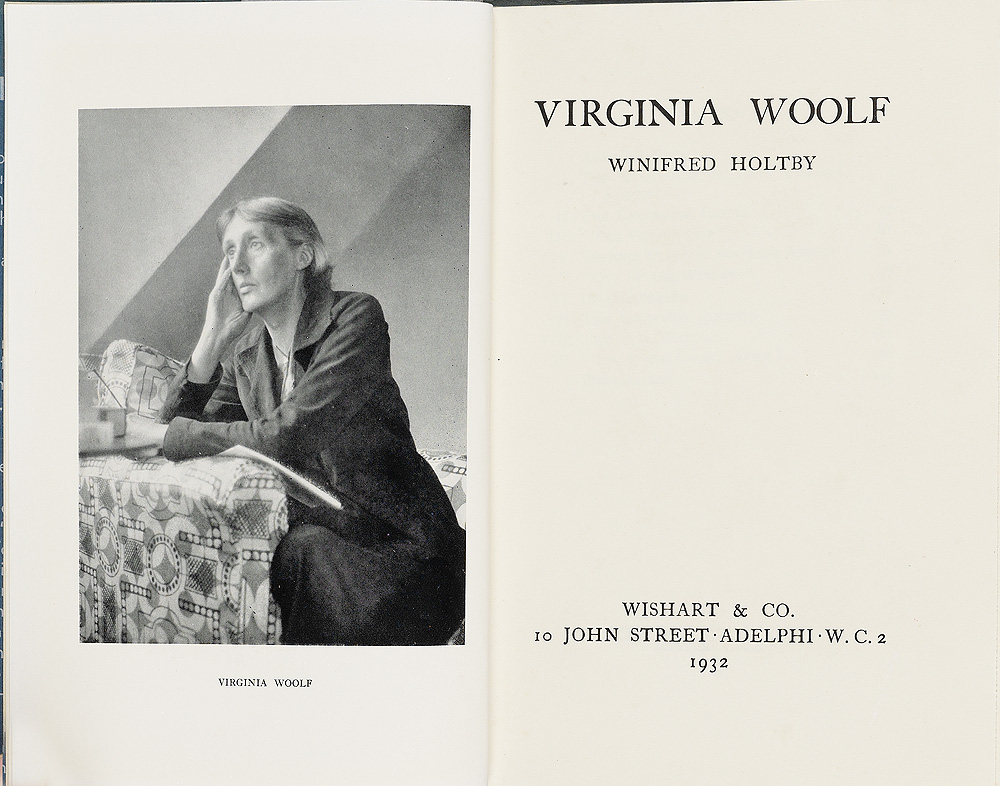
Woolf and Holtby met once in 1931 while Holtby was writing Virginia Woolf: A Critical Memoir. In her introductory note, she states that Woolf did not authorize the book or read the manuscript; that she asked only that Holtby “treat her work with the candour and impartiality applied by critics to the writings of the dead.”

Woolf, however, wrote to Ethel Smyth, expressing annoyance that Holtby was going to Smyth to verify facts. “Why doesn’t she send the biography straight to me … after all I’m the chief authority… Why she should impute such delicacy to me I can’t imagine. And she is far too kind, gentle, and well meaning to hurt a hair on the hinder leg of a fly” (Letter #2429, 6 Sept. 1931).

Indeed, Holtby expressed high praise for Woolf’s writing, calling To the Lighthouse “one of the most beautiful novels written in the English language.” She was disappointed in The Waves, however, and predicted a limited audience for future work, in spite of ranking Woolf beyond any other living writer and placing her “beside the work of the great masters.”

It is reported that Woolf wrote to Holtby in 1935 and asked if she would write an autobiography for Hogarth Press. I don’t find it among the collected letters—is there any record of it? Holtby declined, as she was not well and was writing South Riding at the time; she died shortly after its completion.

Read Full Post »

Dealing with a plagiarism case in one of my classes recently reminded me of how Mrs. Dalloway was examined for plagiarism when it was first published.

While I was heavily immersed in researching Mrs. Dalloway in graduate school, I discovered that, almost immediately, Woolf was accused of plagiarizing James Joyce’s novel Ulysses. Some of the critics who jumped in to attack Woolf included William Jenkins, Kelly Anspaugh and Hugh Kenner.

The most well known, at least to me, critic to accuse Woolf of stealing from Joyce was Wyndham Lewis, who wrote in 1934 that parts of Mrs. Dalloway were “exact and puerile copies” of Joyce’s novel. From what I saw, the majority of these attacks seemed to be more about personal issues with Woolf than any kind of intellectual criticism. In The Pseudo Homeric World of Mrs. Dalloway, Molly Hoff has more details about plagiarism accusations against Woolf and the history of plagiarism.

Read Full Post »

We are in the midst of the dog days of summer, so everyone is getting in on the reading — and reviewing — action. As a result, Virginia Woolf’s novels are being both praised (#15) and panned (#3).

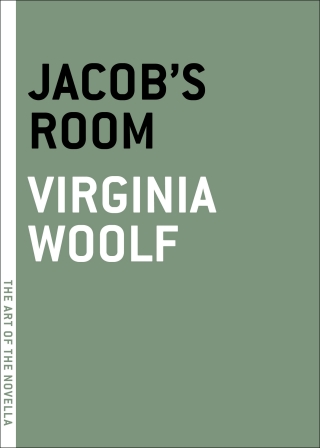
So I have to hand it to Heidi’s Books. Not only did she decide to start the Art of the Novella Reading Challenge with women writers. She decided to begin reading the 42 books in the series with Woolf’s Jacob’s Room.

But I can’t stop my praise there. Frances Evangelista of the Nonsuch Book blog, plans to read all 42 titles in the series this month and write a review of each on her literary blog. So far, she has kept her promise. She has posted 13 reviews.

Scroll down to #44 for more about Heidi.

  1. Neil Cooper Keith Bruce, Herald Scotland
    Once swept away, however, the party of the year erupts into life with a guest list of 20th-century icons including Edith Piaf, Frida Kahlo, a well-oiled Picasso, a soggy Virginia Woolf taking stones from her pockets, Neil Armstrong and Muhammed Ali.
  2. Coverboy: Mondo, Metro Weekly
    A framed photo of Helen Thomas, a trashy Virginia Woolf novel and a cheeseburger. Where do you keep the condoms and lube? 30 Rock. I relate a lot to Liz Lemon. What was your favorite cartoon when you were a kid? The Fairly OddParents.
  3. Tom Perrotta, Francine Prose, and others on “great books” that aren’t great., Slate Magazine
    But if I had to pick the most overrated of the last century, I would choose first Virginia Woolf: noxious smoke and dusty mirrors. Not far behind, and for completely different reasons, William Carlos Williams: So little depends on stuff lying around.
  4. Could This Kickstarter Project About Chris Crocker Yield the Definitive Doc of , Movieline
    Which is fab. 3. The mysterious black and purple cloak/dress he’s wearing at 2:37. Like something Virginia Woolf’s Orlando would wear in a low-budget remake without Tilda Swinton. And with Chris Crocker. I’m rooting for this. Don’t leave him alone.
  5. Summer reading: To the Lighthouse by Virginia Woolf, The Guardian (blog)
    I was camping in France after my first year at university, To the Lighthouse was on my summer reading list, and I clearly remember feeling startled by the time I had finished the first page. by Virginia Woolf Looking back at that opening now,
  6. Hoss Intropia Fall/Winter 2011 Lookbook, becomegorgeous.com
    Virginia Woolf said once that “dresses, though they may seem frivolous, have a much more important role then merely covering our body. They also change our vision of the world and the vision the world has of us”. Following this philosophy, the Spanish
  7. A very English modernism, Art Newspaper
    Whether the works of Betjeman, John Piper, Paul Nash, Eric Ravilious, Edward Bawden, the Sitwells, Virginia Woolf and Evelyn Waugh add up to a kind of soft modernism reflecting the English character and climate is an interesting question.
  8. Donnelly’s ‘Rose’ trilogy comes to its epic conclusion, The Daily News Online (blog)
    History and literature buffs will delight at cameos by Virginia Woolf, TE Lawrence and others. But whether readers are enamored of history or not, they are in for a smashing good story regardless.” Library Journal: “Donnelly skillfully integrates
  9. Lev Grossman on Exploring Magic, Moment by Moment, Wall Street Journal (blog)
    Speakeasy sat down with Grossman to discuss the new challenges his characters face in the sequel, how he began writing fantasy, and why Virginia Woolf is as much an influence on his work as JK Rowling. At the beginning of “The Magician King,” where do
  10. God Is a Character, New Yorker (blog)
    It seems apt that, in evoking the appeal of religion even to nonbelievers, Wood cites a work of art (in the event, Virginia Woolf’s “To the Lighthouse”). Art is the closest thing that atheists have to religion, and it’s the devotion to art that ought
  11. Stand With Yourself! Stunning Insights from the Remarkable Jayden Morris, Student Operated Press
    Random House published it and you were the next Virginia Woolf overnight. With performers and artists, the thought is much the same. In their `fairy-tale` they write a song, give a performance, and in less than a month they are the next `Lady Gaga,` or
  12. The Best Two Half-Decades in Literary History, Huffington Post (blog)
    Classics from that period by authors who entered the world in cooler months included James Joyce’s Ulysses (1922), F. Scott Fitzgerald’s The Great Gatsby (1925), Virginia Woolf’s Mrs. Dalloway (1925), LM Montgomery’s The Blue Castle (1926), Woolf’s To
  13. All of Edinburgh is a stage – even the loos, BBC News
    But men are also invited to catch the “chance meeting with Ophelia and Virginia Woolf“. Ms Lampard said: “Every man who has come in so far has commented on how exciting it is to be allowed into this sacred and secret space.” Another unusual location is
  14. Across the literary pages, Spectator.co.uk (blog)
    Something unpleasant in the woodshed: Rachel Cooke reveals what Virginia Woolf thought of Stella Gibbons’s comic masterpiece, Cold Comfort Farm. ‘In 1930 a young journalist called Stella Gibbons started a new job on the Lady, “the magazine for
  15. Lev Grossman, A.V. Club Chicago
    So for me, massively influential are obviously James Joyce, another reinterpreter of Homer, and Virginia Woolf. My prose comes more from the Americans, Ernest Hemingway and F. Scott Fitzgerald, rather obviously. The other influence is Evelyn Waugh.
  16. Holiday Reading, Daily Mail (blog)
    Joseph Conrad, TS Eliot and Virginia Woolf were kind about him. What’s more, his books sold enormously well on both sides of the Atlantic, he was knighted, and he became very rich, with a lovely Lakeland house in his favourite part of England,
  17. Secularism and its discontents., New Yorker
    I think of these anxieties as the Virginia Woolf Question, after a passage in that most metaphysical of novels “To the Lighthouse,” when the painter Lily Briscoe is at her easel, mourning her late friend Mrs. Ramsay. Next to her sits the poet,
  18. London site of Lawrence Durrell 100th anniversary celebration, Examiner.com
    Bloomsbury is a vibrant historic district made most famous by a group of turn-of-the-century writers that included Virginia Woolf and EM Forster (“Bloomsbury Set”), economist John Maynard Keynes and the artist Roger Fry. Goodenough College has been
  19. Posted On Sunday, August 07, 2011 at 07:50:22 PM, Bangalore Mirror
    In her wonderful book of essay-poems, Men in the Off Hours, poet Anne Carson begins with an essay called ‘Ordinary Time: Virginia Woolf and Thucydides on War’. Greek historian
    Thucydides wrote about the Peloponnesian War and in Book 2 of his History,
  20. Stella Gibbons: Cold Comfort Farm was just the beginning, The Guardian
    The following year the novel even won the Prix Étranger of the Prix Femina-Vie heureuse, a surprising literary award for a comic novel, and one that infuriated Virginia Woolf (“I was enraged to see they gave the £40 to Gibbons,” Woolf wrote to
  21. Unfaithful reader, The Hindu
    Carver and Chekhov Raymond Carver in turn loved Chekhov, another hero of mine, as did Virginia Woolf. This seemed to place them in a nice love triangle, which I, in love with the trio, felt was a good way for them to be. While Carver wrote of “the
  22. Happy 20th birthday, World Wide Web!, My Fox Boston
    you’re trolling on tumblr or parsing through Facebook today or working on that research paper about themes of mortality in Virginia Woolf’s Mrs. Dalloway, take a moment to thank Tim for making everyone’s favorite resource/time-killer/thing a reality.
  23. extended puberty without the blues, The Australian
    IN her 1924 essay Mr Bennett and Mrs Brown Virginia Woolf declared that “On or about December, 1910, human character changed”. Arch, polemical and disingenuous, the line nevertheless began an argument about character and
  24. Feminism today: The long and winding road, The Guardian (blog)
    And what on earth does Virginia Woolf have to do with Orwell? You may like her work or not but if you mean to suggest one is a pale shadow of the other then you clearly know little about it. Women have hardly ever been according equal rights and
  25. Excellence on Campus: Fairport, Penfield, Webster, Rochester, Rochester Democrat and Chronicle
    Quinton Saxby, son of Chantelle Saxby of Bloomfield, presented “Relational Selves in the Everyday: Virginia Woolf’s Depiction of the Conscious Power Struggle;” Ashley Wistner, daughter of Betsy and Shawn Wistner of Canandaigua, presented “Antisocial
  26. Expressway: Cabin, sweet log cabin, Newsday (subscription)
    While I agreed with Virginia Woolf on the necessity of having a room of one’s own, I knew that, for me, responsibility for family was paramount. My “room” was wherever I could grab a pencil and paper and write. Although happiness comes from within,
  27. Dominique Woolf packs a punch, Mirror.co.uk
    Raised by her father, Dominique is a distant relative of troubled writer Virginia Woolf. Until the age of nine she lived in the Middle East, where she made her TV debut singing with her dad. “It was on a show called Aunty Lucy, the equivalent of Blue
  28. This Season’s ‘Project Runway’ Includes A Local Face. Patch.com
    DE: Always in my mind are heroines of the past, Annie Oakley, Katherine Hepburn and Virginia Woolf. These strong women has served as my moral and style icons. DE: Beautiful, functional, empowering pieces that nod to my background in fine art and
  29. Sylvia Heisel, Paper No. 9′s Paper Dress Wears Away to Reveal Inspirational , Ecouterre (blog)
    As the dress reacts with body heat and friction over time, the top layers peel away to reveal hand-scrawled inspirational quotes from big thinkers like William Shakespeare, Virginia
    Woolf
    , Confucius, and even Tupac Shakur. Obviously this dress isn’t
  30. ‘The Cambridge Companion to the Literature of London’ book launches, Time Out London
    In short, we live in this city in a bookish way, haunted, seduced or cheered up by the characters we’ve met in novels, poems, plays and non-fiction – and when we walk around Bloomsbury or up Fleet Street we do so with Virginia Woolf and George Gissing.
  31. Theatre Ad Infinitum, The Skinny
    Here a woman sings a cappella about her life, depression and suicide, inspired to the works and lives of Sylvia Plath and Virginia Woolf. If Odyssey is a breathtaking proof of versatility by the performer, The Big Smoke’s dark, introspective narration
  32. Virginia Woolf’s Tips for Telling Loved Ones to Keep Their Day Jobs, The Atlantic Wire
    Virginia Woolf had this experience, and handled it quite well. In a letter released for the first time ever at The Paris Review, Woolf gently suggests to her favorite nephew, Julian Bell, that his poetry needs a bit of work. Monday. My dear Julian.
    Read More on Virginia’s letter to Julian–and a day at the beach
  33. My PC Needs , ESP, Slate Magazine
    It doesn’t just offer suggestions for keywords, as other browsers do, but actual results—when I type Virginia W, there’s a link to the Wikipedia entry on Virginia Woolf right there in the drop-down list. Google Instant, the search engine’s system to
  34. CanLit legend Frank Prewett’s aboriginal ancestry claims shot down by DNA, Vancouver Sun
    Nearly a century after ‘Toronto’ Prewett penned his best poems about the battlefield horrors he’d faced in wartime Europe — then befriended the likes of novelist Virginia Woolf, fellow soldier-poet Siegfried Sassoon and I, Claudius author Robert
  35. Preparing for Success, Huffington Post (blog)
    I end the class with a quote from Virginia Woolf: “The success of the masterpieces seems to lie not so much in their freedom from faults… but in the immense persuasiveness of a mind which has completely mastered its perspective.” What does that mean?
  36. When ‘Everything must go’ includes coffee, courtesy and jobs, Baltimore Sun
    Virginia Woolf. Or taking time to peruse the bargain book racks, with all the $9.99 children’s books about the universe or Learn to Play a Harmonica kits you could want. Where will I go to find cool last-minute birthday or Christmas presents that don’t
  37. First-time author Amor Towles debuts first novel ‘Rules of Civility,’ about NY , New
    York Daily News

    It was a time when, he says, “suddenly, you have James Joyce reinventing the novel with Virginia Woolf, and you have Picasso and the Dadaists and Nijinsky in dance, and atonal music, and the skyscraper is invented. … Almost every field of human
  38. The Stranger’s Child shows us that history is written in the margins, The Guardian
    In this context, I often recall the use of the first world war in Virginia Woolf’s To the
    Lighthouse. This first major global conflict happens in the margins of the pivotal central section, aptly titled “Time Passes”. Ten years elapse, and much happens
  39. Literary Life: July 31, Telegraph.co.uk
    They are all children’s stories written by, respectively, James Joyce, Mark Twain, Virginia Woolf and Mary Shelley. Publishers Weekly ranks them alongside TS Eliot’s Old Possum’s Book of Practical Cats and Oscar Wilde’s The Happy Prince.
  40. Mystery author Jane Cleland invites you to a public reading of her noir play, Examiner.com
    The title “The Writer’s Room,” harks back to a wonderful quote from Virginia Woolf. Writing in A Room of One’s Own, she said, “A woman must have money and a room of her own if she is to write fiction.” With thanks to the lovely Jane Cleland for
  41. Dog stories for the dog days of summer, Milwaukee Journal Sentinel (blog)
    Brenda Aloff’s “Canine Body Language: Intrepreting the Native Language of the Domestic Dog,” “The Dog Whisperer” by Paul Owens and “Shaggy Muses” by Maureen Adams (five
    women writers and their dogs, including Emily Dickinson and Virginia Woolf).
  42. Two Great Summer Reads, Patch.com
    I had very little trouble following the gist of the narration (Virginia Woolf, for example, is much more difficult). It unfolds like a puzzle that slowly and continuously reveals itself. I was at times bowled over by Egan’s beautiful prose.
  43. Marla Mase: The Goddess Continues to Inspire!, Student Operated Press
    And it would be incredibly horrific for the next Virginia Woolf to be stalled or unheard of because of this. Not only that, but Tinderbox also allocates some of its donations to the Willie
    Mae Rock Camp for Girls (http://williemaerockcamp.org/).
  44. Wine, tea, kindred spirits, and statistics… The Art of the Novella Reading , MobyLives
    Heidi’s Books is beginning the challenge with a reading/review of Virginia Woolf’s Jacob’s Room, accompanied by a cup of “China green tea with pineapple.” Words and Peace began with James Joyce’s The Dead. Ready When You Are, CB began with How the Two

Read Full Post »

Anne Fernald posted a message to the VWoolf Listserv directing us to Sarah Funke Butler’s post on The Paris Review website that discusses a letter Woolf wrote to her nephew Julian Bell in 1929.

Patricia Laurence, author of Julian Bell, The Violent Pacifist, a monograph in Cecil Woolf Publishers Bloomsbury Heritage Series, added her insights to the listserv discussion:

“The poem that Woolf refers to in her letter is probably “Chaffinches” published in the Songs for Sixpence Series, 1929, Cambridge. Julian’s early poetry was not marked by `modernist’ or `currency’ in subject, diction, rhythms or metres. His promise in `Chaffinches’ is marked rather by his Hopkinesque description of birds:

Startled, flock after springing flock they rise
With rustle of beating wings as as each flies
The sudden coverts flicker white,
In drooping, jerked finch flight
Of rise and fall: Stray chinking call.

“Nature description and the pastoral came naturally to him in poetry and letters, and when in Paris in 1930, `his first experience of a large town’, made him not a modernist but `fiercely naturalist….sending…[him] to watch all the gulls and sparrows of Paris.” Romanticism (what he viewed as “emotionalism”) and modernism (currency) were anathema to him, and the consciousness of “the chasm in the road’ after the Great War is absent from most of his poetry–though he is of the Auden generation.

“Nevertheless, though he may not have been as talented as others in Bloomsbury, he was not given much encouragement by his family.”

The letter is part of a Virginia Woolf collection currently held by Glenn Horowitz Bookseller, Inc., which features a photo titled Virginia Woolf Goes to the Beach on its home page.

Woolf items are featured in two of Horowitz’s catalogues: The Robert Reedman Collection of Virginia Woolf and Bloomsbury and Virginia & Leonard Woolf. The company also offers Vita Sackville-West and T.S. Eliot catalogues.

Read Full Post »

« Newer Posts - Older Posts »