Virginia Woolf is already a superhero at my house, but she may soon be one on the commercial market as well.
One day, as I sat at my laptop in a room of my own, my eight-year-old twin grandchildren pulled Virginia Woolf down from her shelf, grabbed Wonder Woman, and had the two battling each other, as well as Spiderman and Aquaman.
When Woolf seemed to be losing against the comic book heroes, I told my grandchildren that she had a superpower of her own: The power of the pen. That stopped them in their tracks.
Now a company called Little Giants is launching a Kickstarter campaign to fund a toy line that will include Nikola Tesla, Albert Einstein, Mahatma Ghandi and Andy Warhol.
Yes, all four figures are men — and three out of four are white. But the company says that if all goes well, it will add Woolf to the lineup, along with Frieda Kahlo.
I want to see that. And maybe my grandchildren will too.
The four walks feature 15 minutes of audio from a sometimes breathless Alexandra Harris as she follows Woolf across favorite paths, accompanied by such guests as Woolf biographer Hermione Lee and Scarlet Baron of University College London. The walks cover Woolf territory in Spain, Kensington Gardens, Cornwall and Sussex.
Harris’s audio includes background sounds — of seagulls, waves, boots crunching on the path — all set off by references to Woolf prose.
As writer Michael Bird says as he accompanies Harris on the Cornwall walk, “I brought my copy of To the Lighthouse and suddenly it makes sense.”
Local history is part of the programs, too, as the walkers discuss such things as the age of the cliffs and the reach of the Godrevy Lighthouse beam as they traipse along.
They also describe the scenery — from the mica particles in the rock to the shimmer of the water — as they speculate about Woolf’s walking habits.
The bit I have listened to so far has given me goose bumps. But of course I am touched by all things related to Virginia and her crowd. I even liked Life in Squares.
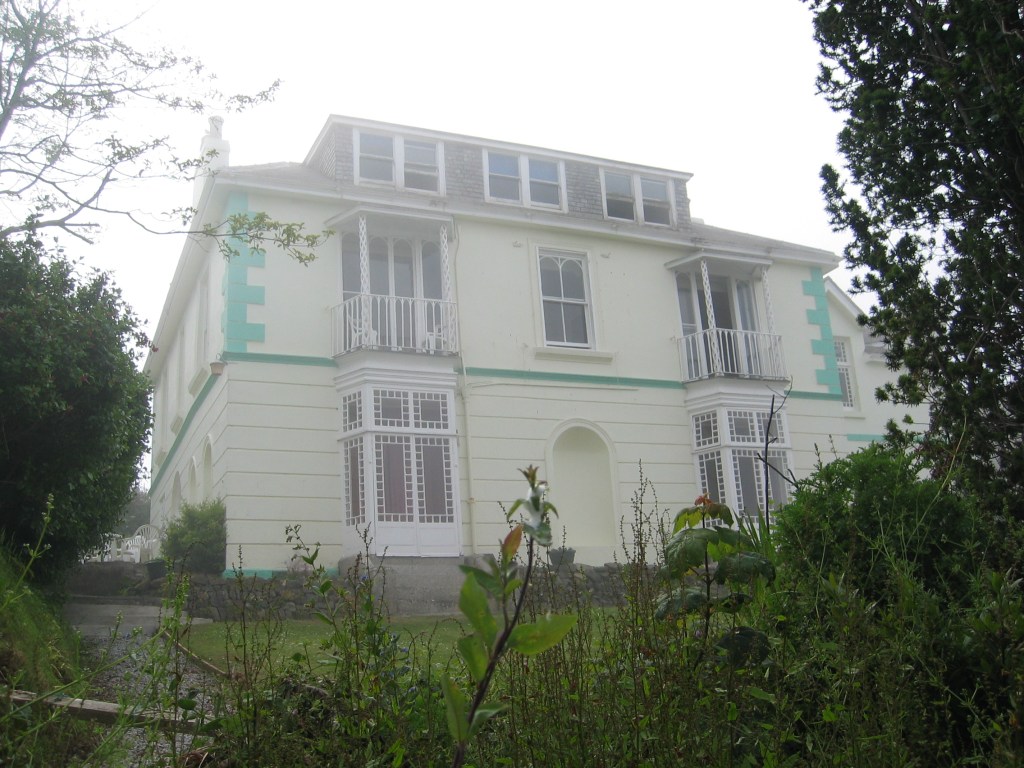
Encouraging news has arrived from the UK. The proposed development that threatened to destroy Virginia Woolf’s view of Godrevy Lighthouse from Talland House, has stalled.
The move comes after Woolf scholars and common readers from around the globe raised an outcry using email, social media and the Web. Their efforts generated media coverage that included the BBC and resulted in the Cornwall Council Planning Committee postponing its decision on the project.
Now a helpful source from Cornwall Council emailed this news to Woolf scholar Maggie Humm: “The application has been affected by the affordable housing changes…at this stage the application is not likely to go to the planning committee.”
Here’s what this means. In November 2014, the Conservative (Tory) Party ruled that developments of 10 or less could avoid paying an affordable-housing levy or offering any such housing in their development. Humm said this provision offered licence for any developer.
In early August, the High Court threw out this legislation, so the developer of the St. Ives project, which included a six-story block of six flats and a car park to be constructed in front of Talland House, must rethink the economic viability of the project and resubmit it.
In addition, a local resident forwarded Blogging Woolf an email from English Heritage saying legislation includes a provision to “avoid harm to the setting of a listed building if it contributes to the significance of the building.” Talland House is considered Grade II, which means it is “nationally important and of special interest. The St. Ives resident cited National Planning Framework Section 12 paras. 128,9,132 and noted that he would add this information to the planning comments page for the project, PA15/04337.
Woolf and her family summered at Talland House for the first 12 years of her life. The lighthouse she could see from her summer home plays an integral role in her famous novel To the Lighthouse (1927).
Plus here is more good news that indicates the St. Ives Town Council may be taking the preservation of local history more seriously: The Council recently voted down a different application to build on an ancient site.
Mentions of Virginia Woolf in all kinds of book reviews, interviews and essays are so frequent I tend to nod knowingly (maybe a little smugly) and move on. Perhaps we take them for granted because we already know she’s a literary touchstone, perhaps one of the most frequently mentioned.
But when I saw side by side references in last week’s New York Times Book Review and then another two in this week’s issue, I thought it was worth calling attention to them by virtue of their very frequency. My point being, it’s not going to lessen—Virginia Woolf will always be a reliable standard for critics and reviewers, essayists and novelists.
Here’s what I found in the Aug. 23 issue:
In a review of the new T.S. Eliot bio, Young Eliot by Robert Crawford, David Yezzi calls on Woolf’s description of Eliot and her observation that “There are some stories which have to be retold by each generation.”
On the facing page, David Shields reviewsPalimpsest: A History of the Written Word by Matthew Battles. According to Shields, there isn’t enough material for the book, “and perforce it becomes a dumping ground, with long, potted exegeses of works by Charles Dickens, Virginia Woolf and Ha Jin….”
Aug. 30:
The cover review is of the fourth novel in the Neopolitan saga by Elena Ferrante, The Story of the Lost Child. Reviewer Rachel Cusk, whose 2006 novel Arlington Park pays homage to Mrs Dalloway, notes that Lila, the secondary protagonist, “is the unwritten, unexpressed female potentiality, a more obstinate version of Virginia Woolf’s concept of Shakespeare’s sister.”
Ann Beattie is the featured subject of the “By the Book” feature. Asked about her favorite fictional hero, she cites “…Mrs. Ramsay, although she’d protest being called a ‘heroine’ for all good reason.”
Wait a minute–here’s one more. I skimmed through the just-arrived Aug. 31 issue of The New Yorkerover lunch. An op-ed piece about Hillary Clinton’s travails includes two references to “rooms of one’s own,” one by HC herself from her memoir, which the columnist reiterates in his closing sentence.
And so it goes. (That’s Linda Ellerbee, not Woolf.)