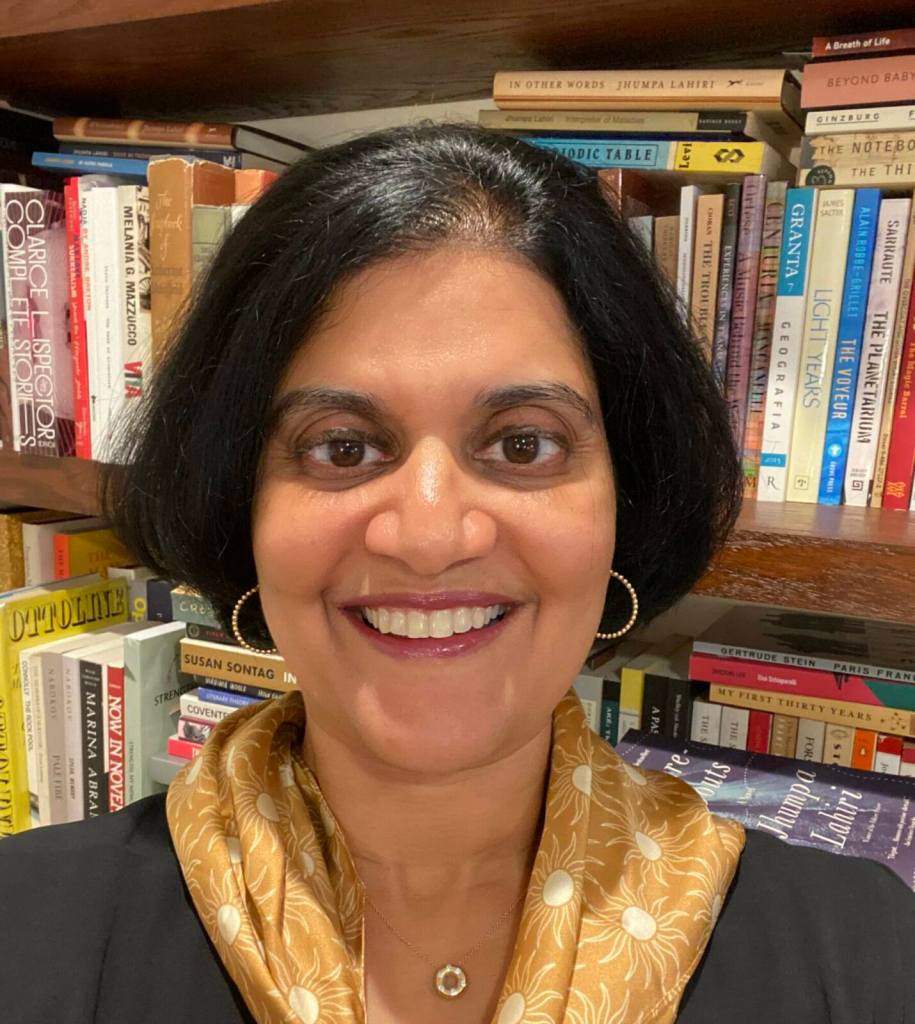
The reception of A Room of One’s Own in Egypt will be the topic for the fourth session of the A Room of One’s Own Around the Globe seminar on Thursday, Feb. 12, at 6 p.m. (CET) on Zoom, in English.
Who:Hala Kamal of the University of Cairo What: Presented in English, this fourth session of the “A Room of One’s Own Around the Globe” seminar will discuss the reception of Woolf’s 1929 polemic in Egypt. When: 6 p.m. CTE, noon. EST. Check your time zone. Where: On Zoom. Cost: Free and open to all. How: Log in at this Zoom link. ID meeting: 94948594890. Password: 244826
The A Room of One’s Own: Echos and circulation research project offers to take up Virginia Woolf’s landmark essay A Room of One’s Own (1929) and explore its full potential. One question it attempts to answer is what echo chambers has A Room of One’s Own opened up nearly a century after its publication?
Led by Valérie Favre (Université Paris 1 Panthéon-Sorbonne) and Anne-Laure Rigeade (Université Paris Est Créteil), this project will continue until 2029, the centenary of the publication of A Room of One’s Own, and will include seminars, a conference, and a collective publication.
Virginia Woolf’s reception in South Korea will be the topic for the third session of the A Room of One’s Own Around the Globe seminar on Thursday, Jan. 22, at 4 p.m. CET on Zoom.
Who:Boosung Kim and Hyunji Choi of Ewha Womans University What: Presented in English, this third session of the “A Room of One’s Own Around the Globe” seminar will discuss the reception of Woolf’s 1929 polemic in South Korea. When: 4 p.m. CTE, 10 a.m. EST. Check your time zone. Where: On Zoom. Cost: Free and open to all. How: Log in at this Zoom link. ID meeting: 949 4859 4890. Password: 244826
The A Room of One’s Own: Echos and circulation research project offers to take up Virginia Woolf’s landmark essay A Room of One’s Own (1929) and explore its full potential. One question it attempts to answer is what echo chambers has A Room of One’s Own opened up nearly a century after its publication?
Led by Valérie Favre (Université Paris 1 Panthéon-Sorbonne) and Anne-Laure Rigeade (Université Paris Est Créteil), this project will continue until 2029, the centenary of the publication of A Room of One’s Own, and will include seminars, a conference, and a collective publication.
Two Virginia Woolf events will take place this week, one on Thursday, one on Friday, and both on Zoom. In the first, Maria Oliviera discusses the reception of Woolf’s A Room of One’s Own (1929) in Brazil. In the second, Amy Smith considers Woolf’s critical engagement with Platonism in her 1919 novel Night and Day.
“A Room of One’s Own in Brazil” seminar
Who:Maria Oliviera, professor, Federal University of Paraiba What: This first session of the “A Room of One’s Own Around the Globe” seminar will discuss the reception of Woolf’s 1929 polemic in Brazil. Presented in English. When: 6 p.m. CTE; noon EST on Thursday, November 20. Check your time zone. Where: On Zoom. Free and open to all. Get more details:Get the Zoom link in order to attend.
About the project: The A Room of One’s Own : Echos and circulation research project offers to take up Virginia Woolf’s landmark essay A Room of One’s Own (1929) and explore its full potential. One question it attempts to answer is what echo chambers has A Room of One’s Own opened up nearly a century after its publication?
Led by Valérie Favre (Université Paris 1 Panthéon-Sorbonne) and Anne-Laure Rigeade (Université Paris Est Créteil), this project will continue until 2029, the centenary of the publication of A Room of One’s Own, and will include seminars, a conference, and a collective publication.
“‘Dreams and Realities’: Woolf’s Revisions to Plato in Night and Day — a talk
Who:Amy Smith, associate professor of English at Lamar University and author of Virginia Wool’s Mythic Method. What: A talk for the Virginia Woolf Society of Turkey titled “‘Dreams and Realities’: Woolf’s Revisions to Plato in Night and Day. Presented in English. When: 7 p.m. Turkey time on Friday, November 21. Where: On Zoom. Free and open to all. Get more details:Register online for the event in order to attend. The Zoom link will then be provided.
About the talk: The intellectual significance of Night and Day in Woolf’s development as a writer and thinker has long been overlooked. In her talk, Amy considers Woolf’s critical engagement with Platonism in the novel, where it appears both as a genre model and as a reservoir of imagery, to which Woolf makes polyvalent references that disrupt Platonic idealism. Woolf’s active wrestling with Plato suggests that she is processing and separating from early philosophical influences just as she is from her inherited models of love, marriage, and the correct life for a woman, and also from conventional models of writing in her emerging in her modernist stories and aesthetic theory. Equally important as the aesthetic and personal revolutions Woolf makes at this moment is her philosophical revolution, and wrestling with Plato is a necessary step in her development of a unique, mature philosophy of her own.
About the book: Amy’s book, Virginia Woolf’s Mythic Method, is also now available in paperback. Use code SMITH at http://www.ohiostatepress.org for 40% off the hardcover or paperback.
“Lock up your libraries if you like; but there is no gate, no lock, no bolt that you can set upon the freedom of my mind.” – Virginia Woolf, A Room of One’s Own, p. 76
Yesterday, after weeks of drought in Northeast Ohio, the skies clouded over and the rain came down as both a drizzle and a downpour, continuing all afternoon and into the evening. At last!
Although I considered staying cozy and dry at home, I had a meeting to attend. So I grabbed my raincoat, started my car, flipped on my wipers, and drove along streets shining wet with our much-needed rain.
When I arrived, I would find food. I would find wine. But more importantly, I would find a gathering of mostly women doing their best to resist the tyranny under which we are all living at this terrible time in the history of the United States of America.
Not in my lifetime
I have not been around forever, but I can say that we are living in a time like none I have experienced before.
Not during my childhood, when some whites and many Blacks of all ages lay their lives on the line to demand civil rights. Not during my college years, when students faced teargas (and in the case of Kent State University on May 4, 1970—bullets) to protest the Vietnam War and women of all ages marched for equal rights.
So it is no surprise that I—and many others—feel anxious. And afraid. And disillusioned, depressed, and angry. But many of us also feel resolute, determined, and strong. Because we are committed to the belief that wecan take our country back if we keep our minds free, keep the truth safe, and work together to take action.
Woolf’s words apply today
At this moment I find that Virginia Woolf’s words quoted above speak to me more than ever. They soothe my soul and give me hope that despite everything the felon’s regime is doing to destroy our freedoms, we will always have the freedom of our minds. That is the one thing that no one—not even autocrats—can control.
But here is how they persist in trying.
Libraries — and their books — under threat
Libraries are not locked yet, but they are under threat. Federal grant funding has been eliminated, and book bans are widespread.
School is back in session, but public schools, which Thomas Jefferson and John Adams believed were necessary for an educated populace and a successful democracy, are losing funding to unregulated charter and private schools through voucher programs pushed by the right.
In addition, our felon in chief has made it legal for individuals to donate up to $1,700 to an organization that supports private schools and take a 100 percent tax credit for their donation.
Our federal Department of Education is being dismantled. And diversity, equity, and inclusion programs have been banned across the board.
At the state level, Texas has mandated that some time each day be allotted to prayer and Bible study. Ohio has passed a law that requires schools to give students “release time” to attend religious instruction during school hours. And according to a Pew Research Report, “Just over half of U.S. adults (52%) say they favor allowing public school teachers to lead their classes in prayers that refer to Jesus.”
Colleges and universities are still open, although the felon’s administration has withheld or threatened to withhold billions of research dollars from Brown, Columbia, Cornell, Duke, Harvard, Northwestern, Penn, Princeton and the University of California, Los Angeles until they succumb to his demands.
Professors are still teaching, although they are being closely watched, with at least 60 of them suffering recent retaliation due to comments they made on social media regarding Charlie Kirk’s murder.
Campus women’s centers and LGBTQ+ centers closed before fall semester. And ethnic studies programs are either dead or under threat.
Media censored
The media—public broadcasting, legacy media, and the major television networks—are still functioning, although in the case of for-profit media, their hands are increasingly tied and their mouths shut so their business mergers will receive government approval.
The felon’s toadies in Congress cut $1.1 billion of funding for NPR and PBS this year. The felon himself filed lawsuits against the New York Times, Washington Post, Wall Street Journal, CBS News (Paramount), and ABC News for simply reporting news he did not like.
And two of the main comedic truth tellers of our time—late night TV hosts Stephen Colbert (CBS) and Jimmy Kimmel (ABC)—have either had their show’s tenure cut short or suspended because they dared to criticize the felon in the White House.
Woolf’s eternal relevance
Today, in the face of this rising tide of autocratic populism, Woolf is more relevant than ever. Her methods of thinking, reading, and writing—as both critic and creator—remain effective fighting tools for us today and into the future.
Like her, we must value and preserve the freedom of our minds, so we can wage a smart fight against those who would take away our freedoms. As Woolf wrote in her diary during World War II:
“This idea struck me: the army is the body: I am the brain. Thinking is my fighting” (D5 285).
And so we must do as Woolf advised in Three Guineas (1938):
Think we must. Let us think in offices; in omnibuses; while we are standing in the crowd watching Coronations and Lord Mayor’s Shows; let us think as we pass the Cenotaph; and in Whitehall; in the gallery of the House of Commons; in the Law Courts; let us think at baptisms and marriages and funerals. Let us never cease from thinking – what is this ‘civilization’ in which we find ourselves? (62-3)
We must use our thinking to resist the horrors we confront in the news each day, as Woolf did in the face of even graver threats. For ignorance is the handmaiden of tyranny—and we will never become handmaids.
Join Literature Cambridge September 2025 to June 2026 for a live online season of lectures and seminars on the major works of Virginia Woolf on the theme of Woolf’s Rooms.
A table and six painted chairs with needlework panels designed by Vanessa Bell dominate the dining room at Monk’s House.
Rooms are important in all of Woolf’s novels. The seminars in this season, season six, will explore the ways in which rooms shape, or contain, the human lives within them.
How do people connect (or not) in Mrs Dalloway’s party room?
Why is the dining room so important in To the Lighthouse (1927)?
What happens in the many rooms in The Waves (1931) and The Years (1937)?
And why is it so important for a woman to have a room of her own?
Woolf’s Rooms Schedule
Woolf’s Rooms sessions are all at 18.00-20.00 p.m. British time and are offered live online via Zoom. Most are on Saturdays, but please note that the first session* is on a Sunday.
Summer Time and Greenwich Mean Time: Please note that clocks in Britain are on Summer Time in September 2025, and change to Greenwich Mean Time on 26 October 2025. In spring 2026, the clocks change from GMT to Summer Time on 29 March 2026.
• *Sunday 21 September: Lecture 1, Trudi Tate, To the Lighthouse (1927): The Dinner Party.
• Saturday 18 October: Lecture 2, Frances Spalding, A Walk Around A Room of One’s Own (1929).
• Saturday 15 November: Lecture 3, Natasha Periyan on Rooms in Woolf’s Short Fiction (Set reading: KewGardens and Other Short Fiction).
• Saturday 6 December: Lecture 4, Alison Hennegan on Rooms for Women in A Room of One’s Own (1929).
• Saturday 10 January 2026: Lecture 5, Beth Daugherty on Room to Think in Woolf’s Essays.
• Saturday 21 February 2026: Lecture 6, Karina Jakubowicz on Jacob’s Room (1922).
• Saturday 21 March 2026: Lecture 7, Claire Davison on Orlando’s Rooms (1929)
• Saturday 18 April 2026: Lecture 8, Angela Harris on Rooms in Mrs Dalloway (1925).
• Saturday 16 May 2026: Lecture 9, Trudi Tate on Rooms in The Years (1937).
• Saturday 13 June 2026: Lecture 10, Ellie Mitchell on Rooms in The Waves (1931).
Prices and how to book
Book all 10 sessions for the price of nine. Offer closes Sunday 21 September at 16.00 British Summer Time (just before the first lecture).
Individual lectures
£33.00 full price
£28.00 Students on a low income
£28.00 CAMcard holders
£28.00 Members of the VWSGB
Full season
£297 Full price for all 10 sessions (save £33)
£252 Students and CAMcard holders for all 10 sessions (save £28)
£252 Members VWSGB for all 10 sessions (save £28)
All prices include VAT at 20%
Recordings available
Each lecture will be recorded live and will be available to participants after the live event for 48 hours. Literature Cambridge hopes this will be helpful to participants in various time zones, and to those who want to hear the lecture again. The recordings are available only to people who have booked the session. The seminars are not recorded.
Virginia Woolf’s bedroom at Monk’s House in Sussex