Feeds:
Posts
Comments

Archive for the ‘contemporary fiction’ Category

Back in December 2008, I asked Blogging Woolf readers if they would send me references to Woolf that they come across in fiction. I didn’t realize at the time just how many of these literary allusions I would find or how fascinating and absorbing my research would be.

This exploration was initially for my paper at the 2009 Virginia Woolf Conference, and from that evolved a recently-published monograph, Beyond the Icon: Virginia Woolf in Contemporary Fiction, part of the Bloomsbury Heritage Series from Cecil Woolf Publishers.

In this work, I discuss more than thirty such references, exploring context and intertextuality, and coming to the conclusion that Woolf is alive and well in the minds of contemporary authors. Their use of her life and work as points of reference is more than just name-dropping and more, as my title indicates, than part of the Woolf as icon phenomenon.

While it’s time to move on to other projects, my interest in Woolf “sightings” in fiction doesn’t show any signs of abating, and the references continue to accumulate. I’m not sure what I will do with them, but that’s not going to stop me from following up on leads and hunting them down.

Since my monograph was finalized, I’ve already found another dozen or so references, a couple of which I’ve posted here, including one on Jane Gardam and another on Olivia Manning. The newest finds represent an amazing array of work, ranging from the elegant prose of Penelope Lively, to a quirky story in The New Yorker (June 7, 2010) by Jeffrey Eugenides, to a romp of a “beach read,” Literacy and Longing in L.A. by Jennifer Kaufman and Karen Mack.

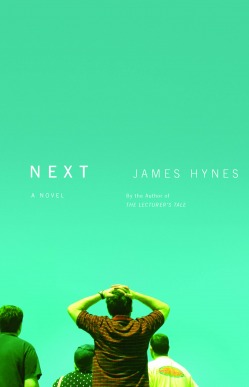
I just came across a new novel with three epigraphs, one from Woolf’s diary, another from Mrs. Dalloway, and the third from the character portrayed by James Coburn in the movie Pat Garrett and Billy the Kid: “Comes an age in a man’s life when he don’t want to spend time figuring what comes next.”

My curiosity is piqued—I’ll have to read Next by James Hynes to see what he’s trying to evoke with these quotations. And perhaps I’ll start collecting Woolf epigraphs too (there’s already one in Oryx and Crake by Margaret Atwood).

Read Full Post »

Finding MyselfI just finished reading something wild and wicked, wonderful and Woolfian. Knowing that I’m always looking for fiction with Woolf references, Beth Hicks (an Australian friend and Woolfophile) told me about Toby Litt’s Finding Myself, a 2003 novel about a novelist who is writing a novel called From the Lighthouse.

Victoria plans to invite a group of acquaintances to spend a month together, all expenses paid, during which she will observe them, with their consent, and write about them. This book is her manuscript, her “docu-novel,” with handwritten comments and deletions from her editor.

She finds a house on the Suffolk coast with not just a lighthouse, but “all the atmosphere one could desire. I kept expecting Virginia Woolf herself to waft round the corner, silk gloves in hand.”

She buys copies of To the Lighthouse for everyone to read for what she envisions as “an extended discussion of Virginia’s masterpiece, all secretly examining the parallels with our own relationships.” And she will, on their last evening, serve boeuf en daube.

She notes in her diary that if it comes out right, it will be “just the best beach book in the world, ever: naughty, gossipy—with just the right ratio of tittle to tattle. Virginia Woolf’s letters are all very well, but they don’t exactly make one throb, do they?”

Woolf is Victoria’s muse and is never far from her mind. When the guests decide to go to church, she is dismayed: “We’re meant to be the Bloomsbury set—who would never have been caught engaging in Anglicanism.”

Writing her notes by hand “seems more fitting to the spirit of Virginia” when necessitated by a computer malfunction. But from the start, the experiment fails to live up to Victoria’s expectations, and a hilarious romp ensues.

Read Full Post »

Oryx and CrakeOryx and Crake, Margaret Atwood’s terrifying picture of the future run amok, starts with an epigraph from To the Lighthouse: “Was there no safety? No learning by heart of the ways of the world? No guide, no shelter, but all was miracle and leaping from the pinnacle of a tower into the air?”

Woolf appears in two seemingly inconsequential instances of name-dropping that nevertheless help establish and substantiate Jimmy/Snowman’s literary background. Recalling great human achievements, all of which were relegated to the distant past, he recites a list to help commit them to memory: “The Divine Comedy. Greek statuary. Aqueducts. Paradise Lost. Mozart’s music. Shakespeare, complete works. The Brontes. Tolstoy. The Pearl Mosque. Chartres Cathedral. Bach. Rembrandt. Verdi. Joyce. Penicillin. Keats. Turner. Heart transplants. Polio vaccine. Berlioz. Baudelaire. Bartok. Yeats. Woolf” (79).

Recalling his university days at The Martha Graham Academy, “named after some gory old dance goddess of the twentieth century” (186), he explains that there was no longer a need for film-making and video arts, as anyone could splice together or digitally alter whatever they wanted. “Jimmy himself had put together a naked Pride and Prejudice and a naked To the Lighthouse, just for laughs” (187).

Also notable is a passage that evokes the interludes that begin each section of The Waves: “The sun is above the horizon, lifting steadily as if on a pulley; flattish clouds, pink and purple on top and golden underneath, stand still in the sky around it. The waves are waving, up down up down” (147).

In an essay written not long before Oryx and Crake, Atwood describes rereading To the Lighthouse in her early sixties, appreciating it in ways that she couldn’t when she first read it at the age of 19. She remarks on the patterns, the artistry, the resonance, “the way time passes over everything like a cloud, and solid objects flicker and dissolve” (Writing with Intent, 241-242). Little wonder that it left an impression that showed up in her next and perhaps most ambitious novel.

Read Full Post »

white gardenThe White Garden: A Novel of Virginia Woolf by Stephanie Barron, author of a mystery series based on Jane Austen, examines Woolf’s death from the vantage point of present-day England.

According to Publisher’s Weekly, the story begins when American Jo Bellamy sets out to study the White Garden at the Sissinghurst estate of Vita Sackville-West. Bellamy is working for Long Island clients who want to recreate it and also wants to figure out why her grandfather, who worked at the garden as a youth, killed himself.

The story line includes a journal that may be Woolf’s work and a wild tour of Woolf’s stomping grounds to track down answers to questions and missing journal pages.

“While leaning on convenient stereotypes—the headstrong but clueless American; the femme fatale (with eyes like “liquid pools”); stuffy Brits—Barron invests the text with a quick pace and an absorbing plot, making this a dynamic thriller with a well-tempered literary fixation,” Publisher’s Weekly relates.

The novel is expected to be out in bookstores in September.

Update: Read reviews of Barron’s novel in January magazine and the L.A. Times.

Read Full Post »

brookner

Anita Brookner

Anita Brookner published her first novel in 1981 at the age of 53, following with one a year until 2000 when she slowed down just a bit. Her 25th novel, Strangers, was released this year.

She rejects feminism, and her protagonists are very traditional, but sometimes they make surprisingly independent and unorthodox choices.

Virginia Woolf appears in at least two of her novels, once as a significant icon and once in passing, both references adding flavor to the stories.

Hotel du Lac

hotel du lacEdith Hope is a romance writer with the pen name of Vanessa Wilde. People have noted her resemblance to Virginia Woolf, including her publisher, who says: “She really does look remarkably Bloomsburian…the hollowed cheeks and the pursed lips.”

Her life in disarray, she retreats to a Swiss resort and its eclectic cast of characters. A man says, “Whoever told you that you looked like Virginia Woolf did you a grave disservice, although I suppose you thought it was a compliment.” Edith prefers men to women, and favors the work of Colette and Henry James. Yet she is proud that she earns her own money, and she rejects the opportunity for a conventional life of comfort and ease.

Undue Influence

undue influenceClaire faces her future after her mother’s death, content to take life as it comes: her job in a Bloomsbury bookshop, involvement with the lifeless Martin. Claire’s opening line is a hook: “It is my conviction that everyone is profoundly eccentric.” She admits to making hasty assessments as a result of observing rather than participating in life, but her bland façade hides secrets.

Claire says of the bookshop owners: “I was surprised that they…always had lived in Bloomsbury. But I suppose that what was once an accident of geography had hardened over the years to a conviction that he was part of a ‘set’, an authentic Bloomsburian. Whether [Virginia Woolf] ever noticed him when they passed in the street, as they must have done on occasions, would have been highly unlikely.”

The Debut

debutI reread Brookner’s first novel, with another woeful protagonist and dutiful daughter, and another great opening line (“Dr. Weiss, at forty, knew that her life had been ruined by literature”), wondering if I might find a forgotten reference to Virginia Woolf.

Woolf didn’t appear, but Ruth Weiss, an authority on women in Balzac, seems the academic counterpart to Edith Hope. “Her appearance and character were exactly halfway between the nineteenth and twentieth centuries; she was scrupulous, passionate, thoughtful, and given to self-analysis, but her colleagues thought her merely scrupulous…” She is often sidelined by the exploits of her manipulative parents and escapes for a time to Paris to pursue her Balzac studies.

Read Full Post »

« Newer Posts - Older Posts »