Feeds:
Posts
Comments

Archive for the ‘in memoriam’ Category

David Bradshaw, professor of English literature at Worcester College at Oxford University and a plenary speaker at the 26th Annual International Conference on Virginia Woolf held June 16-19 at Leeds Trinity University, died Sept. 13. He had been ill with cancer.

David Bradshaw at his plenary talk at this year's Virginia Woolf conference.

David Bradshaw giving his plenary talk at this year’s Virginia Woolf conference at Leeds Trinity University.

At the conference, Mr. Bradshaw gave a talk titled “‘The Very Centre of the Very Centre’: Herbert Fisher, Oxbridge and ‘That Great Patriarchal Machine’.” In his talk, he quoted Woolf as saying that her contact with Fisher “brought back my parents more than anyone else I knew.”

Vara Neverow, editor of the Virginia Woolf Miscellany, invites those who knew Mr. Bradshaw to share their memories of him for that publication. “The publication of such recollections would be much valued by others, whether they knew David himself or knew only his scholarship,” she wrote in a message to the VWoolf Listserv.

Tributes to Mr. Bradshaw, who has been called “one of the great recent scholars of modernism,” prevailed on the list after news of his death was announced. Here are just a few:

I miss him already – Bonnie Scott

Just joining in the chorus of sorry over this sad news. I had heard he was ill but, I regret to say that I cherished the luxury of denial. I’m just so very very sad. He was such a funny, warm, silly, vital, brilliant, generous person. It was always a joy to see him and I learned so much from him. To this day, whenever I give a paper I remember his admonishment to himself once–“don’t get distracted, David,”–which he uttered aloud to great effect years ago. Sharing his digressive streak, I loved that so much. And, of course, almost every note of his Dalloway appears, with credit, in my edition. I owe him so much. What a terrible loss. – Anne Fernald

His plenary at Leeds was special. I have often and continue to teach from his considerable body of work. This is a terribly sad loss. My heart goes out to his family and many friends. – Jean Mills

Such an unbelievably sad loss. A superb scholar and wonderfully witty and generous man. – Maggie Humm

His colleagues in the Complete Works of Evelyn Waugh project also posted their tributes on the Waugh and Words blog on the University of Leicester website.

Mr. Bradshaw specialized in late nineteenth- and early twentieth-century literature and had written many articles on literature, politics and ideas in the period 1880-1945, especially in relation to the work of Virginia Woolf, T. S. Eliot, Aldous Huxley and W. B. Yeats, according to the Worcester College website.

His current projects included an edition of Woolf’s Jacob’s Room (CUP) with Stuart N. Clarke and a monograph “in train” that he said “will examine the ways in which Woolf, Waugh and Huxley challenged the culture of their time through their provocative engagement with the obscene.”

His books related to Woolf include:

  • (Ed.) Virginia Woolf, The Waves, `Oxford’s World’s Classics’ series (Oxford: Oxford University Press, 2015).
  • (Ed., with Stuart N. Clarke) Virginia Woolf, A Room of One’s Own, Shakespeare Head Press Edition of Virginia Woolf (Chichester and Malden, MA: Wiley-Blackwell, 2015).
  • (Ed., with Ian Blyth) Virginia Woolf, The Years, Shakespeare Head Press Edition of Virginia Woolf (Chichester and Malden, MA: Wiley-Blackwell, 2012).
  • (Ed.) Virginia Woolf, Selected Essays, `Oxford’s World’s Classics’ series (Oxford: Oxford University Press, 2008).
  • (Ed.) The Cambridge Companion to E. M. Forster (Cambridge: Cambridge University Press, 2007). I also contributed the chapter on `Howards End’ (see below).
  • (Ed.) Virginia Woolf, To the Lighthouse, `Oxford’s World’s Classics’ series (Oxford: Oxford University Press, 2006).
  • (Ed.) Virginia Woolf, Carlyle’s House and Other Sketches (London: Hesperus, 2003). Incorporated into the 2nd, rev. ed. ofA Passionate Apprentice: The Early Journals of Virginia Woolf, ed. Mitchell A. Leaska (London: Pimlico, 2004).
  • Winking, Buzzing, Carpet-Beating: Reading `Jacob’s Room’, 4th Annual Virginia Woolf Society of Great Britain Birthday Lecture (Southport: Virginia Woolf Society of Great Britain, 2003).
  • (Ed.) Virginia Woolf, Mrs Dalloway, `Oxford’s World’s Classics’ series (Oxford: Oxford University Press, 2000).

His articles related to Woolf include:

David Bradshaw (center front) with colleagues at the 26th Annual International Conference on Virginia Woolf, held June 16-19 at Leeds Trinity University

Read Full Post »

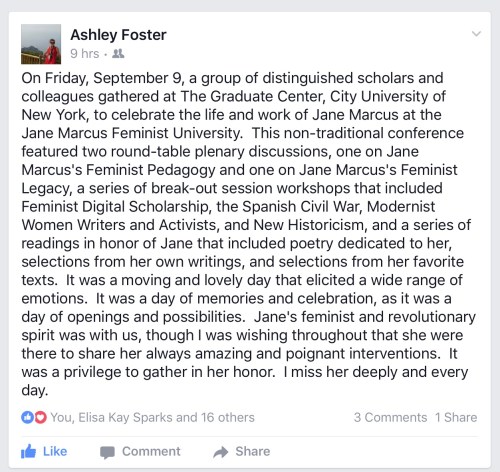
The late Jane Marcus, a revered feminist scholar whose seminal work established Virginia Woolf as a major canonical writer, was honored Sept. 9 with a day-long event organized by her former students and dubbed Jane Marcus Feminist University.

The day included breakout workshops, plenary roundtables and a reception in Marcus’s honor with time for sharing reminiscences and memories. It was held at The Center for the Humanities at The Graduate Center, CUNY.

Topics included:

  • Modernist Women Writers and Activists
  • The Spanish Civil War
  • Feminist Digital Pedagogy
  • Jane’s Scholarly Legacy
  • Jane’s Reading List

Speakers included:

  • Amanda Golden
  • Margaret Carson
  • Conor Tomás Reed
  • Cori L. Gabbard
  • J. Ashley Foster
  • Blanche Wiesen Cook
  • Jean Mills
  • Meena Alexander
  • Mary Ann Caws

For the full program and list of speakers, visit the event website.

According to Vara Neverow, who attended: “I felt very privileged to be able attend. Of the 50 or so people who came to the event, most were Jane Marcus’s former students or her long-term colleagues and friends in the world of scholarship and of them, many were Woolfians (and many of the Woolfians were members of the IVWS). Also attending the event were Michael Marcus, Jane’s husband, and Ben Marcus, her son. Her daughter, Lisa Marcus, was able to participate via a live feed. I wish that everyone who had known Jane, had met Jane even once or had been inspired by her work could have been able to attend.

“I was very glad to discover that Jean Mills is working directly with Michael Marcus on organizing and reviewing Jane’s unpublished work. Thus, we can hope that some of Jane’s scholarly endeavors will be published posthumously. Jane’s contributions to Woolf studies brought into focus the Virginia Woolf we know as a feminist, a pacifist, and a socialist. Jane’s scholarly impact was both immeasurable and invaluable,” Neverow added. 

She also provided these links:

Marcus, distinguished professor emerita at CUNY and author of so much ground-breaking scholarship on Virginia Woolf, Rebecca West, feminism, modernism and other topics, died May 28, 2015, at the age of 76. At the time of her death and at the 2015 Woolf conference in Bloomsburg, Pa., scholars and students paid tribute to Marcus for her scholarship, her feminist integrity and the relationships she nurtured with students and colleagues.

Here’s an update posted today by organizer Ashley Foster:

Conference organizers J. Ashley Foster, Cori Gabbard, and Conor Tomás Reed . Photo by Vara Neverow.


Read Full Post »

Kristin Czarnecki, president of the International Virginia Woolf Society, posted the note below on Facebook today to commemorate the 75th anniversary of Virginia Woolf’s death.

To read more about her last note, as well as its social, literary, cultural and scientific contexts, visit this page on the Smith College website.

“On the 75th anniversary of Virginia Woolf’s death, one of my favorite passages from Mrs. Dalloway from one of the most remarkable characters ever created:

Why then rage and prophesy? Why fly scourged and outcast? Why be made to tremble and sob by the clouds? Why seek truths and deliver messages when Rezia sat sticking pins into the front of her dress, and Mrs. Peters was in Hull? Miracles, revelations, agonies, loneliness, falling through the sea, down, down into the flames, all were burnt out, for he had a sense, as he watched Rezia trimming the straw hat for Mrs. Peters, of a coverlet of flowers.

R.I.P. Virginia–and Septimus.

And on Twitter:

Read Full Post »

Jane Marcus, distinguished professor emerita at CUNY and author of so much ground-breaking scholarship on Virginia Woolf, Rebecca West, feminism, modernism and other topics, died May 28 at the age of 76. The news was announced by her son Ben. Since then, tributes to her have come in via the VWoolf Listserv, Facebook and Twitter.

Jane Marcus: 1938-2015

From Jean Mills:

She was a giant upon whose shoulders we all stand. Jane Marcus asked the important questions. Go back. Re-read her. All of it. There are gems to be mined there that will guide you, test you, frustrate you, but demand that you rethink possible. Her work will remain generative, bold, and meaningful to our own questions and research as we stay up late reading and writing forgetful of the tea kettle on the stove …but somehow certain that we’re on to something, something that matters.

From Christine Froula:

What very sad news. Jane’s pioneering scholarship and devoted teaching as well as her kindness and generosity have encouraged and inspired countless scholars of Woolf, Elizabeth Robins, feminism, modernism, and much more, and the enduring legacy of her own work will keep her spirit alive. We will miss you, Jane.

From Lauren Elkin:

It’s such a loss I don’t even know what to say, apart from simply that she was my mentor, and she taught me how to read, and how to be fierce. I hope I can live up to that legacy with my own students.

From Jan McVicker:

This is very sad news. Jane Marcus was a passionate thinker and her generosity was legend. I imagine there will be a tribute to her memory and legacy at the upcoming conference? I would be willing to help. Condolences to those who knew her well and to her family.

From Elisa Kay Sparks:

In her 1982 ground-breaking critique of traditional approaches to Virginia Woolf, “Storming the Toolshed,” Jane Marcus wrote: “It is an open secret that Virginia Woolf’s literary estate is hostile to feminist critics. There are two taboo subjects: on one hand her lesbian identity, woman-centered life, and feminist work, and on the other, her socialist politics. If you wish to discover the truth regarding these issues, you will have a long, hard struggle. In that struggle you will find the sisterhood of feminist Woolf scholarship” (Signs 13.1, p. 628). The degree to which those two subjects now provide the cornerstones of international Virginia Woolf studies is largely due to Jane Marcus’s long, hard years of struggle to document the full political and social context of Woolf’s writing. We are all forever in her debt.

From Bonnie Scott:

Jane was so many things to so many people, and to the authors she helped us see anew.  Her passion for following new lines of investigation was infectious, and she supported what she inspired?something I came to greatly appreciated when studying Rebecca West. I feel both bereft and blessed this morning.  Much love to the family she was so justly proud of.

From Diana Swanson:

She was and is an inspiration and one of the founding mothers of feminist scholarship and Woolf scholarship. Her contributions are incalculable.

From Allison Lin:

We will miss you, Jane… a wonderful Woolf scholar.

From Angeliki Spiropoulou:

Very sad news indeed. Her work is foundational.

From an unidentified member of the list:

This is terrible news — my very, very best to those who knew her well. Her work has been magnificent; and the generosity and real, insightful interest with which she engaged inexperienced young scholars, and normalized that interest, was wonderful. And she coined “the Virginia Woolf Soap Operas”! She will be missed so much.

I cut my teeth on Jane’s work when I was a fledgling graduate student working on my master’s in liberal studies with a focus on Woolf. I particularly appreciated her work on Woolf and anger, since that is a topic that continues to resonate. Though I never met her in person, I will miss her as well.

Added June 10, 2015:

Read Full Post »

It was 74 years ago today, on March 28, 1941, that Virginia Woolf left two suicide notes behind, walked out of Monk’s House and across the Sussex Downs and headed for the River Ouse. With a stone in her coat pocket, she waded into the river and drowned. She is still missed today.

Past tributes

Many tributes have been made to her on the anniversary of her death. Eight years ago, a video, The Adventures of Virginia Woolf, was posted on YouTube that speculates on what Woolf would have accomplished if she had chosen to live on that fateful date in March of 1941.

Four years ago, the Elite Theatre Company presented the world premiere of Arthur Kraft’s  drama “Goat,” about what might have happened if a psychologist had prevented Woolf’s suicide.

That same year, her great niece, Emma Woolf, wrote an article for The Independent, “Literary haunts: Virginia’s London walks,” that speculated about what Virginia Woolf would have thought of today’s London.

“The Writer’s Almanac” has payed tribute to her.

Tributes this year

And each year on this day, social media lights up with posts that commemorate her life, her work and her death, making Woolf a trending topic. One example is @HistoryTime_’s Twitter post below that features a photograph of The New York Times coverage of her death.

The most notable piece so far this year is Maria Popova’s critique of the media treatment of Woolf’s death 75 years ago in her post on Brain Pickings: “March 28, 1941: Virginia Woolf’s Suicide Letter and Its Cruel Misinterpretation in the Media.”

The perfect accompaniment to that is the video of actress Louise Brealey’s poignant reading of Woolf’s last letter to Leonard, which is posted on The Telegraph website. A video of Brealey reading the letter at the Hay Festival is also available on YouTube, but the audio is not as pristine.

Screenshot of Louise Brealey reading Woolf’s last letter on The Telegraph website.


Read Full Post »

« Newer Posts - Older Posts »