Feeds:
Posts
Comments

Archive for the ‘On Being Ill’ Category

Editor’s Note: As an introduction to the upcoming 34th  Annual International Conference on Virginia Woolf: “Woolf and Dissidence,” set for July 4-8 at King’s College London and the University of Sussex, England, we offer the first in a series of four posts in which Leanne Oden and Serena Wong reflect on their encounters with Virginia Woolf and with Woolf scholars — dubbed Woolfians — that they met at the 33rd Annual International Conference on Virginia Woolf: Woolf, Modernity, Technology, held June 6-9, 2024, at Fresno State University.

“Arrange whatever pieces come your way”—Virginia Woolf, A Writer’s Diary

This first piece of our four-part reflection series on the 2024 Woolf conference introduces the ways in which we each found our paths to Woolf, and subsequently the approaches we respectively took going into the conference.

Leanne Oden, Serena Wong, and Jessica Kim, all first-time Woolf Conference attendees. Photo courtesy of Benjamin Hagen.

Though our interests may differ, there are common grounds in our experiences – Mrs. Dalloway has served as the starting text to our research as Woolfians, and we were both contemplating on notions of illness when first arriving at Fresno.

When we met on the first day of the Woolf conference, therefore, we found our interests enhanced by the nuances of each other’s research perspectives. The dynamic that emerged from our conversations, which led to a fast friendship, mirrors the vibrant cohesion that marks the Woolf community at large.

This collaborative series is a tribute to the generations of multifaceted Woolf exchanges that we hope our contribution will continue to add to and encourage.

For of course there is not one reflection but an almost infinite number” –Virginia Woolf, “The Mark on the Wall” (1917)

Leanne on encountering Woolf: illness vs. health

By Leanne Oden, Ph.D. Student, University of Rhode Island

Leanne Oden

As inspired by Sonita Sarker’s keynote presentation “Teks, Technê, Technology: Woolf as Modernist Icon,” I open this contribution with a reflection on who I need Woolf to be and the experiences I carry with me into my reading and research on her work.

Coming to Woolf

I came to Woolf in 2012 in the throes of an illness. In my sophomore year of undergraduate studies, reading Mrs. Dalloway — an assigned text for a course on “Fiction: Narrating Society and Self” — breathed new life into me and profoundly shaped my aspirations as a scholar. Her words captured what I felt, yet could not express.

When I think back to that first reading, an experience I wish I could have again, it is the feeling of recognition, of survival, of the courage to face seemingly insurmountable challenges, that calls me to Woolf and holds me there.

I recovered from the illness that gripped me in those earliest encounters with Woolf. However, illness would remain a driving force in my life and my reading of Woolf.

Taking a risk

In 2018, after the birth of my second child, illness would return to my life in the form of postpartum complications. The way I came to understand myself was permanently altered with the diagnosis that I received — a diagnosis that requires me to take medication for the rest of my life.

It took years for me to live a life reminiscent of the one I had previously enjoyed. In 2022, I took what I consider to be the risk of my life and applied to grad school years after determining that I now had to live out the rest of my life with a broken brain. In her 1926 essay “On Being Ill,” Woolf writes so brilliantly into existence:

It becomes strange indeed that illness has not taken its place with love, battle, and jealousy among the prime themes of literature.

While my doctoral work is just beginning as a first-year Ph.D. candidate, having just completed my master’s program in May, I am eager to bring my own encounters with illness into an investigation of the closure narrative of the illness versus health binary through Woolf’s writing, among other experimental modernist writers.

Woolf’s fiction and nonfiction alike have become my own survival narratives, and this is the lens through which I come to understand Virginia Woolf.  

Serena on encountering Woolf: illness and an orientalist aesthetic

By Serena Wong, Ph.D. Candidate, University of Glasgow

Serena Wong

I came across Virginia Woolf in my undergraduate studies but was first truly enthralled by her work when doing my master’s in 2019, during which I joined a course titled “Woolf Writes Modernity” that covers all the novels in her oeuvre.

Woolf’s celebrated reputation in the modernist studies canon gave me high expectations of her texts that do not disappoint. Like many other new readers of Woolf, I found myself soon admiring the poetic flow of her writing and the feminism that abounds in her narratives.

Struggling with discomfort

Yet I also found myself struggling with some descriptions that the majority of my peers seemed not to notice. As one of the two Asian students in an overwhelmingly Caucasian cohort, Woolf’s aesthetic employment of “Chinese eyes” in Mrs. Dalloway and subsequently in To the Lighthouse was, and still is, a point of discomfort that I actively raise in the classroom. This observation led to my master’s dissertation, which went on to become my Ph.D. project.

My early encounter with Woolf and with modernist literature at large is then also intertwined with contemplations on illness. My illness, according to orientalist literature, is one that pertains to culture and race.

In 2023, within the Woolf panel of my first American conference at the Modern Language Association Convention, I gave a paper centered in “On Being Ill” that discussed an overlapping merge of illness with racialized, orientalist aesthetics in the works of Woolf and Thomas De Quincey.

As I compare my research interests with Leanne then — at the Woolf conference — and now — at the time of our collaborative writing — I am fascinated by how our respective positions drive us to see things uniquely, albeit in the context of the same texts and theme.

I am grateful for Leanne’s open-mindedness to my research project, and I hope I have been just as supportive of hers. Our exchanges – which, by happy coincidence or fate, began when we initially met in the first panel of the first day of the 33rd Woolf conference – reaffirmed for both of us the necessity of flexible and sympathetic communications in academic practices.

Keen to collaborate

As scholars in the early stages of our studies and careers, we are keen to collaborate on this entry as a testament to our inheritance of the shared efforts that have come before us, and as an example to those who will come after. Besides, Leanne is one of the many lovely people with whom I’ve engaged in broad and stimulating conversations at last year’s Woolf conference.

Here I must thank the members of the International Virginia Woolf Society and all others involved who have sustained the Woolf community as such a vibrant and forgiving space of exchange. It is no surprise, perhaps, that the Woolf community is  working hard to encourage inclusive practices within its scholarship.

Woolf’s writing, though problematic, has always been radical in political thought and creative experimentation by the standards of its time. Though I am criticizing in parts her orientalism, I am by no means trying to extend harsh commentaries to the ensemble of her work. We are all products of our own time, and the generations that follow will continue to reorient the faults in our discourses.

In the meanwhile, however, the success of this intellectual legacy is dependent on a process that communicates from a multiplicity of perspectives and a diversity of forms.

Future posts in the four-part series

Our future posts for Blogging Woolf will record snippets of the panels, workshops, and keynotes at the 2024 Woolf conference that in their multifariousness together celebrate the accomplishments of this culture.

About the authors

Leanne Oden is a first-year Ph.D. student and an Instructor of Record in the English Department at the University of Rhode Island. In her forthcoming research, Leanne is interested in questioning the closure narrative of the illness versus health binary as challenged through Woolf’s writing among other modernists. In her role as an educator for the University of Rhode Island, she regularly teaches ENG 110: Introduction to Literature and WRT 106: Introduction to Research Writing. 

Serena Wong is a Ph.D. Candidate in English Literature at the University of Glasgow. Her doctoral study situates itself at the crossroads of British modernisms and Chinese modernity, with a focus on the orientalism in Virginia Woolf’s stylistic and formal representations of China. Her research also looks at theoretical and creative studies of ornamentation, which she positions as an important dimension of orientalist thought.

Read Full Post »

Virginia Woolf’s numerous experiences with illness led her to write the essay On Being Ill, published in 1930 by the Hogarth Press. Inspired by this work and the  coronavirus, Norwegian typesetter Ane Thon Knutsen has turned her spontaneous homage to the essay into book form.

Here’s how it came about.

In March of 2020, as lockdowns due to the COVID-19 pandemic spread around the globe, Ane already had two other projects focused on Woolf under her belt — A Printing Press of One’s Own and The Mark on the Wall.

Working from her private letterpress studio at home, Ane started a third. She printed one sentence from “On Being Ill” on one sheet of paper every day. Her project ran from March 23 to Aug. 29, 2020, and she shared those pages on Instagram. She also shared her thoughts about the project with Blogging Woolf.

Through this process, she shaped a diary in response to the COVID-19 pandemic and allowed for research on pandemics by creating an artist book.

The book merges Woolf’s sentences with with my reflections on covid, pandemics, isolation, escaping reality through literature, waiting, time, art, love, protests, feminism, typesetting, printing, family, small stuff, big stuff. – Ane

The publication also contains reflections on teaching during the pandemic in the spring of 2021, along with insights and works by master’s students in graphic design and illustration at The Oslo National Academy of The Arts, using Woolf’s essay as a mirror for their own pandemic experiences.

The digital book edition

With an introduction by Mark Hussey, the book is available as a digital book edition of 150. It is now available through several independent bookshops, which are handling distribution. They include the following:

Copies will also be available at the 33rd Annual International Woolf conference in June.

Support and gratitude

The publication is supported with research funds from The Oslo National Academy of The Arts. Graphic design was done by Tiril Haug Johne and Victoria Meyer.

Ane expresses special thanks to the Oslo National Academy of the Arts Class of 2022: Araiz Mesanza, Embla Sunde Myrva, Kristine Lie Øverland Emil Holmberg Lewe, Ruth Emilie Rustad, Nicolo Groenier, her former professor Alan Mackenzie-Robinson, former president of the International Virginia Woolf Society Dr. Benjamin Hagen, the Woolf community, her husband Truls and her son Pil.

Ane Thon Knutsen in her home printshop with a volume of On Being Ill, her pandemic project originally shared on Instagram.

About Ane Thon Knutsen

Ane is internationally known for her letterpress-focused installations and artists’ books. The associate professor of graphic design at the Oslo Academy of the Arts has won numerous awards for her work. She owns and works from her private letterpress studio in Oslo.

Ane Thon Knutsen at her exhibition “Printed Works: Adaptations of Virginia Woolf” at the 32nd Annual International Conference on Virginia Woolf at Florida Gulf Coast University, Jun3 8-11, 2023.

She also debuted her installation, “Printed Words: Adaptations of Virginia Woolf,” at University Archives and Special Collections at the Florida Gulf Coast University library during the 32nd Annual International Conference on Virginia Woolf: Virginia  Woolf and Ecologies, June 8-11, 2023.

In “Printed Works,” the self-taught typesetter who has exhibited other letterpress projects and installations related to Woolf, adapted a selection of Virginia Woolf’s self-published short stories. The exhibit focused on Woolf’s poetic short stories “Blue” and “Green.” The printed pages were collected and are being stored in book form in FGCU Bradshaw Library’s Archives and Special Collections.

More coming up

In addition, Ane will display another installation, Woolf’s “Kew Gardens,” May 16 – June 11 for the 33rd International Virginia Woolf Conference. The adaptation of Woolf’s short story consists of 1,514 letterpress-printed sheets of kozo.

According to Ane, it is an “organic book allowing you to walk through the pages, like insects in a flowerbed.”

Read Full Post »

How can literature and nature console us? How can it give us courage and insight in difficult times?

Sally Bayley is an English Lecturer at Hertford College, Oxford, and a reader of Virginia Woolf’s diaries and journals. She lives on a boat, surrounded by nature.

In her podcast, “A Reading Life, a Writing Life,” she explores the sustenance that nature, along with reading and writing, provide. And her first episode shares wisdom from Virginia Woolf.

That episode connects to two pieces of Woolf’s writing — the short story “The Death of a Moth” (1941) and her 1926 essay “On Being Ill.”

Listen to Episode 1 now.

More Woolf podcasts

You can listen to another podcast connected to Woolf. More than a dozen episodes of The Virginia Woolf Podcast are available on the Literature Cambridge website.

This morning I was thinking, what makes a novel? Because Virginia Woolf in some ways doesn’t really write novels. She writes sets of propelling feelings, I think. She writes the inner world out, in all of its outbursts, in all of its prejudice. – Sally Bayley in Episode 1 of “A Reading Life, a Writing Life”

Read Full Post »

Editor’s Note: Emma Morris, the author of this post, is a digital copywriter from Johannesburg, South Africa. She is also a self-proclaimed logophile and loves Virginia Woolf and the Bloomsbury Group. Emma spends her days writing engaging marketing copy for brands and her evenings immersed in literature and literature blogs. 

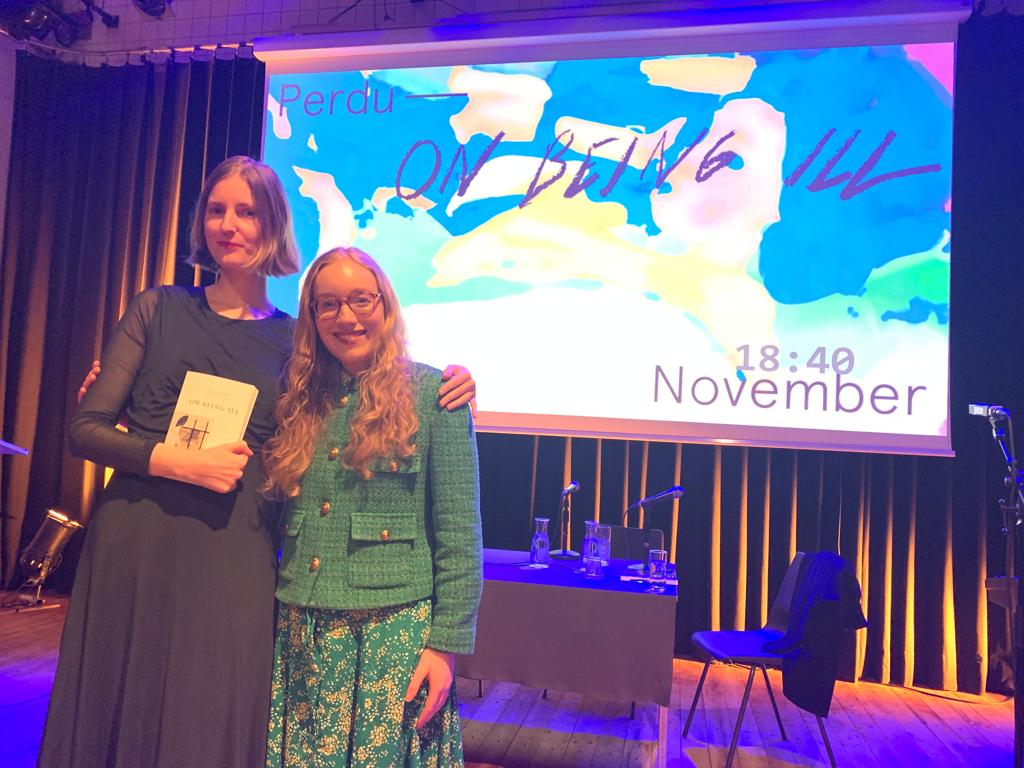
On Nov. 5, cultures and creators came together in Amsterdam and online to celebrate the publication of an anthology of essays, letters and poems which resonate with Virginia Woolf’s essay On Being Ill.

There was a diverse range of speakers at the hybrid event organized by the Perdu Literary Foundation. Both in-person and on Zoom, they spoke to the complexity of the theme. Speakers included Elte Rauch, Marielle O’Neill, Nadia de Vries, Lucia Osborne-Crowley, Deryn Rees-Jones, Sophie Collins and Mieke van Zonneveld, as well as superb live music from Ekster.

Pandemic allows identification

The timing of the publication date could not be more perfect. As the world limps out of isolation, we can most certainly identify with Woolf’s essay on illness itself and the resulting isolation, loneliness and vulnerability that comes with it.

The anthology examines the way illness and literature are dialectically connected to each other, and how the process from conceptualization to the publication of the anthology mirrors the stages of illness.

Connecting as writers

Elte Rauch from HetMoet

As Elte stated in her opening address at the launch, the people involved in this anthology didn’t know each other, but each of them was able to connect at varying points in the process.

This idea that connection can never be lost is pivotal, she said, explaining that while writing is a solitary action, publishing is done together. It is the time when writers, illustrators and musicians all come together.

In an evening that celebrates the relevancy of Virginia Woolf, and especially her “revolutionary act of empowerment,” as Marielle O’Neill stated in her essay, that by openly embracing such a taboo subject as mental health – especially at a time in our history when illness itself is a taboo subject, the anthology as well as the original essay by Woolf will resonate with post-lockdown readers.

When everyday moments become special

As Marielle stated in her essay, small everyday moments, like Mrs. Dalloway buying flowers, become special moments. For example, coffee with a friend becomes a special occasion.

Writer Nadia de Vries with Marielle O’Neill from the Virginia Woolf Society of Great Britain

This anthology shows us, as readers, how beautiful it can be to write about a subject that is, in all honesty, not beautiful.

As Woolf so describes in her essay, when adults are ill, it inevitably makes us feel like children again. Illness is not beautiful. It’s messy, it’s raw and it leaves us vulnerable. In some ways, being ill mirrors the act of writing and creating itself.

How often do we as artists, writers and musicians share some of the most secret parts of our souls when we put pen to paper or paint to canvas?

Literature and anthologies bring us together

As I close this blog piece, I will leave you with something that was repeated during the evening, and certainly echoes in the anthology itself. Just as literature succeeds in bringing people together, this anthology brought writers, creators, scholars, and musicians together for an evening. It even brought you and I together for an evening.

It helped us put aside the loneliness of lockdown, illness and a global pandemic and allowed us to just enjoy each other’s company and inner most thoughts and feelings.

When we talk about illness, we lay bare how naturally afraid of illness and the finality of death we are – almost on a primitive level. But one thing is certain, when we do discuss our vulnerabilities and share our fears, magic is created.

How to get it

The anthology is available now in Holland in English and Dutch editions, with a UK book launch planned for January 2022. For more information contact Elte Rauch at info@uitgeverijhetmoet.nl.

Read Full Post »

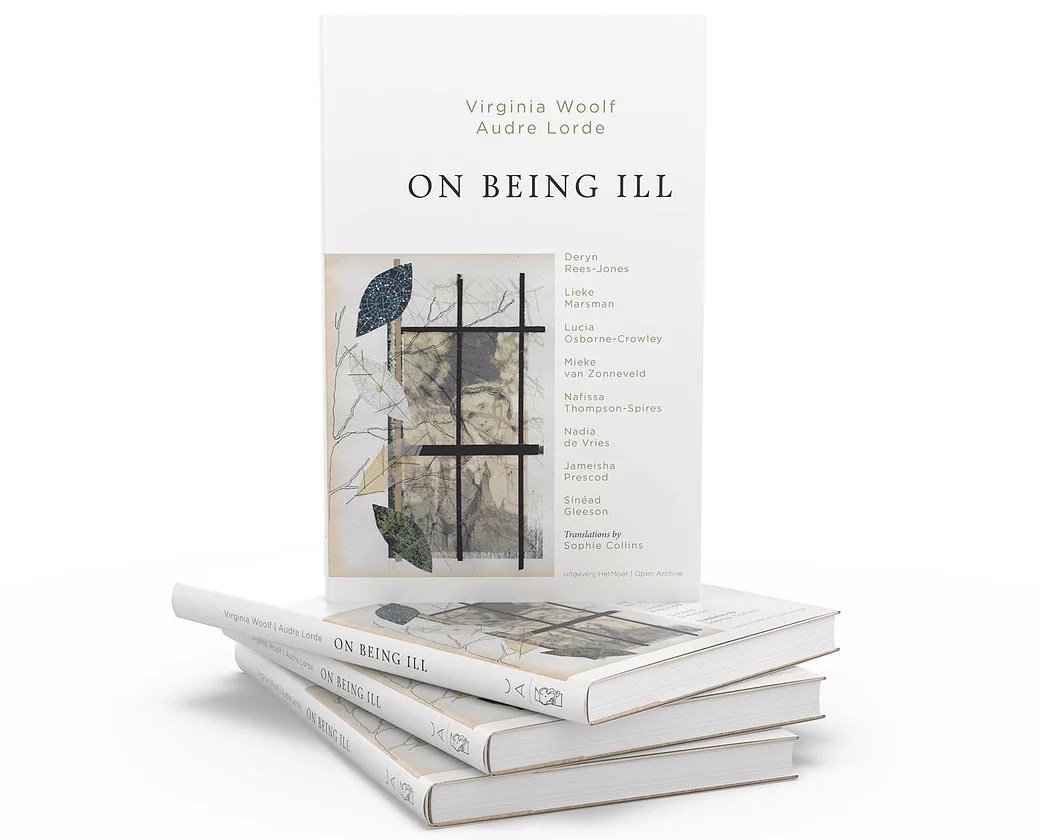
Nothing could be more timely than a new edition of Virginia Woolf’s On Being Ill which will be out in anthology form on Oct. 25 and include essays on illness from writers across the globe, with cover art by Louisa Albani.

Even in the midst of the current pandemic, illness remains an unpopular theme in literature. But in her essay, On Being Ill Virginia Woolf asks whether illness should not receive more literary attention, taking its place alongside the recurring themes of “love, battle and jealousy.” According to the publishers, this book, On Being Ill, does exactly that.

Thinking about illness

This edition serves as a complement to HetMoet’s 2020 publication of the first Dutch translation of Virginia Woolf’s On Being Ill. In this collaborative volume, authors, translators and illustrators have come together from Great Britain, Ireland, the United States and the Netherlands to represent past, present and future thinking about illness.

Noteworthy contributions to this 172-page paperback edition are Deryn Rees-Jones’ preface to Woolf’s essay from 1926 and the introduction to Audre Lorde’s The Cancer Journals of 1980. Against these, the voices of contemporary authors resonate as they contemplate the interactions between sickness and literature.

Readers are able to begin the book at the end, or might happily start in the middle, as every contribution is a unique, personal piece that offers poignant observations of the world of illness from within.

Book launch Nov. 5, in person and live online

The book launch of this new edition will take place Nov. 5 at 7 p.m. GMT at Perdu Literary Foundation in Amsterdam and will be also be transmitted live online. The event will mainly be in English.

Elte Rauch from Uitgeverij HetMoet will talk about how the book came into being and will introduce the panel members and writers. There will be readings and contributions from Mieke van Zonneveld, Deryn Rees-Jones, Lucia Osborne-Crowely, Nadia de Vries and Jameisha Prescod. Marielle O’Neill from the Virginia Woolf Society of Great Britain will speak about Woolf’s essay. The evening will be accompanied by music.

Tickets are €7.50. For more information email Elte Raunch: info@uitgeverijhetmoet.nl

Read Full Post »

Older Posts »