Feeds:
Posts
Comments

Archive for the ‘The Voyage Out’ Category

Yesterday, survivors of Jeffrey Epstein, who were as young as 13 when they were first sexually abused and trafficked, released a powerful PSA that featured their childhood photos. It made the news and spread through social media.

Today, they channeled the power of their truth into a second press conference (the first was held in September) that shared their stories and announced the establishment of a national, survivor-led non-partisan political movement to expose all aspects of sexual abuse and exploitation. It made the news and spread through social media.

This afternoon — at long last — the House of Representatives voted 427-1 for a bill demanding that the Justice Department release all the Epstein files. But that did not happen until one Republican after another stepped before the mic to lie, blaming Democrats for the long delay in releasing the files and falsely claiming Republicans had wanted transparency all along.

The lone dissenter in today’s vote was far-right conspiracy theorist Republican Clay Higgins of Louisiana. Shame on him and the many Republicans, including our felon-in-chief, who worked tirelessly to keep the Epstein files under wraps.

Hours later, Minority Leader Chuck Schumer won unanimous agreement for the Senate to pass the measure as soon as it arrives in the chamber. It will then go to the felon in the White House for his signature, with the hope he does not use any further tricks to circumvent justice for women and girls.

Sexual abuse and Virginia Woolf

You might ask how any of this connects to Virginia Woolf. Here’s how.

Virginia Stephen was six years old the first time she was sexually abused. Her abuser, her half-brother Gerald Duckworth, was 18. Virginia was 13 when she was abused again, another incestuous abuse that went on until she was 29. This time, her other half-brother George Duckworth, a father figure to both Virginia and her sister Vanessa, was her abuser. He was 29 when it began and 45 when it ended.

Here are Virginia’s own words from her collection of five memoir pieces included in Moments of Being:

There was a slab outside the dining room door for standing dishes upon. Once when I was very small Gerald Duckworth lifted me onto this, and as I sat there he began to explore my body. I can remember the feel of his hand going under my clothes, going firmly and steadily lower and lower. I remember how I hoped that he would stop; how I stiffened and wriggled as his hand approached my private parts. But it did not stop. His hand approached my private parts too. I remember resenting, disliking it-what is the word for so dumb and mixed a feeling? It must have been strong, since I still recall it. This seems to show that a feeling about certain parts of the body; how they must not be touched; how it is wrong to allow them to be touched; must be instinctive. – Moments of Being, p. 69

Sleep had almost come to me. The room was dark. The house silent. Then, creaking stealthily, the door opened; treading gingerly, someone entered”. “ ‘Who?’ I cried. ‘Don’t be frightened,’ George whispered. ‘And don’t turn on the light, oh beloved.’ Beloved – and he flung himself on my bed, and took me in his arms. Yes, the old ladies of Kensington and Belgravia never knew that George Duckworth was not only father and mother, brother and sister to those poor Stephen girls; he was their lover also. – Moments of Being, p. 180

It was long past midnight that I got into bed and sat reading a page or two of Marius the Epicurean for which I had then a passion. There would be a tap at the door; the light would be turned out and George would fling himself on my bed, cuddling and kissing and otherwise embracing me in order, as he told Dr Savage later, to comfort me for the fatal illness of my father–who was dying three or four storeys lower down of cancer. – Moments of Being, p. 182

Incestuous sexual abuse and its effects on Virginia

Others have written about the effects this traumatic sexual abuse had on Virginia’s mental health, as well as her feelings about herself, her appearance, and her sexuality.

Louise DeSalvo’s Virginia Woolf: The Impact of Childhood Sexual Abuse on Her Life and Work (1989) comes to mind first. Sara Culver’s 1990 article in the Grand Valley Review, “Virginia Woolf as an Incest Survivor,”is worth reading as well. Gillian Gill’s Virginia Woolf: And the Women Who Shaped Her World (2019) also adds insight.

Among other things, such works speak of Woolf’s discomfort with any attention to her looks, whether it be her hat, her dress, or her body. They also speak of her own shame regarding looking at her own image in a mirror.

The looking-glass shame has lasted all my life, long after the tomboy phase was over. I cannot now powder my nose in public. Everything to do with dress-to be fitted-to come into a room wearing a new dress- still frightens me; at least makes me shy, self-conscious, uncomfortable. ‘Oh to be able to run, like Julian Morrell, all over the garden in a new dress’ I thought not too many years ago . . .

Yet this did not prevent me from feeling ecstasies and raptures spontaneously and intensely and without any shame or the least sense of guilt, so long as they were disconnected with my own body. – Moments of Being, pp. 68-9

Incestuous sexual abuse and its effects on Virginia’s writing

Virginia’s sexual abuse also influenced her writing in such novels as The Voyage Out (1915) and The Years (1937).

Remember the scene where the married Mr. Dalloway holds virginal Rachel Vinrace tightly and kisses her “passionately” against her will? (TVO 89) Recall the time Rose escapes the strange man under the lamppost who sucks his lips, makes a “mewing noise,” and starts unbuttoning his clothes? (TY, p. 29)

In both cases, the traumatized females suffer nightmares after the event.

Surviving with strength

Despite the incestuous sexual trauma Virginia suffered beginning at the age of six, she survived and went on to leave a body of work that lives on to be revered by new generations of common readers and scholars.

As Culver puts it, “Her detractors have dismissed Virginia Woolf as a pretentious snob, comfortably insulated from the ‘real world’ by her sex, her class, and her recurring illness. This is a slander that needs to be disproved. Woolf — while still a child — had to face realities so ugly they tormented her for years. But they did not conquer her. That she not only survived such violations of her integrity, but survived magnificently, argues that she was neither weak nor spineless, but remarkably strong and courageous.”

The same can be said of the thousand Epstein survivors who survive “magnificently” with remarkable strength and courage. We call on those in power to ensure they receive the full justice they have long deserved. We call on those in power to BELIEVE WOMEN.

Read Full Post »

The Virginia Woolf Society of Great Britain, in association with the directors of the Clifford’s Inn Management Company Limited, has commissioned and installed a blue plaque on London’s Clifford’s Inn where Virginia and Leonard lived from 1912-13 following their honeymoon.

The Woolfs lived in flat 13, with Virginia writing most of her first novel, The Voyage Out (1915) while living there. The block of flats was rebuilt in the 1930s, but the entrance on Clifford’s Inn Passage, where the plaque is placed, is where the Woolf’s would have entered the building.

The Passage, one of the oldest alleys in London, is the route which the Woolfs would have used to go to the Cock Tavern on Fleet Street.

Other tenants in the building during the Woolfs’ residency were individuals working in law, as well as photographers, tailors, architects, and artists including both painting and sculpture. The building was also used for commercial purposes. It was home to organizations including the Society of Women Writers and Journalists, the London Typographical Society, the London Positivist Society and the Art Workers’ Guild.

When ongoing construction work in the neighborhood is finished and the Clifford’s Inn Passage undergoes renovation and tree planting, the VWSGB will hold an unveiling ceremony for the plaque.


Read Full Post »

The news that Virginia Woolf’s personal copy of The Voyage Out (1915), discovered in 2021 after mistakenly being housed in the science section of the University of Sydney’s Fisher Library for 25 years, is all over the internet. But the best news is that the volume has been digitized and is now available online.

It is one of just two copies of the novel that were annotated with her handwriting and with preparations to revise it for a U.S. edition.

A private collector based in London owns the other. It has typesetter’s marks and a greater number of revisions, including those to other chapters, but without the chapter 25 revisions, according to the library website.

The digitization of Woolf’s novel allows scholars and readers around the globe to study and consider Woolf’s edits from their own armchairs.

More background

In the 1996 article “Virginia Woolf’s Revisions of The Voyage out: Some New Evidence” by James M. Haule, published in Vol. 42, No. 3 of Twentieth Century Literature, Haule explains the story behind this rediscovered book, saying it was a working copy that appears to be one of two in which Woolf marked up revisions of her novel for the first U.S. edition, published in 1920.

It is thought that the Fisher Library copy was kept by Woolf as a record of the main revisions, with the other being sent for use in publication, according to the library website.

“With the possible exception of The Years (1937), none of her novels was as long in preparation or as difficult for her to complete,” Haule maintains.

About the edits

Inscribed by the author on the flyleaf, the volume includes handwritten revisions to chapters 16 and 25 made by Woolf’s own hand in pen and in blue and brown pencil.

In Chapter 25, whole pages are marked for deletion, although they were ultimately not removed for the first U.S. edition, published in 1920. The volume also includes pasted-in typewritten carbons in chapter 16.

The fact that Woolf signed on the volume’s flyleaf, not the title page, indicates that it was one of her personal copies, experts say.

Where the volume came from

The University of Sydney acquired the book in the 1976 through Bow Windows Bookshop in Lewes, East Sussex, near the Woolfs’ Monk’s House. The shop currently has some first editions of Woolf’s works on hand, including a copy of The Voyage Out, at least when this piece was written. The price? £600.

The Berg Collection at the New York Public Library holds a holograph draft of The Voyage Out.

Read Full Post »

Artist Ruth Dent has created a handpainted scarf to commemorate the 100th anniversary of Virginia Woolf’s first novel The Voyage Out.

You can purchase The Voyage Out Centenary Scarf online through her IndieGoGo campaign. Printed digitally on silk, only 100 are available.

//platform.twitter.com/widgets.js

Read Full Post »

The slogan “Keep calm and carry on” is now appearing on everything from coffee mugs to note pads. I have both. But where did it come from?

As this PBS video shows, the slogan originated on a propaganda poster during World War II, but the poster itself was never displayed publicly.

http://www.youtube.com/watch?feature=player_embedded&v=FrHkKXFRbCI

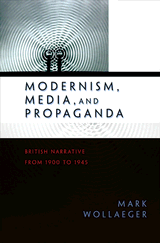
Watching this video led me to think about Virginia Woolf and propaganda, and that thought led me to Mark Wollaeger’s book Modernism, Media, and Propaganda: British Narrative From 1900 To 1945 (2006). It  provides an excellent discussion of Woolf’s views on the subject — and the ways she struggles with propaganda in her novels.

As Wollaeger puts it, Woolf thought of modernism as antithetical to propaganda, and her goal was to steer clear of it. He mentions, for example, that while writing “The Pargiters,” she wrote that “this fiction is dangerously near propaganda, I must keep my hands clear” (D4 300).

Woolf avoids polemic when she explores the subject of war in Mrs. Dalloway (1925) and To the Lighthouse (1927), but in his book, Wollaeger focuses on a seemingly unlikely choice for an exploration of Woolf and propaganda, her first novel, The Voyage Out (1915). In this novel, according to Wollaeger, Woolf is engaged in a developing struggle between her own emerging modernism and “the propaganda of everyday life,” also known as the “propaganda of conformity” (73). It is a struggle in which Rachel Vinrace engages as she endeavors to discover a pure native culture in South America while still being mentally immersed in the colonial culture — and popular culture — of England.

Wollaeger explains the difficulty Rachel would have had in thinking for herself — and differentiating between national identity as reinforced by her community and calculated manipulation as perpetrated by powerful institutions — after having grown up in an environment saturated by the propaganda disseminated by mass media. In this category he includes picture postcards, which became a craze at the turn of the twentieth century, along with ads; cigarette cards; newspapers and posters.

So while Woolf directly engages with the idea of war propaganda in Mrs. Dalloway and To the Lighthouse, in The Voyage Out, she does something different. She explores the subtly intrusive ways that modern propaganda invades everyday life in ways one does not consciously recognize.


Read Full Post »

Older Posts »