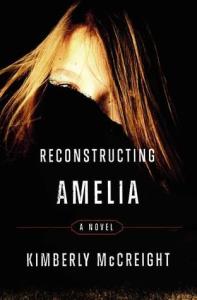
 Starting with the epigraph—a passage from The Waves—and throughout the novel, haunting words from Woolf mark the days and moods of Amelia Baron in Kimberly McCreight’s riveting first novel, Restructuring Amelia.
The story is about a tragic teenage suicide, or so it’s believed until her mother, who finds the idea inconceivable, starts delving into it. Amelia is a model student at her upscale Brooklyn private school, shining most brightly in her English classes. Amelia knows Woolf’s work intimately, so when her paper about To the Lighthouse is found to be plagiarized, suspicions are aroused.
The novel recaps the period leading up to her death with chapters in Amelia’s voice, prefaced by her Facebook posts, many of them quotes from Woolf novels.
[Amelia] … picked up To the Lighthouse. It wasn’t like I needed to read it again to write my English paper. I practically knew the whole thing by heart. Virginia Woolf was kind of my hero. Not because she walked into a river with rocks in her pockets—though as far as ways to kill yourself went, that did have a certain style—but because she was crazy talented and had been who she’d wanted to be, despite the world telling her to be someone different.
Alternating chapters are from Amelia’s mother, Kate, who sleuths for the truth after receiving an anonymous text saying that “Amelia didn’t jump.”
Kate forced herself off the windowsill and over to the bookshelves. She ran her hand down the well-worn spines—The Odyssey, The Sound and the Fury, Lolita, and, of course, all those books by Virginia Woolf. Virginia Woolf—suicide committer extraordinaire—was her daughter’s favorite author. The coincidence hadn’t been lost on Kate. But Amelia would have found copying her literary hero in that way to be a pathetic cliché, of that Kate felt sure.
I was able to contact Kim McCreight and ask her, “Why Virginia Woolf?” She responded: “Because I love her work, first and foremost. She’s one of my own personal literary heroes and so it felt natural to make her one of Amelia’s. There is, of course, her own suicide, too, which hangs over Amelia death with a kind of foreboding. Also, my sense of Woolf as something of an outsider, but a defiant one. Woolf rejected female stereotypes and forged her own road. It is that kind of independence that Amelia tragically never managed to achieve before she died, but that I believe was always there, deep in her heart.”
Kim professes not to be a Woolf scholar, but it’s clear that she did a tremendous amount of reading and intuiting to find the right passages to reflect Amelia’s thoughts and temperament over the course of her story.
- The Aviator’s Wife reads Woolf (bloggingwoolf.wordpress.com)
Read Full Post »