Feeds:
Posts
Comments

Virginia Woolf’s desks — from her stand-up version to her writing board — generate a lot of interest. A March 3 lecture by Leslie Hankins titled “Virginia Woolf: Writing Surfaces and Writing Depths” will answer all questions.

It will be held March 3, from 4-5 p.m. at Duke University, where one of Woolf’s desks is on display. Read more below and via a link on the Events page.

Here’s the latest collection of Woolf sightings from around the Web, which I originally posted on Facebook.

  1. The Masterpiece PBS post on Virginia Woolf and Downton Abbey. However, it doesn’t include mention of the Jan. 31 episode (Season 6, Episode 5) in which Neville Chamberlain, then the minister of health, talks about the participation of his prankster brother-in-law, Horace de Vere Colethe, in the Dreadnought Hoax.
  2. Woolf witchThe weekend quiz from The Guardian includes Virginia Woolf.
  3. Virginia Woolf’s To the Lighthouse is one of Alison Bechdel’s 10 favorite books.
  4. Virginia Woolf, Rupert Brooke and the tranquility of Grantchester
  5. Virginia Woolf’s Guide to Grieving in The Huffington Post
  6. In “Women on the Verge of Extraordinary Recognition,” by Nancy Jones, Virginia Woolf is asked to write a play for the WWI village fete. Read more.
  7. Virginia Woolf had articles published in Vogue in the 1920s when Dorothy Todd was editor.
  8. Donation from Woolf’s great niece to help refurbish Charleston.
  9. Virginia Woolf on Androgyny, Creativity, and a Room of One’s Own,” by Nathan Gelgud
  10. Virginia Woolf: Witch of the Waters. A comic of literary witches.

From Alice Lowe, regular contributor to Blogging Woolf, comes this post, “Where’s Lillie?”, that links us to an eponymous essay in the journal 1966 that explores the veracity of memory. In it, Lowe says this about memory and Virginia Woolf:

Neuroscience has corroborated what novelists, poets and memoir writers have been saying for centuries. They’ve confirmed the physiological basis of memory and explored the brain activity involved in recalling stored memories, demonstrated that memory may be a result of the act of remembering and as such can be altered with every recall. Memory was the basis for Virginia Woolf’s concept of consciousness and our construction of it. She frequently questioned the accuracy of her memories and articulated her speculations. In memoir sketches she tells about her step-brother clubbing a fish with a broom handle, and immediately follows by asking: “Can I be remembering a fact?”

News and analysis of a recently discovered Vanessa Bell nude. Read more at this post, “Vanessa Bell’s Bathers, on The Charleston Attic blog.

Mrs. Dalloway lives. And walks. And is mapped. Here are several fun and helpful resources I recently discovered.

  1. The first is @mrsdallowayday on Twitter, who is encouraging a ‪#‎MrsDallowayDay‬ event June 13 in London, starting this year. Use the hashtag #MrsDallowayDay.
  2. The second is the Mrs. Dalloway Mapping Project, a series of interactive, annotated maps of London that serve as a guide to the novel.  The maps show the paths that Clarissa, Peter and Rezia and Septimus follow over the course of the novel, something I once tried to do for a class I was teaching. However, I found myself a bit confused about Peter’s route midway through my explanation. I hope this resource does a better job. It includes links to analyses of the text organized by event, location, and time. It apparently was created by Adam Erwood, London Lamb, Jasmine Perrett, Anjaly Poruthoor and Manoj Vangala for an English class at the Georgia Institute of Technology.
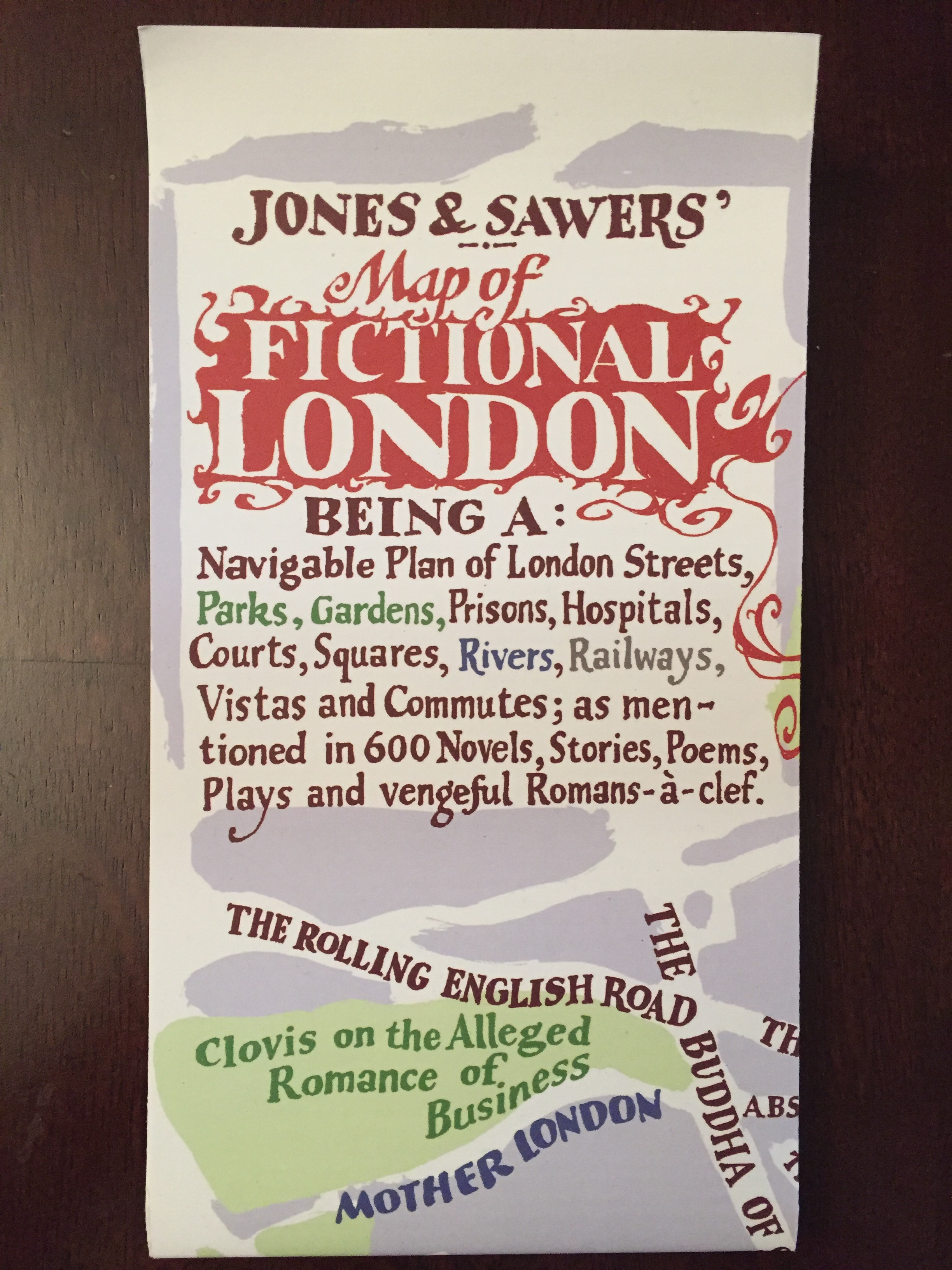
  3. The third is a Map of Fictional London from the Literary Gift Company. Dani Hall, company creator, was good enough to send me a copy. I plan to take this foldable, indexed resource along on my next trip to London, as it marks sites mentioned in 600 literary works by 400 authors, including Virginia Woolf. I may carry it in the purple Woolf Library Bag that accompanied it.