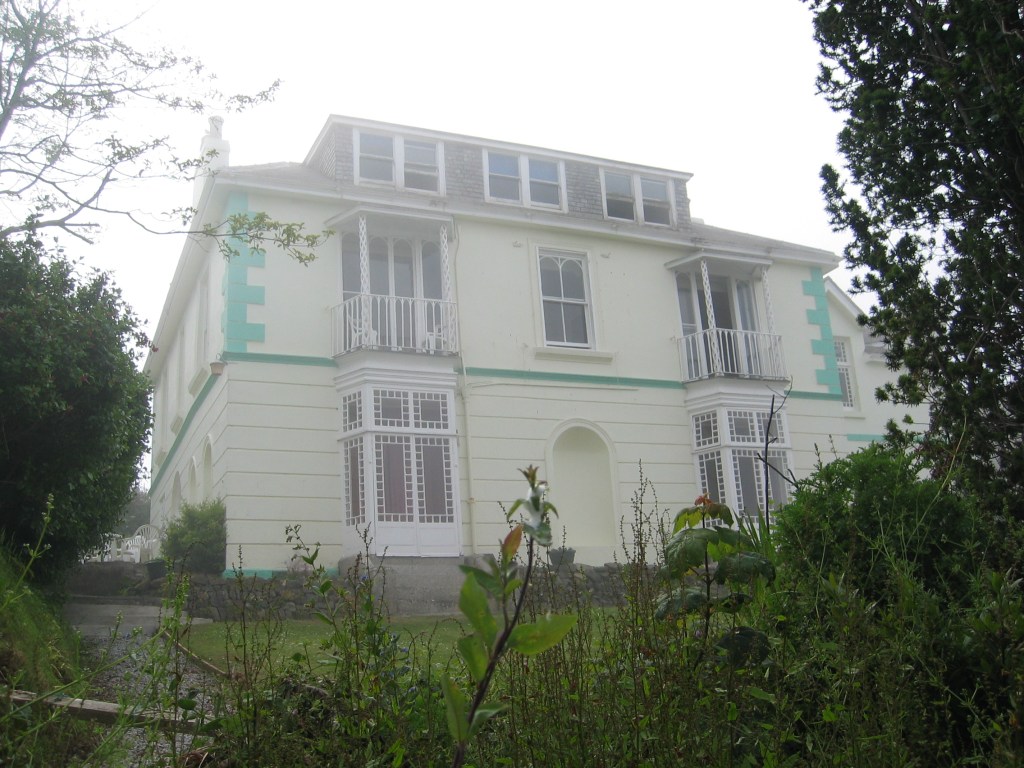
Blogging Woolf was part of a pilgrimage to Talland House in 2004. This photo depicts the front right corner of the home.
In mid-January, we reported on the most recent plan to construct a multi-million dollar flat project that would obstruct the view of the Cornwall coast and Godrevy Lighthouse from Talland House in St. Ives, Cornwall, the setting and inspiration for Virginia Woolf’s 1927 novel To the Lighthouse. We are sad to report that the plan is moving ahead, according to the Virginia Woolf Society of Great Britain.
Below is the text of a March 13 message sent by the Virginia Woolf Society of Great Britain, which helped lead the resistance effort.
Talland House planning update
”It is with regret that we report the decision of the Planning Committee of Cornwall Council this week to allow the planning application for a building in front of Talland
House in St Ives to go ahead.
“There were over 130 objections to the plan, including a handwritten letter from our President Dame Eileen Atkins. The Talland House Group, including the VWSGB and led by Polly Carter, the heritage gardener at Talland House, employed a KC who raised a legal challenge to the lawfulness of the application.
“The particular points brought by our Counsel remain unaddressed by Cornwall
Godrevy Lighthouse in St. Ives, Cornwall
Council’s legal department. They responded, but not to the points raised. Sadly, the developer can go ahead and build what will irrevocably destroy the To the Lighthouse view. BBC Cornwall supported our campaign.
“We are considering opening this up to judicial review and are exploring other options. The Talland House Group is to be formalised, and may have a website and events that celebrate the view and its importance to Virginia Woolf and her works.
“Time will be needed to re-focus our strategy, but we hope to issue more guidance as to how you can further support the campaign and all that Talland House stands for.
“Our thanks to everyone who contributed to the campaign against this development, and we will keep you updated. This story may not be over yet!”
Virginia Woolf scholars from Brazil invite participants from all over the world to submit a proposal to the open forum Virginia Woolf: Sound and Rhythm in Translation, in preparation for the 35th Annual International Conference Virginia Woolf: Woolf and Sound, which will take place in Istanbul, Turkey, 24-28 June 2026.
About the forum
The forum aims to discuss the participants’ texts on sound and rhythm concerning the translation of Virginia Woolf’s oeuvre, with the prospect of having them published after the conference. Papers about all forms of translation, including intersemiotic translations and adaptations, are welcome.
Important notice: There will be a pre-conference meeting to discuss proposals on 22 May 2026, from 9-10 a.m. (GMT-3), pre-conference readings, and a post-conference follow-up to discuss publication ideas on a date to be determined. Both pre- and post-conference meetings will be held online. The number of participants is limited to 15.
As the forum follows a collaborative model, in which researchers share their works in progress and explore possible connections with other researchers’ work, participants are encouraged to take part in both the pre- and post-conference meetings even if they do not plan to attend the conference in person.
How to submit
Submit your proposals (200–300 words) by 30 March 2026. Should you have any questions or comments, please write to woolftranssound26@gmail.com
Editor’s Note: Woolf scholar Kristin Czarnecki contributed this post about her creative experience with Mrs. Dalloway and erasure poetry.
A year or so ago, on the recommendation of a friend, I bought Sarah J. Sloat’s HotelAlmighty, a book of erasure poems born from Stephen King’s novel Misery. Each page bears not only Sloat’s erasures but also her beautiful, evocative art and collages.
I read it repeatedly and became curious about the potential of erasure poetry. As Sloat says in her introduction to Hotel Almighty, “The form leaves room for chance.”
I suspected the form was something I’d enjoy, and as I so often do, I turned to my shelves of Woolf books for inspiration.
Right away, my eye went to the Eastern Press edition of Mrs. Dalloway I’d found years ago in a Lexington, Kentucky, bookstore. It was bound in genuine leather in a glorious, saturated shade of green, my favorite color, and I snapped it up.
And there it sat on a shelf for years until, in a fit of purging, I brought it to Half-Price Books to see what I could get for it in trade. Not much, but I easily let it go, confident it would wind up with someone who would appreciate it.
A book returns
Fast forward a few months, when an English major at the college where I was teaching stopped by my office one afternoon. She and her girlfriend had taken several classes with me, including modern British literature, which of course had Mrs. Dalloway on the syllabus.
That day in my office, she reached into her bag, drew out a book, and proudly handed me the Eastern Press edition of Mrs. Dalloway I’d recently given away.
“We found this at Half Price Books!” she said, “And we knew we had to get it for you.”
I was deeply moved by the gesture and thought, “Well, I’m clearly meant to have this book.”
I kept it in my campus office, and when my husband and I moved across the country, it of course came with us.
Having fun with Mrs. Dalloway
Looking at the book recently, I began to wonder how I might do justice to
Woolf’s words, to my students’ thoughtful gift, and also to the physical thing. I wondered how it might manifest into a different type of aesthetic object, and I wondered if I might fall under Woolf’s spell once again if I approached her writing in a different way.
Since leaving academia nearly four years ago, I’d been losing interest in Woolf, a sad and unsettling experience I hoped was only temporary.
“Mostly, I set out to have fun,” Sloat writes towards the end of her introduction to Hotel Almighty. I set out to do the same when creating erasure poetry from Mrs. Dalloway.
I sought combinations of words that would reflect Woolf’s concerns in the novel, like the vagaries of time and fluctuating relationships. Sometimes, I sought to counteract the unbearable sadness on the page, like Septimus Warren Smith’s suicidal despair. Sometimes, I tried not to overthink it and just remain alert to any words or phrases that might jump out.
I decided to create 51 erasures, Clarissa Dalloway’s age in the novel.
Adding art to the words
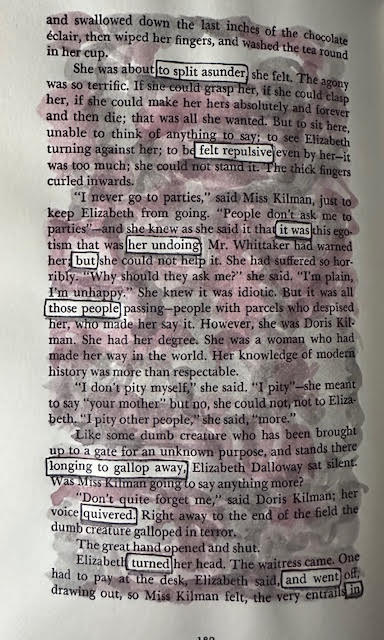
As for the art, some of the erasures called out for a particular color or striking color combination. For a few, I wanted strips of paper to cover all but the circled words. For added visual interest, I cut out some of my drawings and paintings from other notebooks and pasted them in.
I appreciate anew, or differently now, her writing to a rhythm, her threading of specific motifs throughout the novel, her aversion to verbs (!), and her insights into the multitudes of human experience.
The process of running a paint brush, colored pencils, or pastel crayons across the lines, a repetitive and meditative action, found me absorbing and thinking about words I hadn’t singled out.
Selecting from among Woolf’s words and adorning them with art made for a unique and enjoyable creative experience. I appreciate anew, or differently now, her writing to a rhythm, her threading of specific motifs throughout the novel, her aversion to verbs (!), and her insights into the multitudes of human experience.
I like to believe we created these erasures together. And, it’s nice to have her back.
About the author
Kristin Czarnecki at the 2019 Annual International Conference on Virginia Woolf held at Mount St. Joseph University in Cincinnati, Ohio.
Kristin Czarnecki taught English in Georgetown, Kentucky, for many years and is now executive director of the Rockport Art Association & Museum in Rockport, Massachusetts. A former president of the International Virginia Woolf Society, she has published literary criticism in Woolf Studies Annual, Journal of Feminist Scholarship, Journal of Modern Literature, the CEA Critic, College Literature, and Journal of Beckett Studies as well as in edited volumes. She is also the author of two memoirs: Encounters with Inscriptions (Legacy Book Press, 2024), about the books inscribed and given to her by her parents over the years, and The First Kristin: The Story of a Naming(Main Street Rag, 2020), about the experience of being named after a deceased sibling. Her chapbook, Sliced, was published by dancing girl press & studio in 2023. Her next book, My Moomin Memoir: Reflections on Tove Jansson’s Classic Tales, is forthcoming from Legacy Book Press.
Erasure poems from Mrs. Dalloway by Kristin Czarnecki
The organizers of the 34th Annual International Conference on Virginia Woolf, held in London and Sussex last July on the theme of “Woolf and Dissidence,” invite submissions for the upcoming volume in the Virginia Woolf: Selected Papers series.
The volume will add to the digital, open-access series published by Clemson University Press, and will add to the edited collections open to scholars and readers of Woolf from around the world.
The collection will focus on the theme of the 34th annual conference — “Woolf and Dissidence” — and will explore the many forms that dissent takes in Woolf’s work, continuing a conversation about the nature and context of Woolf’s dissidence, while also exploring dissident approaches and responses to Woolf’s writing.
As with previous volumes, between 25 and 30 of the hundreds of papers presented at the conference will be selected for inclusion in the volume.
Submission guidelines and deadline
Submissions should be approximately 2,000-3,500 words, including notes. All submissions must be in Word and follow the Chicago Manual Style Guide. (See further style and formatting guidance here). Authors must secure permissions for quotations or images.
Please send complete, edited papers by March 31 to H.Tyson@sussex.ac.uk.
Please note that submission does not guarantee acceptance; there will be a selection process. Any questions can be sent to Helen Tyson at H.Tyson@sussex.ac.uk.
At the 34th Annual International Conference on Virginia Woolf: Woolf and Dissidence, Anne Fernald gives a keynote address, “Dangerous Days: A Century with Clarissa Dalloway.”
The next Woolf Seminar by the Virginia Woolf Society of Turkey is set for March 6 at 7 p.m. Turkey time, with a lecture from Pamela L. Caughie on “Virginia Woolf in the Age of a New Aurality: Reprising Scholarship on Woolf and Sound 25 Years On.”
The talk will revisit a quarter century of scholarship on sound in Woolf’s works, situating Woolf within the soundscape of modernism and examining the interplay of new technologies, mass culture, and the arts.
Registration and time
Register online at this link to receive the Zoom link. If you do not receive the Zoom link after registering, email virginiawoolfturkiye@gmail.com.
Seven p.m. Turkey time is 11 a.m. EST. Check the lecture time in your zone here.
About the lecturer
Professor Caughie is professor emerita of English and Gender Studies at Loyola University Chicago, and a former president of the Modernist Studies Association. She has authored two monographs and edited or co-edited several volumes, including including Virginia Woolf in the Age of Mechanical Reproduction (2000) and the first comparative scholarly edition of Man into Woman, Lili Elbe’s 1931 life narrative. She serves as Project Director of the Lili Elbe Digital Archive.