Feeds:
Posts
Comments
Marta Rodríguez Iborra submitted this guest post to Blogging Woolf. It describes her impressions of Virginia Woolf’s Diary entry written one week after Katherine Mansfield’s death.

Among all the entries of the second volume of Virginia Woolf’s Diary I would like to comment briefly on the 16 January 1923 record, as I consider it to be quite unique. Katherine Mansfield died on 9 January 1923, and so a week later VW tries to describe the impact that this loss has had on her in her private diary.

Katherine Mansfield

VW has some difficulty in expressing what she feels. “It is strange to trace the progress of one’s feelings. […] A shock of relief? –a rival less?” However, despite the confusion and the apparent two-fold dimension of this tragic event, VW confesses to have fallen into depression. If KM is not there anymore, what is the point of writing? VW remembers that KM once wrote a letter to her with the request: “Do let us meet in the nearest future darling Virginia, and don’t quite forget”. Now in this 16 January1923 diary entry, VW wants to analyze how far she is obeying Katherine. First of all, though, before answering that question, she needs to find out what kind of relationship they had.

Any reader of VW’s diary knows that she writes in it as a professional writer. She is obviously under time pressure and she does not correct her texts as they are private, but as far as the style, the choice of themes and the depth of her observations are concerned, one notices that VW can hardly take off her mask of experienced writer, of an intellectual woman. In fact the mask is her skin. As an exquisite writer Woolf describes emotions in a literary way, at the exact distance avoiding a pathetic undertone. So even after KM’s death VW does not surrender to sentimentalism. The colour and music of her sentences are perfectly and naturally controlled by her pen. However, in this specific diary entry she exceptionally lets go. And those leaks are pure and too important to get to know our Bloomsbury diarist in a new dimension. Through the half open door of this entry the reader does not only see Virginia’s Woolf writer’s mask/face, but she/he reaches her soul, too.

In order to understand her emotion and “analyse” the situation VW writes down some of her visual impressions of KM in a kind of a flash back subjective description. “She had a look of a Japanese doll, with the fringe combed quite straight across her forehead”. Isn’t it a delicate way of describing Katherine Mansfield? And she adds “Sometimes we looked very steadfastly at each other, as though we had reached some durable relationship, independent of the changes of the body, through the eyes.” After this deep and poetic statement VW controls herself again as she doesn’t want so sound too melancholic and she continues the portrait of KM in the way she usually illustrates acquaintances or friends, namely sharply and with a particular tincture of humour or sarcasm: She had “beautiful eyes- rather doglike, brown, wide apart”, “her nose was sharp, a little vulgar” and then she moved “like some suffering animal.”

VW asks herself if KM ever cared for her and she immediately acknowledges she did. For example, the way KM looked at her, the fact that KM wanted her to read her diary. So yes, VW admits that despite the fact that KM never answered one of her letters (VW seems not be able to forget it) their friendship was true and long-lasting. “She would promise never never to forget.”

The end of the 16 January 1923 diary entry contains some traces of guilt (VW feels she did not give KM credit for her illness) and quite an important confession: VW openly admits that KM’s is “the only writing I have ever been jealous of”. Isn’t it amazing for a writer such as VW to confess she was jealous of KM’s literature? And then any good reader can feel VW’s deep pain in sentences such as “For two days I felt I had grown middle aged, & lost some spur to write.” But then again Woolf needs to gain some distance to what she has revealed, so she immediately writes that the feeling is going and that she no longer pities KM that much. However, unable to escape a sort of emotional spiral she once again admits with conviction “I have the feeling that I shall think of her at intervals all through life”. And the reason why is because “we had something in common which I shall never find in anyone else.”

In the following diary entry dated 28 January, VW confesses that she continues to write but that she does it “into emptiness” because there is no competitor anymore. That might be true, but one also feels a painful ellipsis there. VW misses KM as a human being, as a woman, as a writer, as a friend, almost as a sister, or even as an alter ego, as another I.

How could Virginia Woolf possibly ever forget Katherine Mansfield?

With the exception of Virginia and Leonard Woolf themselves, Caroline Zoob and her husband Jonathan are thevw garden only two people who have had access to the garden at Monk’s House year in and year out. But we can all get a glimpse of the year-round beauty of that special place through Virginia Woolf’s Garden: The Story of the Garden at Monk’s House

As Zoob puts it in her Introduction, the couple “opened the curtains each day to see the garden spread out below, still shaped according to Leonard’s inspiration” during their decade-long tenancy of Monk’s House, from 2000-2011.

And in his Foreward to the volume, Cecil Woolf, Leonard’s nephew, offers recollections that go back even farther. He writes about his visits, beginning in 1936, to “that charming house and garden” where he pushed open “the creaking wooden gate” to what he remembers as a “little Eden.” The book, he writes, “brings back memories of long-ago visits before and after the war.”

Story of a home and garden’s evolution

Zoob’s 192-page book is divided into seven chapters that tell the story of the home and the garden’s evolution since 1919, when the Woolfs discovered the home in Rodmell, Sussex and were immediately enamored of the garden. The hefty book gives us a tour of that garden and fills in the background as well. And at the end of each chapter, a different garden “room” is described in detail.

Featured throughout are full-color photographs by Caroline Arber, who was a frequent visitor to Monk’s House during the Zoob’s tenure at the home. The photos include wide views of garden elements such as The Flower Walk — the borders running from the lawn steps to the Orchard — and crisp close-ups of individual flowers, such as Leonard’s beloved roses. They show Monk’s House and its garden transformed by the seasons — with the bursting bulbs of spring, the vibrantly colorful blooms of summer and the snow-capped garden sculptures of winter.

Old alongside the new

Archival photos of the Woolfs and their friends at Monk’s House are juxtaposed alongside photos of Monk’s House in the present day. An old photo that I had never before seen pictures Virginia standing outside her first writing lodge, which was converted from a toolshed. Zoob found the photo at Sissinghurst, and although a cropped version was printed in Volume 3 of Woolf’s Letters, the untrimmed new version includes the loft ladder.

Leonard’s desk, as pictured on Pages 122-123.

Interior close-ups of such things as both Virginia’s and Leonard’s writing desks are a special treat. Others show intimate views of details not available to visitors to the house. One includes an oak step leading toward the kitchen that is visibly work with use. Another is a 1970 photo showing the kitchen before the National Trust remodeled it for tenants.

Charming garden layouts in textiles

Another charming element of the book are the garden layouts. At first glance, they all look like watercolor sketches — and some of them are — but upon closer inspection it is clear others are textile art — a combination of embroidery and appliqué with inserted text.

Treasure available Oct. 14

The Italian Garden, pictured in fabric art at left and in a photograph at right.

The book, an indispensable treasure for any Woolf fan, Anglophile, or gardener, will be available in hardback from from Jacqui Small Publishing Oct. 14.

Zoob, an embroiderer and textile artist, is the author of The Hand-Stitched Home and Childhood Treasures.

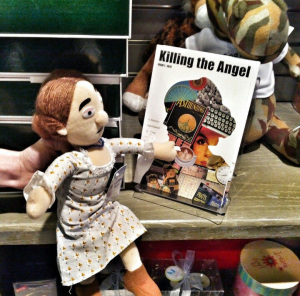
Killing the Angel … again!

With so many print literary journals folding up their tents and going away, I was happy to see that Jessica Rosevear has just published the second issue of Killing the Angel.

While the journal is inspired by Virginia Woolf, it’s not intended to be Woolf focused. But as in the first issue, announced here last October, it includes a couple of pieces that are directly related–and what better home for them? A poem by John DeLaurentis, “Call of the Woolf,” begins:

“What did you find, Virginia?
You searched like a woman on fire
through your father’s library,
looking for words to dance
off the gilded pages …”

I particularly enjoyed Emily Burns Morgan’s provocative essay, “Moments of Being: The (Buddhist) Philosophy of Virginia Woolf.” While Woolf was not believed to be influenced by Eastern philosophy or religion, Morgan makes an interesting case for similarities in the mindset that speaks of being and non-being, death and rebirth. Orlando, she posits, “might be read as a particularly literal illustration of the idea of reincarnation.” And “moments of being,” the concept itself, can be seen as the Buddhists’ “mindfulness.”

The issue includes a sampling of fiction, essays and poetry by a variety of voices, including oft-published authors and in one case, a very talented high school student. Killing the Angel is available through the website.

Wearing Woolf on your neck

Always on the lookout for all things Woolfian, I found this pendant at the Made in Ohio Craft Festival at Hale Farm in Bath last weekend.

The image of Woolf is affixed to a domino and sealed with a glossy substance. It is from a Roger Fry painting of Woolf, circa 1917.

Of course, this Woolf necklace is not the only one out there. A quick Google search turns up quite a few for sale on ebay, etsy, etc. Some feature Woolf’s face, others her words.

There’s also a Bloomsbury necklace with portraits of key members of the group. And a Woolf Whistle necklace. Not sure about that one.