The fall 2012 issue of the Virginia Woolf Miscellanyinvites brief analyses and explorations of how queer studies can help or has helped illuminate Woolf’s life and work, and vice versa – how Woolf’s work and life nuances or otherwise influences queer studies, broadly conceived.
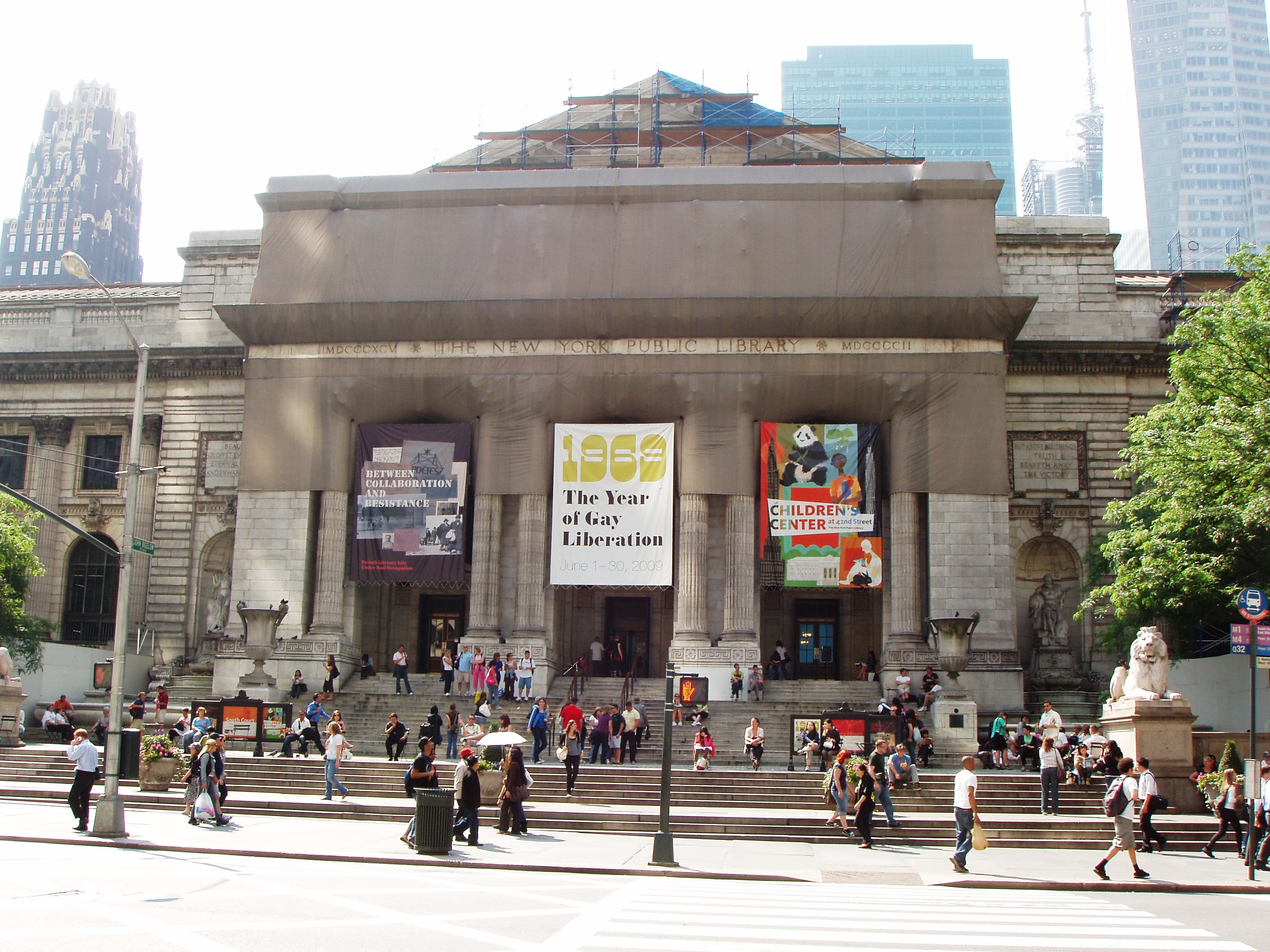
Rebecca Filner, librarian at the New York Public Library’s Berg Collection, doesn’t leave her job behind when she walks out of the Schwarzman Building on 42nd Street and Fifth Avenue.
What that means for me is that after she left work last night, she continued thinking about the Bloomsbury pacifists, the focus of my research at the Berg. And when I arrived this morning for the second day of my Short-Term Research Fellowship, she had some tips to share.
She told me of a recent Berg acquisition, a letter from Lytton Strachey to Duncan Grant. And she also sent me links to unpublished letters from Vanessa Bell to Maynard Keynes currently housed at the Morgan Library & Museum, 225 Madison Avenue at 36th Street in Manhattan, and sent me the link to the reading room application.
This unusual pair of earrings must be shared. Take a look at the “Mrs. Dalloway by Virginia Woolf Typewriter Earrings.”
As the name implies, they combine an image of a vintage typewriter with two lines from the novel typed on the tiny slip of paper inserted in its carriage. But there’s more. The cover of the book, a picture of Woolf, and replica typewriter keys are also part of the set. Kind of a lot to dangle from one’s ears.
Nervous. Anxious. Excited. Awed. Those were my top four feelings today as I walked into the Schwarzman Building of the New York Public Library for the first day of my Short-Term Research Fellowship. Feelings not so different from my first trip to Manhattan when I was 12.
That summer, my Italian-American New Yorker dad drove me from Ohio to Brooklyn to visit family. As a special treat, he escorted me into Manhattan on the subway for my first visit to the city of my dreams.
We were strolling along glitzy Fifth Avenue when he suddenly stopped and pointed to the massive building with the elegant stairs and its pair of guardian lions.
“That’s the library,” he said. My mouth hung open. “You mean, it’s full of books?” I asked.
I think we went inside, but I can’t quite remember. It was a long time ago. But I will never forget the feeling of awe I experienced as I looked at that block-long building filled with one of my favorite things on earth — books.
I never would have imagined that I would be doing research on the Bloomsbury pacifists at the building that struck me dumb when I was a girl.
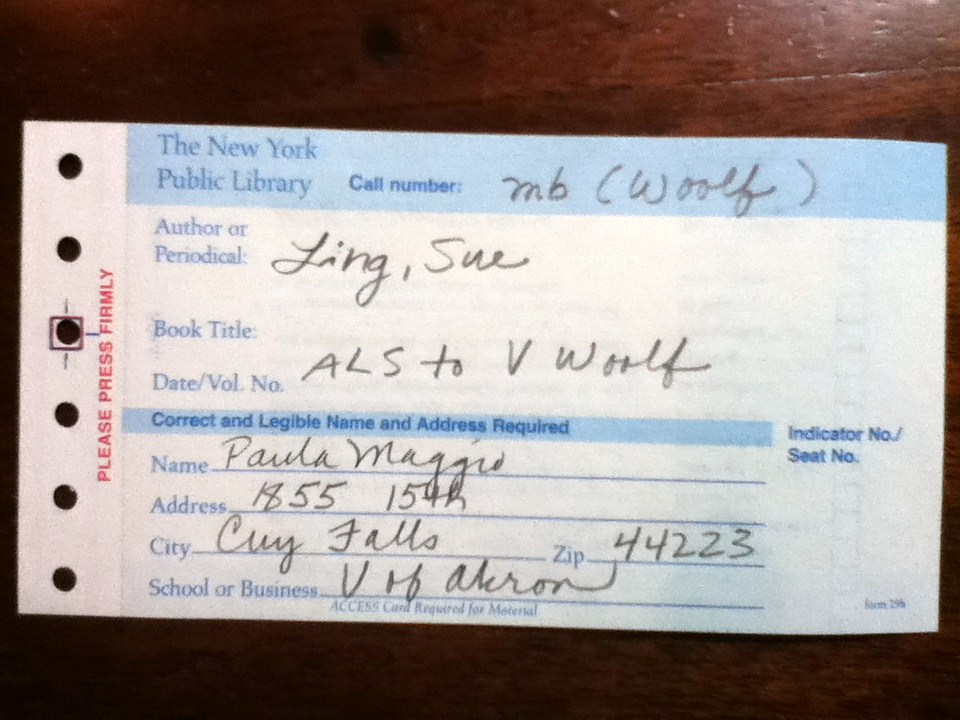
But here I am, and I just finished my first day of bending over a card catalogue drawer and filling out a multitude of tiny forms used for requesting materials from the archives of the Berg Collection.
The collection contains the world’s largest manuscript holdings of Virginia Woolf and W.H. Auden. I am there for Woolf and her friends. Another researcher is poring over Auden documents. And a third, Bill Goldstein, is working on a book, The World Broke in Two: A Literary Chronicle of 1922, which will be published by Holt. It focuses on the intertwined lives and works that year of Woolf, T. S. Eliot, E. M. Forster and D. H. Lawrence.
Of course, librarian Anne Garner introduced us, and Bill and I compared stories about former careers as journalists, recent work as adjunct faculty, and our current work on Woolf. Bill’s experiences are decidedly more impressive than mine. He is the former books editor of nytimes.com, is a contributing editor at WNBC-TV and taught at Hunter College.
And I? Well, let’s just say I have small-town credentials. Although I do admit that at heart, I am a big city girl.
The 2013 volume of Woolf Studies Annual will be devoted to the topic of Jews and/or Jewishness in Woolf’s writing.
We are less interested in the question of whether or not Woolf herself was or was not antisemitic (except insofar as this can be articulated in readings of her texts) than in how the figure of the Jew operates within her work. The special issue is not limited to work on Virginia Woolf herself, but also will welcome contributions on Leonard Woolf, and on the Bloomsbury milieu. In addition to full-length articles, we also envisage a forum of short commentary, and an annotated bibliography.
Forum:
We invite brief commentary of up to 750 words on a relevant short passage from Woolf’s writing: for example, from the “Present Day” chapter of The Years; “The Duchess and the Jeweller”; “Street Haunting”; Three Guineas; Between the Acts, and elsewhere—there is no limitation on what you might select.
Additionally, we welcome brief statements in response to the following broad questions:
How do Woolf’s representations of Jews compare with those of other modernist writers?
How have treatments of Woolf’s antisemitism/prejudice figured within Woolf scholarship?
In treating this topic within Woolf’s work, what are the salient issues?
What is the relation between her fiction and the extensive biographical record of Woolf’s comments/ruminations about Jews and Jewishness available in her letters, diaries, and memoirs? A number of such brief commentaries and statements would then be shared for response, and the opportunity for dialogue enabled, with the resulting texts published as a forum on the topic.
Annotated Bibliography Recommendations for previously published scholarship and sources on the topic are also welcome and will be included as an annotated bibliography in the special issue.
Deadlines:
Forum commentaries/statements: June 30, 2012 Full-length articles (8,000-10,000 words): August 30, 2012 N.B. WSA submission guidelines apply. Annotated Bibliography recommendations: November 15, 2012
(General articles on any topic may continue to be submitted for consideration.) please direct all correspondence, inquiries, submissions to woolfstudiesannual@gmail.com