“Thinking is my fighting,” Virginia Woolf wrote in her 1940 essay “Thoughts On Peace in an Air Raid.” That still holds true today, International Women’s Day, and every day.

“Thinking is my fighting,” Virginia Woolf wrote in her 1940 essay “Thoughts On Peace in an Air Raid.” That still holds true today, International Women’s Day, and every day.
Posted in essays, events | Tagged International Women's Day, thinking is my fighting, Virginia Woolf | Leave a Comment »
It’s the 100th anniversary of the 1920 German expressionist film, “The Cabinet of Dr. Caligari,” and Virginia Woolf is mentioned in the headline of the story on The Conversation website that celebrates that fact.

Virginia Woolf screensaver on an old keyboard-style Kindle
Woolf, the article says, “marvelled at how the set design mirrored the emotions felt by the characters and the audience: ‘it seemed as if thought could be conveyed by shape more effectively than words.'”
Woolf shared her thoughts in “The Cinema,” an article published in the July 3, 1926, issue of The Nation and Athenaeum. In it, she articulates her fascination with and fear of this newly evolving art form that at the time was strictly a black-and-white, silent medium that she believed was both parasitic and ripe with potential.
It is an art form that starts with the eyes, but the eyes are soon forced to engage the brain, she argues.
We behold them as they are when we are not there. We see life as it is when we have no part in it. As we gaze we seem to be removed from the pettiness of actual existence. The horse will not knock us down. The king will not grasp our hands. The wave will not wet our feet. … Further, all this happened ten years ago, we are told. We are beholding a world which has gone beneath the waves. – Virginia Woolf, “The Cinema”

Posted in films | Tagged Film, The Cabinet of Dr. Caligari, The Cinema, The Conversation, Virginia Woolf | Leave a Comment »
A new exhibit, “Virginia Woolf Was Here: Mapping Mrs. Dalloway,” will be on display at Amarillo College’s Southern Light Gallery in Amarillo, Texas through April 1.

Adriane Little shares the process she used to create “Virginia Woolf Was Here: Short Stories” as part of her presentation at the 28th Annual International Conference on Virginia Woolf at the University of Kent in Canterbury in 2018.
The photographic retracing of Mrs. Dalloway’s walk through London is the work of Adriane Little, a lens-based conceptual artist and educator from Kalamazoo, Mich., who has presented her work at recent Annual International Conferences on Virginia Woolf. That includes her 2018 presentation on “Virginia Woolf Was Here: Altered Books” in which she combined Woolf’s words with water from Woolf sites.
“I walked the streets of London and photographed along the path that Mrs. Dalloway walks in the novel. These are the same streets that Woolf herself walked countless times,” Little said in a news story at Myghighplains.com.
She said her “intention was not to illustrate the novel, but instead to use stream of consciousness in capturing the images. This mirrors the literary strategy of the novel.”
The exhibit is free and open to the public.
Little, on Instagram as @adriane.jpeg, is not the only one to map out Clarissa’s path in the novel.
In 2011, a group of scholars devised the Mrs. Dalloway Mapping Project, a series of interactive, annotated maps of London that serve as a guide to the novel. The maps show the paths that Clarissa, Peter and Rezia and Septimus follow over the course of the novel. The project is the creation of Adam Erwood, London Lamb, Jasmine Perrett, Anjaly Poruthoor and Manoj Vangala for an English class at the Georgia Institute of Technology.
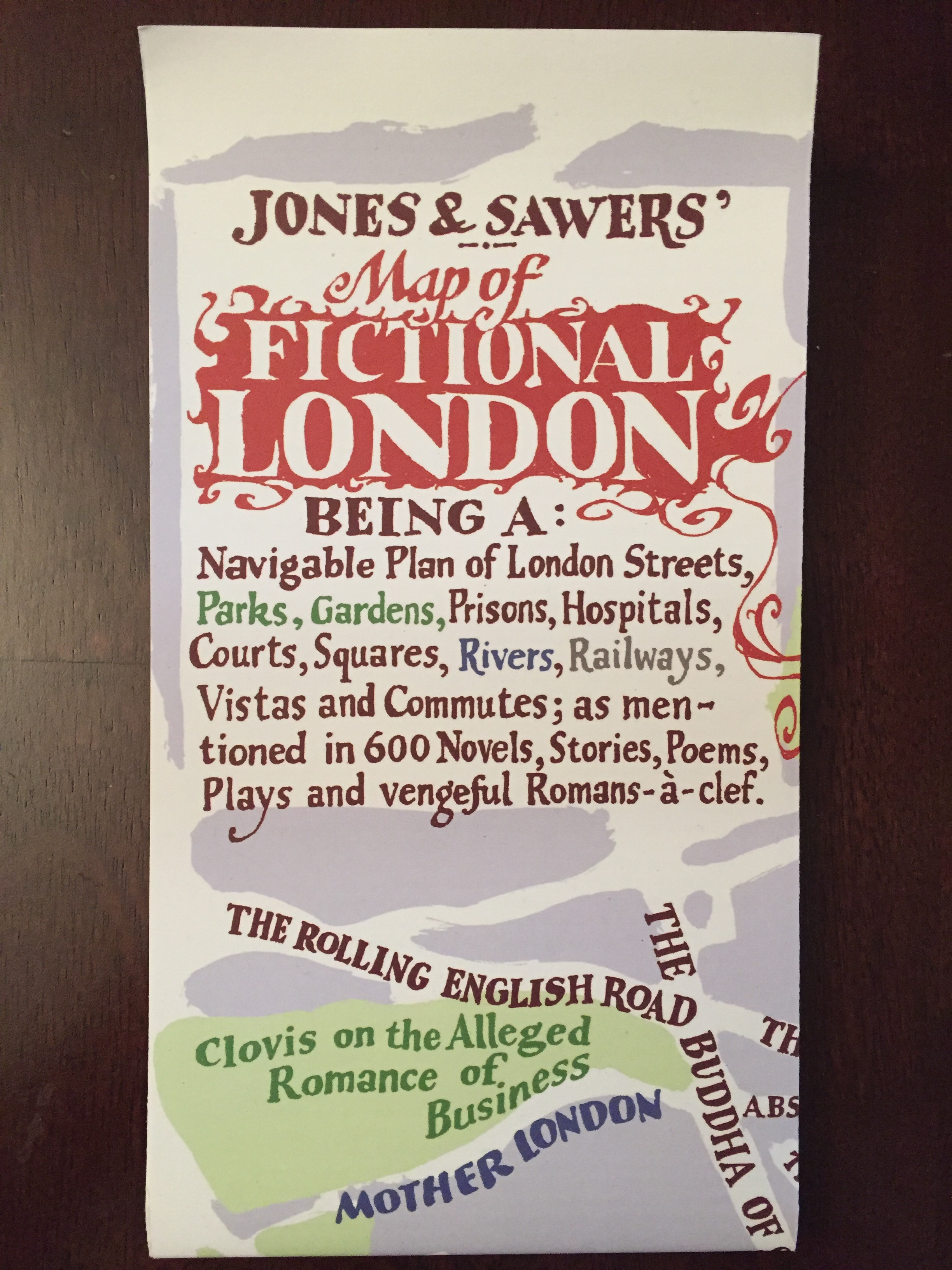
This Map of Fictional London is available from the Literary Gift Company
Posted in art exhibits, Virginia Woolf | Tagged 28th Annual International Conference on Virginia Woolf, Adriane Little, London, Mapping Mrs. Dalloway, Mrs. Dalloway | Leave a Comment »
What: A one-day conference on Virginia Woolf and Her Early Short Stories that incorporates the general meeting of the
When: Saturday, 4th April 2020, 10:30 a.m. – 4:30 p.m. Registration begins at 10 a.m.
Where: Oriental Club, First Floor, 11 Stratford Place, London WIC IES. Opposite Bond Street tube.
Cost: £35 for members of the Virginia Woolf Society of Great Britain and students; £38 for non-members. Lunch and refreshments are included.
Tickets: For tickets, contact Sarah Latham Phillips at latham_phillips@yahoo.com
Availability: Space is limited to 55 and this event is already half-booked.
Posted in events, short stories | Leave a Comment »
Mireille Duchêne, a Virginia Woolf scholar from France, last year published a new work on Woolf in both
Virginia Woolf, Carnet inédit (1907-1909) (Editions Universitaires de Dijon (EUD), Université de Bourgogne). Text Established, Edited, Translated in French and with an Introduction by Mireille< Duchêne.
Virginia Woolf, An Unpublished Notebook (1907-1909). Text Established, Edited and with an Introduction by Mireille Duchêne (Editions Universitaires de Dijon (EUD), Université de Bourgogne).
Woolf’s unpublished journal is made up of hastily written notes on the Greek and Latin classics which she had read avidly since adolescence.
While it was long thought that Woolf had no formal college education, that has been proved false. We now know that from the age of 15 to 19, Woolf took classes in continental and English history, beginning and advanced Greek, intermediate Latin and German grammar at the King’s College Ladies’ Department. She also had private tutors in German, Greek and Latin. While at King’s, Woolf reached examination level standards in some of the subjects she studied and took Greek from George Charles Winter Warr, one of the foremost Greek scholars of his day.
From the publisher comes this description:
Between 1907 and 1909 Virginia Woolf, who was not yet a world-famous writer, kept a notebook which is here published for the first time. It belongs to the Monk’s House Papers (Greek and Latin Studies). These extremely precious pages written by a 25-year-old woman illustrate the novelist’s lifelong familiarity with classical humanities. They shed new light on Virginia Woolf’s biography and on a period of her existence which the Journal largely ignores. Under the guise of simple notes jotted down on paper, it offers an intellectual portrait of someone who, like the narrator in A Room of One’s Own, has not found her place in the academic world. Written at the time when the Bloomsbury group was developing, this text makes it possible to explore the links which Virginia Woolf, overshadowed by her dead father and brother, wove between classical humanities and contemporary literary experiments.
Mireille Duchêne teaches classical and modern literature at the Université de Bourgogne in Dijon. Her research focuses on childhood and education. She has published several papers on Virginia Stephen.
The reproduction of this notebook, including Woolf’s crossings-out and alterations, takes up a scant half of this slim volume. The remaining pages are split between Duchêne’s introduction and her short essays … Coming at a time when there surely cannot be many “new” things left to publish by Woolf, An Unpublished Notebook therefore takes its rightful place on the collector’s shelf.- Times Literary Supplement review, July 12, 2019
Posted in books, diaries | Tagged books, Mireille Duchêne, Woolf in translation, Woolf journals | 1 Comment »


| M | T | W | T | F | S | S |
|---|---|---|---|---|---|---|
| 1 | 2 | 3 | 4 | 5 | ||
| 6 | 7 | 8 | 9 | 10 | 11 | 12 |
| 13 | 14 | 15 | 16 | 17 | 18 | 19 |
| 20 | 21 | 22 | 23 | 24 | 25 | 26 |
| 27 | 28 | 29 | 30 | |||


