Feeds:
Posts
Comments

Posts Tagged ‘A Room of One’s Own’

Speculative fiction, aka sci-fi – a world where at first young women, then all women, discover they have physical powers, superpowers, that enable them to rise up against the patriarchy.

One review of The Power called it “Hunger Games crossed with Handmaid’s Tale.” The author, Naomi Alderman, claims Margaret Atwood and Ursula LeGuin as mentors and models.

I read it with nary a thought of Woolf, caught up in the story and its key characters. So imagine my surprise and delight when I came across this subtle reference, accessible only to those in the know.

A sympathetic male journalist encounters one of the most powerful of the women during an extreme crisis and hopes she will help him:

“A fragment of something he read a long time ago floats through his mind. A flattering looking glass. He has to be a flattering mirror for her, reflecting her at twice her ordinary size, making her seem to herself to be strong enough to do this thing he needs her to do.”

I was able to contact Naomi Alderman and asked if she could say something about her decision to paraphrase this particular concept from A Room of One’s Own. Her reply:

“Firstly because ARoOO is just so so good. Secondly because I found that part particularly relevant to my own life, and how a good Orthodox Jewish girl is supposed to be ‘trained’ to behave – to tell men they’re wonderful all the time. And because it is so horrifying when you realise you’ve been doing it, and because in the moment of writing this scene I understood why in extremis it has been necessary for women to do this, to save their own lives.”

On the subject of women, misogyny and power, it’s ironic that the next book on my stack is Mary Beard’s Women & Power. Same subject but a far different style and approach. But both timely and powerful. When Woolf urged women to write she didn’t say to write futuristic thrillers or feminist manifestos; she said “write what you wish.”

Read Full Post »

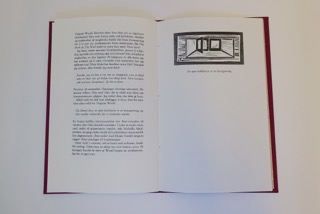
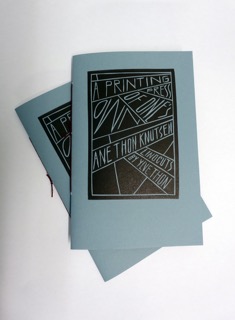
Ane Thon Knutsen with her hand-bound volume “A Printing Press of One’s Own,” introduced at this year’s Woolf conference in Reading, England.

Ane Thon Knutsen combined two loves with her project A Printing Press of One’s Own — her love of Virginia Woolf and her love of typesetting.

The two come together in her hand-set volume by the same name, which she debuted at the 27th Annual International Conference on Virginia Woolf at the University of Reading in June.

It includes Ane’s personal, heartfelt essay about her experience finding a space of her own in which she could pursue her passion — typesetting. Her search occurred at a personally challenging time, soon after becoming a mother.

The intersection of the two — and the rescue role Woolf played in it — comprise her story. It includes her experiences conducting research at the British Library, which allowed her to handle the first volumes Virginia and Leonard printed on the Hogarth Press.

About that, she writes:

What contrasts! In some cases they have really tried to print appealing books, but in others they have not made the effort, or investment of time. Inkblots. Everything off-kilter. The complete disregard for the sanctity of the type area. Scraps of paper crookedly pasted on to cover up misspelled names. Damaged types which had not been replaced. These are not books considered worthy of dignified display alongside William Morris and Gutenberg’s bible. This smacked more of punk rock and anarchy. The books bear the marks of temper and a strong will. I was touched.

The essay also includes Ane’s ruminations on why Woolf did not write about the time she spent with the typecase. As Ane puts its,  “She, who could name the feelings, details and experiences we let slip by unmentioned, was perfectly qualified to describe the meditation of typesetting.”

Thoughts of her own

According to Ane, “The book is an essay referring to A Room of One’s Own by Virginia Woolf. The essay reflects upon women’s role in letterpress, and the importance of a room of one’s own in artistic practices.

“In this book I am investigating the first books printed by Virginia Woolf at the Hogarth Press, both in practice and in the written ‘dialogue’ between Virginia Woolf and myself, as we are both self-taught typesetters.”

Two versions

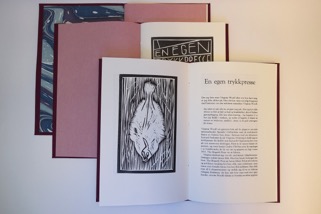
The illustrations throughout both the English and Norwegian versions of the volume are linocuts by Ane’s artist sister, Ylve Thon. All text is hand set and printed together with linocuts on a proofing press.

The English version has a blue cover, is digitally printed, and contains handprinted linocuts and is hand-bound. Both are for sale, with the English version priced at £18. The handset Norwegian version is £75.

Ane’s volume is part of her artistic research project in graphic design at Oslo National Academy of the arts, where she works on a project investigating tactility in printed matter.

You can follow her on Instagram @anetutdelaflut.

“A Printing Press of One’s Own” by Ane Thon Knutsen – Photo courtesy of Ane Thon Knutsen

A look inside – Photo courtesy of Ane Thon Knutsen

Linocuts in the volume are by Ane’s sister, the artist Ylve Thon. – Photo courtesy of Ane Thon Knutsen

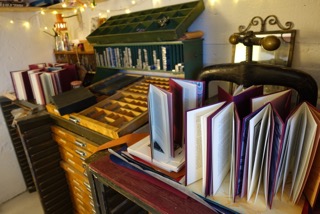
Ane’s books among some of her typesetting equipment. – Photo courtesy of Ane Thon Knutsen

Ane met Cecil Woolf at the conference, and he graciously signed a limited edition Hogarth Press centenary keepsake of Woolf’s “The Patron and the Crocus,” available from Whiteknights Press.

Read Full Post »

I’m not a literary snob—well, maybe a bit—but I’ve never had any interest in John Grisham’s blockbuster novels. I’d heard they’re page-turners, well written even though formulaic, good distractions if that’s what you’re after.

Then a friend told me that his new novel, Camino Island, wasn’t his typical corporate/legal skullduggery, that it was summer fun—a beach read—about the theft of Scott Fitzgerald’s manuscripts from the Princeton Library. The story focuses on a novelist and a bookseller in a Florida island community. Sounded promising, and the deal-maker was a Virginia Woolf reference.

Grant, a bookstore owner and collector of rare books, is showing some of his favorite acquisitions to Mercer, whom he’s trying to seduce and who is a plant, hired by Princeton’s insurer to spy on Grant for any possible connection to the stolen manuscripts. He extracts his most valuable book from safekeeping, a signed first edition of Catcher in the Rye (prized because Salinger seldom signed his books). Mercer mentions that she taught it once but that it’s not a favorite. She prefers female writers. He then brings out the rarest book he has by a woman, A Room of One’s Own.

 Mercer: “I love this book. I read it in high school and it inspired me to become a writer, or at least give it a shot.” She recites the key line: “A woman must have money and a room of her own if she is to write fiction.” They discuss Woolf—“so brave,” “a tortured soul”—and writers’ sufferings and destructive behaviors.

Mercer has been struggling to write a second novel, several years after the success of her first. Now, with free time and the windfall she’s getting from the insurance company, the narrator observes: “With a room of her own and some money in her pocket, perhaps she could settle in and write some fiction.”

The beginning grabbed me—the heist—but it was disappointing after that, with a bit of punch at the end. I tried to enjoy it, but I found Mercer a not very interesting and not very convincing protagonist. It was a quick read, and I did stick with it until the end to find out what happened to the manuscripts. But, like Mercer, I prefer to read women authors.

Still, there was Woolf—existing in the lofty presence of Fitzgerald and Salinger, Hemingway and Faulkner, holding her own with all that testosterone.

Read Full Post »

In the video posted here, Fiona Shaw does a masterful reading of “Shakespeare’s Sister” from Virginia Woolf’s feminist polemic,  A Room of One’s Own (1929), which was based on a series of lectures Woolf gave at Cambridge University in October 1928.

Woolf’s speech is one of several featured in the digital project Figures of Speech,” presented by the Almeida Theatre in London.

The project places history’s greatest speeches centre stage through a series of films read by well-known actors speaking the words of important historical figures and moments, to explore how they resonate in 2017.

Besides Woolf’s speech, the project also includes talks by:

  • Labour Party Politician Neil Kinnock spoken by Ashley Walters
  • American politician Harvey Milk spoken by Ian McKellen
  • Nelson Mandela spoken by Lucian Msamati
  • AIDS activist Elizabeth Glaser spoken by Nicola Walker

Read Full Post »

A Virginia Woolf Word Portrait arrived this morning. Created by Akron artist John Sokol, an admirer of Woolf and her writing, the portrait is entirely made up of Woolf’s words from A Room of One’s Own. Across her forehead: “But, you may say, we asked you to speak about women and fiction”. And so she did. Best. Christmas. Present. Ever. 

Read Full Post »

« Newer Posts - Older Posts »