Feeds:
Posts
Comments

Posts Tagged ‘Berg Collection’

The Life of Violet, edited by Urmila Seshagiri and just out today from Princeton University Press, is the newly discovered revised typescript of three early short stories by Virginia Woolf based on the life of her friend and mentor Violet Dickinson.

Witty, whimsical, lighthearted, and just plain fun, the book is an important discovery that I hope helps dispel the myth that Virginia Woolf was a sad, humorless writer beset by depression and suicidal thoughts.

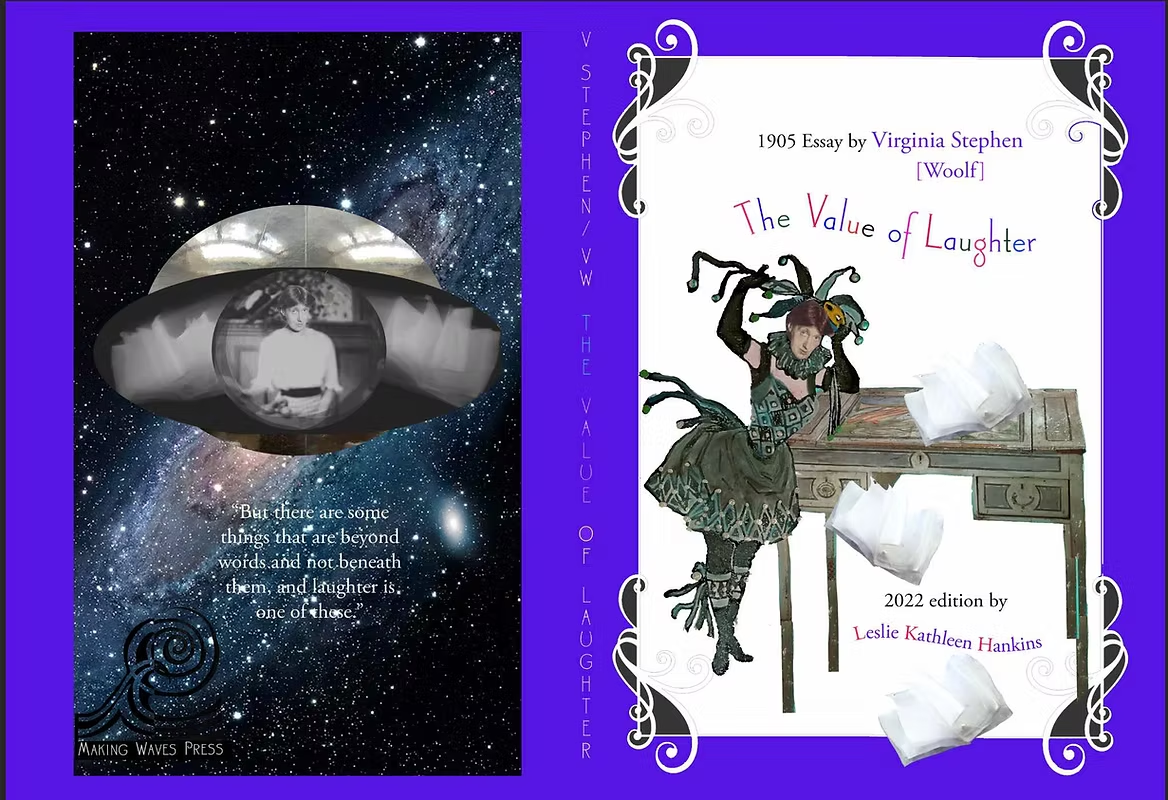
It should be no surprise that Woolf’s humor is often overlooked. That is often the case, and something Woolf recognized in her 1905 essay, “The Value of Laughter,” which was originally published in The Guardian.

Humour, we have been told, is denied to women. They may be tragic, or comic, but the particular blend which makes a humorist is to be found only in men.

Its history

Woolf drafted the three comic stories that make up The Life of Violet in 1907, at the age of 25. Before leaving to spend several weeks in Playden, Sussex, just north of Rye, she sent Dickinson the draft she had “very hastily polished off” (A Passionate Apprentice, 367).

That version, typed in violet ink and titled “Friendships Gallery,” is housed today in the Berg Collection at the New York Public Library. Until lately, it was considered the only version in existence.

But in 2022, Seshagiri discovered a professionally typed revision—with corrections Woolf made by hand in 1908—at Longleat House in Wiltshire, England, after learning about its existence via email several years earlier. It had sat in the Longleat House archives for 80 years, after disappearing into the collection of Dickinson’s papers.

About the book

The Life of Violet is a three-part mock biography of Mary Violet Dickinson (1865-1948). It uses three whimsical, comic, interrelated stories—”Friendships Gallery,” “The Magic Garden,” and “A Story to Make You Sleep” to relate Dickinson’s fanciful life as a giantess (the real Violet was six feet two) who defies the societal norms of English life.

She has a full social life without marrying and inspires others to “have a fire” of creativity within them (12). She lives in a cottage of her own that “was the beginning of the great revolution which is making England a very different place from what it was” (24). And she becomes a giant sacred heroic princess, who brings “[a]ll the most delightful things you can think of” (35) to a Japanese village, which she saves from monsters by laughing and waving her umbrella.

Foreshadowing

The Life of Violet also foreshadows literary things to come from Woolf. As a mock biography, it is a harbinger of Orlando (1928). With its focus on Violet’s cottage of her own in “The Magic Garden,” we see the original stirrings of ideas leading to A Room of One’s Own (1929). But most of all, its overall use of language, its wit, its whimsey, and its feminist thought, both sound and feel like Woolf.

A quote from Anne Fernald, editor of Mrs. Dalloway: A Norton Critical Edition, speaks to The Life of Violet’s thematic importance:

The stories are lighthearted, but in them we see how, as early as 1907, Woolf was concerned with the major themes of her career: the need for a room of one’s own, the value of an ordinary woman’s life, and the imperative to remake the way fiction is written.

In this new volume, Seshagiri stays true to Woolf. She incorporates Woolf’s handwritten edits, which incorporates edits suggested by Dickinson. And she reproduces the page layout, language, spacing, and spelling of Woolf’s revised transcript.

The extras

By including detailed “Explanatory Notes,” she also makes it easy for readers who may not be familiar with Woolf or the social and historical context of her time.

The volume also includes a preface, an afterword that provides a detailed explanation of the history of these early short stories, as well as photographs.
Read Full Post »

Today at the New York Public Library’s Berg Collection, I got firsthand help from curator Isaac Gewirtz.

First, he showed me an article he wrote comparing the proof copy of Virginia Woolf’s A Room of One’s Own to the first published copy. It includes an appendix listing every variant between the recently-acquired proof (long thought to have been lost) and the first published version.

As the article shows, Woolf made significant revisions, many related to her views on war and patriarchy. Dr. Gewirtz’s article was published last year in Woolf Studies Annual Volume 17.

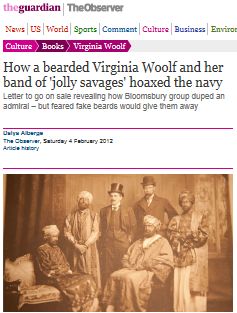
Second, Dr. Gewirtz gave me a printout of a Feb. 4 Guardian article that discusses a newly found letter related to the Dreadnought Hoax in which Woolf and four of her friends impersonated Abbysinian royalty to dupe a British admiral and board a Royal Navy dreadnought ship in 1910.

Written by Horace de Vere Cole, one of the pranksters, the letter is being offered for sale by Rick Gekoski, a London dealer in rare books and manuscripts who is imported from the U.S. The letter is accompanied by an original photograph of the hoaxers.

Third, Dr. Gewirtz told me that the Berg Collection holds one of the few existing photos of the Bloomsbury Group members who participated in the Dreadnought Hoax.

All three pieces of information connect to my research topic, the Bloomsbury pacifists.

Isaac Gewirtz is another reason why I ♥ librarians, including library curators.

Read more about my time at the Berg:

Read Full Post »

Rebecca Filner, librarian at the New York Public Library’s Berg Collection, doesn’t leave her job behind when she walks out of the Schwarzman Building on 42nd Street and Fifth Avenue.

What that means for me is that after she left work last night, she continued thinking about the Bloomsbury pacifists, the focus of my research at the Berg. And when I arrived this morning for the second day of my Short-Term Research Fellowship, she had some tips to share.

She told me of a recent Berg acquisition, a letter from Lytton Strachey to Duncan Grant.  And she also sent me links to unpublished letters from Vanessa Bell to Maynard Keynes currently housed at the Morgan Library & Museum, 225 Madison Avenue at 36th Street in Manhattan, and sent me the link to the reading room application.

Rebecca is another reason why I ♥ librarians.

Read more about my time at the Berg:

Read Full Post »

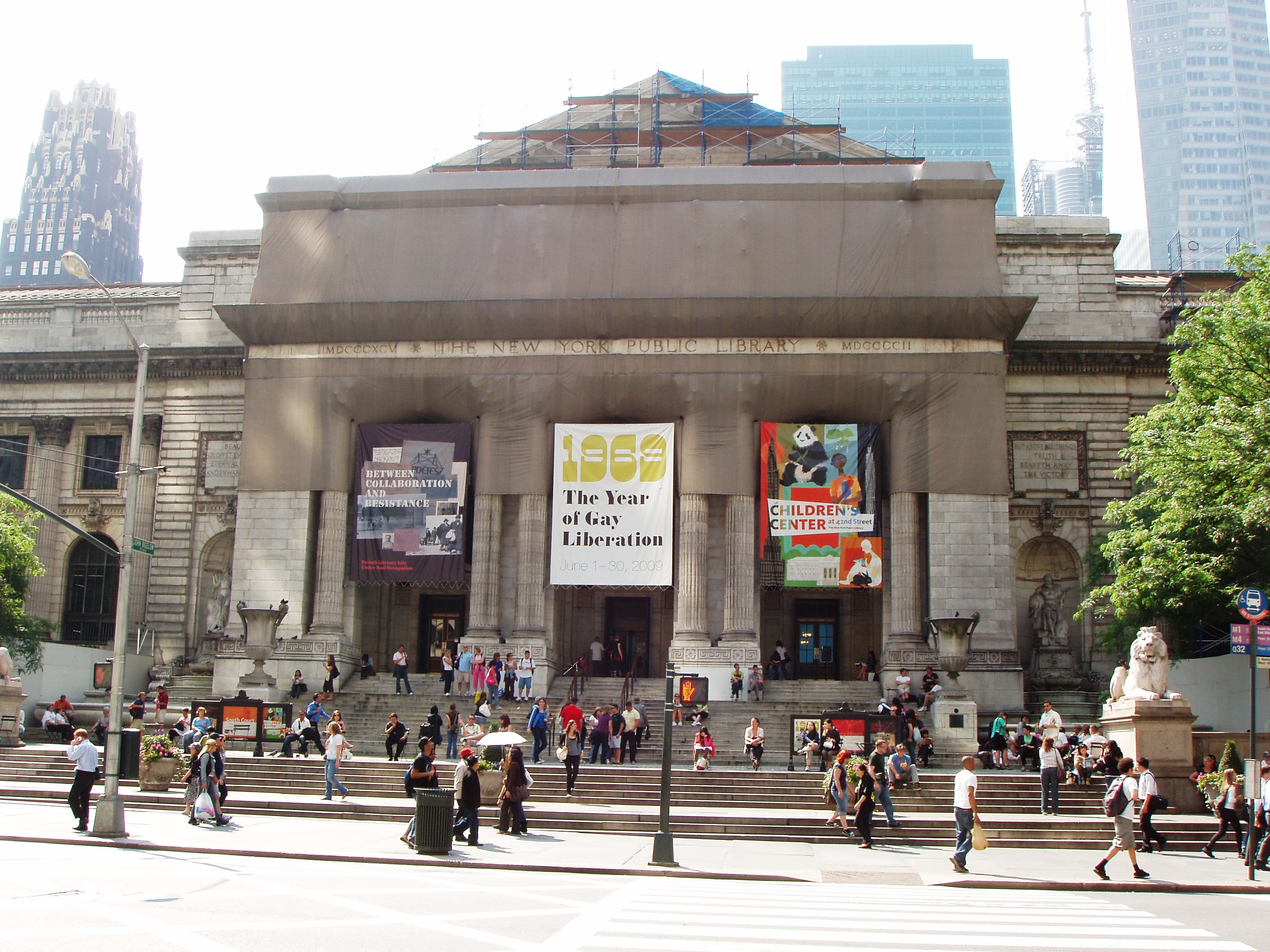
Nervous. Anxious. Excited. Awed. Those were my top four feelings today as I walked into the Schwarzman Building of the New York Public Library for the first day of my Short-Term Research Fellowship. Feelings not so different from my first trip to Manhattan when I was 12.

That summer, my Italian-American New Yorker dad drove me from Ohio to Brooklyn to visit family. As a special treat, he escorted me into Manhattan on the subway for my first visit to the city of my dreams.

We were strolling along glitzy Fifth Avenue when he suddenly stopped and pointed to the massive building with the elegant stairs and its pair of guardian lions.

“That’s the library,” he said. My mouth hung open. “You mean, it’s full of books?” I asked.

I think we went inside, but I can’t quite remember. It was a long time ago. But I will never forget the feeling of awe I experienced as I looked at that block-long building filled with one of my favorite things on earth — books.

I never would have imagined that I would be doing research on the Bloomsbury pacifists at the building that struck me dumb when I was a girl.

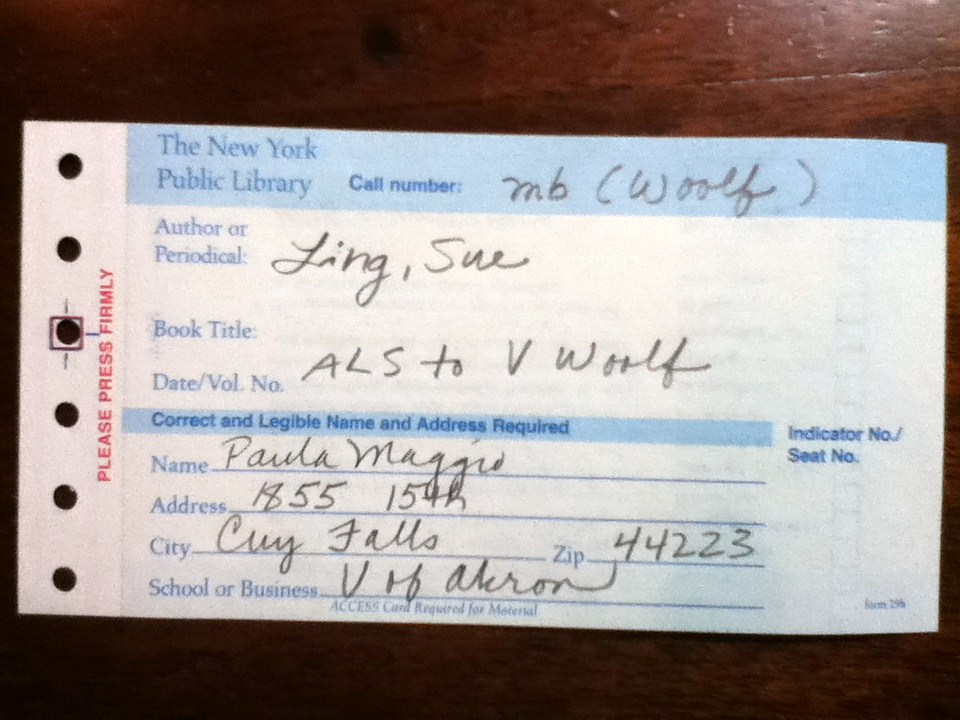
But here I am, and I just finished my first day of bending over a card catalogue drawer and filling out a multitude of tiny forms used for requesting materials from the archives of the Berg Collection.

The collection contains the world’s largest manuscript holdings of Virginia Woolf and W.H. Auden. I am there for Woolf and her friends. Another researcher is poring over Auden documents. And a third, Bill Goldstein, is working on a book, The World Broke in Two: A Literary Chronicle of 1922, which will be published by Holt. It focuses on the intertwined lives and works that year of Woolf, T. S. Eliot, E. M. Forster and D. H. Lawrence.

Of course, librarian Anne Garner introduced us, and Bill and I compared stories about former careers as journalists, recent work as adjunct faculty, and our current work on Woolf. Bill’s experiences are decidedly more impressive than mine. He is the former books editor of nytimes.com, is a contributing editor at WNBC-TV and taught at Hunter College.

And I? Well, let’s just say I have small-town credentials. Although I do admit that at heart, I am a big city girl.

Read Full Post »

The virtual public square featuring conversations about Virginia Woolf is a reality. Anne Fernald, writer in residence at The New York Public Library’s Wertheim Study last year, just posted this news on Facebook: The talk she gave at the NYPL in October is now available online as a free podcast.

Anne Fernald

“On Traffic Lights and Full Stops: Editing Mrs. Dalloway” focuses on her work preparing a textual edition of Virginia Woolf’s Mrs. Dalloway (1925) for Cambridge University Press. The 68-minute piece includes discussion of manuscript material housed in the Berg Collection of the New York Public Library.

Fernald is an associate professor of English at Fordham University where she also directs the first-year writing and composition program and is the author of Virginia Woolf: Feminism and the Reader (Palgrave 2006). She blogs at Fernham.

Other talks in the three-day Woolf lecture “festival” at the NYPL are available as free podcasts as well. They include:

Listen to more podcasts by or about Virginia Woolf.

Read Full Post »

Older Posts »