Feeds:
Posts
Comments

Posts Tagged ‘Leonard Woolf’

On Sept. 17, 1911, Virginia Stephen and Leonard Woolf enjoyed their first unchaperoned date together. On that occasion, they walked from Firle to Alfriston for tea.

A few days earlier, on Tuesday, Sept. 14, Virginia sent Leonard a postcard in advance of his visit. It read:

A fly will be at Lewes for the 11.6 on Saturday. Desmond MacCarthy and Marjorie Strachey are coming by some train, I think. Please bring no clothes.

This year, you can travel to Alfriston to celebrate the anniversary of the Woolfs’ first unchaperoned date with a special “Leonard and Virginia Tea and Chat” at Much Ado Books.

The Alfriston bookshop, which was named one of the seven best browsable bookshops in the UK, is marking the occasion with a relaxed, low-key tea-time gathering at 3 p.m. on Tuesday,  Sept. 17, at The Star Inn.

You’ll be able to order from The Star’ s afternoon menu, which offers tea, scones, and finger sandwiches, as well as cocktails and bubbly.

The afternoon will include a discussion of the life and works of Virginia and Leonard Woolf, whose work changed the course of literature and politics.

Tea drinkers will be free to share their thoughts about the pair and their lives — from Leonard’s gardening to Virginia’s printing to his political writing to her novels.

Alfriston is a lovely village set in the foot of the East Sussex Downs. It is on the banks of the Cuckmere River and the sea, and the magnificent Seven Sisters chalk cliffs are within walking distance.

Read Full Post »

Marielle O’Neill and Elte Rauch. Photo copyright by Marielle O’Neill.

Marielle O’Neill, executive council member of the Virginia Woolf Society of Great Britain, joined publisher HetMoet for the launch of its Dutch translations of Am I a Snob? by Virginia Woolf and The Wise Virgins by Leonard Woolf.

About the launch

Hosted by HetMoet, publisher Elte Rauch and bookstagram influencer Corina Maduro, the Jan. 26 launch event included a panel discussion with translators Jetty Huisman, Thomas Heij and Pauline Slot.

Featured speakers included:

  • Woolf scholar Marielle O’Neill, who is undertaking a PhD. on Leonard and Virginia Woolf’s political activism at Leeds Trinity University,
  • Rindhert Kromhout, who wrote a trilogy of young adult books about the Bloomsbury Group from the perspectives of Quentin and Angelica Bell, and
  • actor Milou van Duijnhoven, who recently starred in an Amsterdam-production of  Orlando.

Elte Rauch mixes a Stinger at the Amsterdam book launch. Photo copyright by Marielle O’Neill.

The event included 1920s jazz music, along with shakers full of Vita Sackville-West and Violet Trefusis’ favorite cocktail, the Stinger, a concoction of brandy and creme de menthe.

“It was wonderful to see Virginia Woolf being read, discussed and celebrated 142 years after her birth. And it was especially refreshing to see a spotlight being shone on Leonard Woolf; an influential and important political thinker and — with Virginia — a pioneering publisher,” O’Neill said.

About the translations

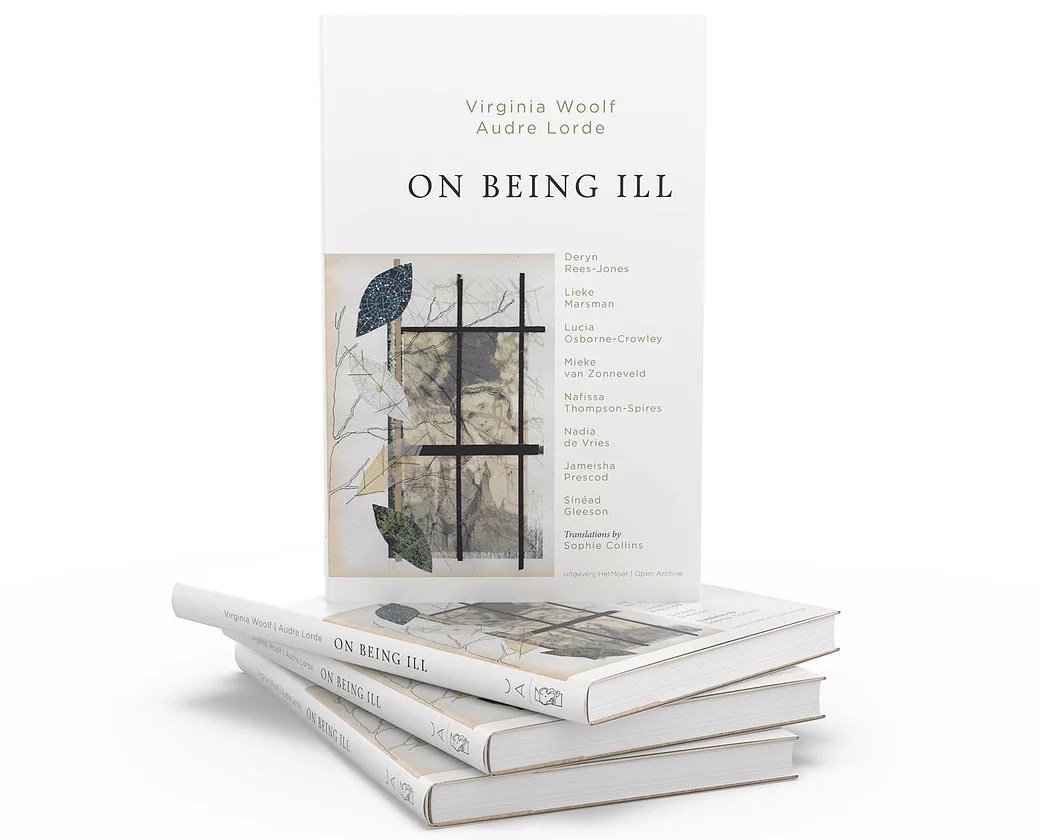
Hetmoet published the first Dutch translation of On Being Ill in 2021.

Moments of Being was first published in Dutch 40 years ago, and the same translator, Leonoor Broeder, has done this modern translation of the work, retitled as Am I a Snob? The current translation of The Wise Virgins is the first-ever in Dutch.

Louisa Albani designed the book covers. Ilse van Oosten edited the volumes and wrote the foreword for Am I a Snob.

HetMoet is a Dutch indie publisher run by Rauch, who recently set up HetMoet’s UK imprint, The New Menard Press, with Anthony Rudolf, who wrote the foreword for The Wise Virgins.

Leonoor Broeder’s translation is excellent. [This Dutch edition deviates] from the original by arranging the texts chronologically, but that works out fortunately. The separate parts thus form a coherent whole that reads like the autobiography that Woolf was unable to complete (while his husband Leonard could not stop and published a six-part autobiography). – Koen Schouwenburg, De Groene Amsterdammer

Rindhert Kromhout. Photo copyright by Marielle O’Neill.

Jetty Huisman, Thomas Heij and Pauline Slot. Photo copyright by Marielle O’Neill.

Read Full Post »

From the Virginia Woolf Podcast comes a new broadcast. This one features a discussion between Marielle O’Neill and Prof. Peter Stansky regarding the many legacies of Leonard Woolf — notably his anti-imperialism, socialism, and work in international politics. Karina Jakubowicz conducts the interview.

Karina Jacubowicz

Listen to Leonard Woolf’s Legacies.

About the podcast

The 17 episodes currently available online and on the podcast app as “The Virginia Woolf Podcast” features Jakubowicz’s interviews with writer, artists, and academics whose work has been influenced by Woolf.

The podcast is made in association with Literature Cambridge, an independent educational organisation that provides university-style lectures on a wide range of literary subjects.

About the experts

Peter Stansky is emeritus professor of history at Stanford University and the author of Leonard Woolf, Bloomsbury Socialist. His most recent publication is The Socialist Patriot: George Orwell and War.

As a distinguished historian, he has judged the Pulitzer Prize, among other book awards. Stansky was a finalist for the National Book Awards in 1967, 1973, and 1981. He has also served as a member of the Executive Council of the American Academy of Arts and Sciences, and has lectured in various parts of North America, Europe and Australia.

Marielle O’Neill is a PhD. candidate at Leeds Trinity University. Her research explores the political activism and partnership of Leonard and Virginia Woolf.

She serves on the Executive Committee of the Virginia Woolf Society of Great Britain. She has been active in politics on both sides of the Atlantic, working on Capitol Hill, Washington, DC and in the Houses of Parliament, London.

Read Full Post »

This Devastating Fever, a new novel by Sophie Cunningham, follows the story of novelist Alice Fox and her struggles to write about Leonard Woolf as he deals with what he and Virginia would do if Hitler invaded England.

The novel, shortlisted for a Victorian Premier’s Literary Award, links Leonard and Virginia’s past dilemmas to those of the present, as Alice deals with the COVID-19 pandemic.

About the author and the talk

Cunningham, a member of the Order of Australia for her literary contributions and the author of nine novels, spent 15 years writing her latest.

If you can get to Sydney, Australia, you can hear Cunningham talk about her novel at Castle Hill Library 11 a.m. – noon on May 27, as part of the Sydney Writers’ Festival.

Complex, darkly funny and deeply moving,– a dazzlingly original novel about what it’s like to live through a time that feels like the end of days, and how we can find comfort and answers in the past.

Read Full Post »

Eighty-two years ago today, Virginia Woolf walked into the River Ouse with a stone in her pocket and drowned. The act was deliberate. The effect on her friends, her family, and the literary world was profound.

Many somber thoughts have been shared on the anniversary of her death. But none are as poignant as those expressed by her husband, Leonard Woolf, in The Journey Not the Arrival Matters: An Autobiography of the Years 1929 to 1969, the final volume in his five-volume set.

Virginia’s attitude to death was very different. It was always present to her. The fact that she had twice tried to commit suicide — and had almost succeeded — and the knowledge that that terrible desperation of depression might at any moment overwhelm her mind again meant that death was never far from her thoughts. She feared it and yet, as I said, she was ‘half in love with easeful Death’ (74).

Leonard went on to write that on Friday, March 28, he “was in the garden” and “thought she [Virginia] was in the house. But when at one o’clock I went in to lunch, she was not there. I found the following letter on the sitting-room mantelpiece”:

Dearest,

I feel certain I am going mad again. I feel we can’t go through another of those terrible times. And I shan’t recover this time. I begin to hear voices, and I can’t concentrate. So I am doing what seems the best thing to do. You have given me the greatest possible happiness. You have been in every way all that anyone could be. I don’t think two people could have been happier till this terrible disease came. I can’t fight any longer. I know that I am spoiling your life, that without me you could work. And you will I know. You see I can’t even write this properly. I can’t read. What I want to say is I owe all the happiness of my life to you. You have been entirely patient with me and incredibly good. I want to say that – everybody knows it. If anybody could have saved me it would have been you. Everything has gone from me but the certainty of your goodness. I can’t go on spoiling your life any longer.

I don’t think two people could have been happier than we have been (93).

He went in search of her.

When I could not find her anywhere in the house or garden, I felt sure that she had gone down to the river. I ran across the fields down to the river and almost immediately found her walking-stick lying upon the bank. I searched for some time and then went back to the house and informed the police. It was three weeks before her body was found when some children saw it floating in the river (94-95).

The “long-drawn-out horror” of those three weeks produced in him “a kind of inert anaesthesia. It was as if I had been so battered and beaten that I was like some hunted animal which exhausted can only instinctively drag itself into its hole or lair” (95-96).

Past posts on Virginia Woolf’s death

Read Full Post »

Older Posts »