The Life of Violet, edited by Urmila Seshagiri and just out today from Princeton University Press, is the newly
Witty, whimsical, lighthearted, and just plain fun, the book is an important discovery that I hope helps dispel the myth that Virginia Woolf was a sad, humorless writer beset by depression and suicidal thoughts.
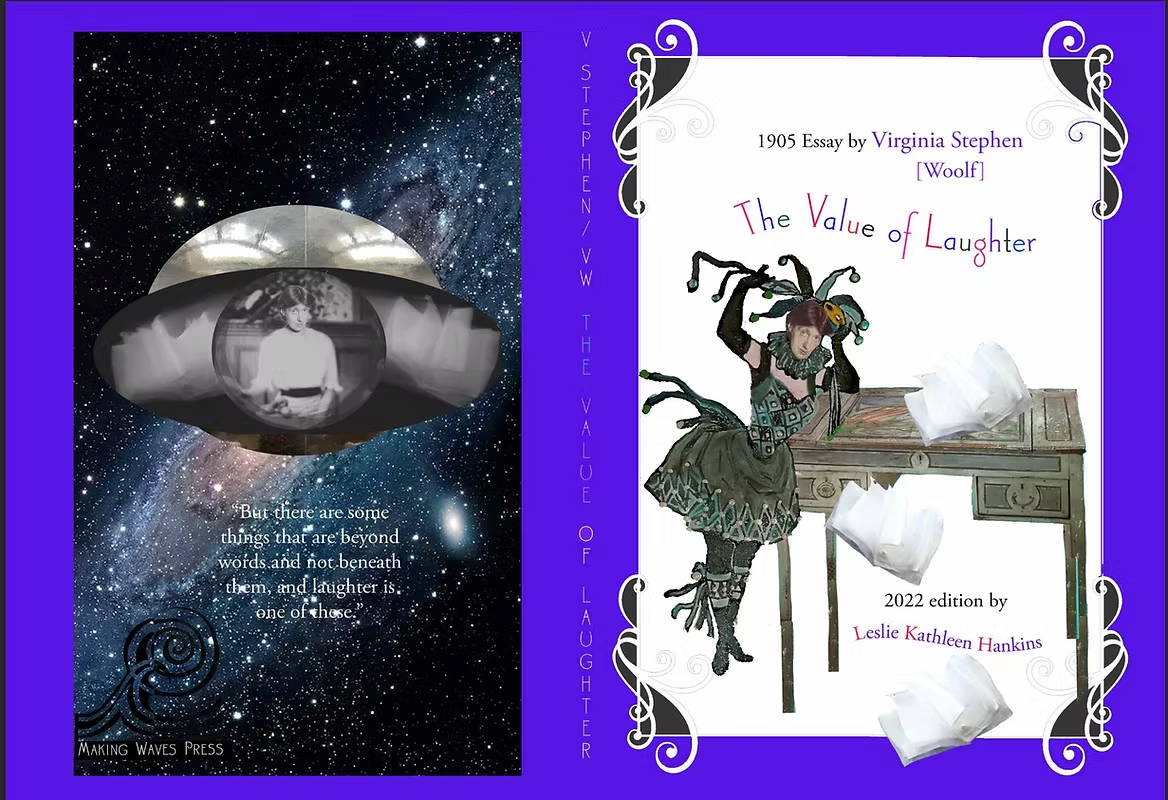
It should be no surprise that Woolf’s humor is often overlooked. That is often the case, and something Woolf recognized in her 1905 essay, “The Value of Laughter,” which was originally published in The Guardian.
Humour, we have been told, is denied to women. They may be tragic, or comic, but the particular blend which makes a humorist is to be found only in men.
Its history
Woolf drafted the three comic stories that make up The Life of Violet in 1907, at the age of 25. Before leaving to spend several weeks in Playden, Sussex, just north of Rye, she sent Dickinson the draft she had “very hastily polished off” (A Passionate Apprentice, 367).
That version, typed in violet ink and titled “Friendships Gallery,” is housed today in the Berg Collection at the New York Public Library. Until lately, it was considered the only version in existence.
But in 2022, Seshagiri discovered a professionally typed revision—with corrections Woolf made by hand in 1908—at Longleat House in Wiltshire, England, after learning about its existence via email several years earlier. It had sat in the Longleat House archives for 80 years, after disappearing into the collection of Dickinson’s papers.
About the book
The Life of Violet is a three-part mock biography of Mary Violet Dickinson (1865-1948). It uses three whimsical, comic, interrelated stories—”Friendships Gallery,” “The Magic Garden,” and “A Story to Make You Sleep” to relate Dickinson’s fanciful life as a giantess (the real Violet was six feet two) who defies the societal norms of English life.
She has a full social life without marrying and inspires others to “have a fire” of creativity within them (12). She lives in a cottage of her own that “was the beginning of the great revolution which is making England a very different place from what it was” (24). And she becomes a giant sacred heroic princess, who brings “[a]ll the most delightful things you can think of” (35) to a Japanese village, which she saves from monsters by laughing and waving her umbrella.
Foreshadowing
The Life of Violet also foreshadows literary things to come from Woolf. As a mock biography, it is a harbinger of Orlando (1928). With its focus on Violet’s cottage of her own in “The Magic Garden,” we see the original stirrings of ideas leading to A Room of One’s Own (1929). But most of all, its overall use of language, its wit, its whimsey, and its feminist thought, both sound and feel like Woolf.
A quote from Anne Fernald, editor of Mrs. Dalloway: A Norton Critical Edition, speaks to The Life of Violet’s thematic importance:
The stories are lighthearted, but in them we see how, as early as 1907, Woolf was concerned with the major themes of her career: the need for a room of one’s own, the value of an ordinary woman’s life, and the imperative to remake the way fiction is written.
In this new volume, Seshagiri stays true to Woolf. She incorporates Woolf’s handwritten edits, which incorporates edits suggested by Dickinson. And she reproduces the page layout, language, spacing, and spelling of Woolf’s revised transcript.
The extras
By including detailed “Explanatory Notes,” she also makes it easy for readers who may not be familiar with Woolf or the social and historical context of her time.
The volume also includes a preface, an afterword that provides a detailed explanation of the history of these early short stories, as well as photographs.