Feeds:
Posts
Comments

Posts Tagged ‘Virginia Woolf’

A Virginia Woolf Word Portrait by Akron, Ohio artist John Sokol received as a Christmas gift in 2016. The words of “A Room of One’s Own” form her visage.

How did Virginia Woolf celebrate Christmas? What thoughts did that day bring to her mind? I thumbed through the edited versions of her diaries to find out.

Editor Anne Olivier Bell includes explanations of where Virginia and Leonard were at Christmas through the years. But while the edited diaries include three entries for days near Christmas, only two of Virginia’s entries were written on either Christmas Eve or Christmas Day.

Here is a synopsis of where the Woolfs spent Christmas from 1917 through 1940, along with what they did and what Virginia wrote.

1917: Leonard and Virginia are at Asheham for Christmas, the rented country house in East Sussex where they spent weekends and holidays from 1912 until 1919. (D1 93)

1916-1922: No mention of the Woolfs’ Christmas is included in Volumes I or II of the edited diaries.

1923: Leonard and Virginia spend Christmas at Monk’s House in Rodmell, Sussex, the 16th-century home they began occupying in 1919. (D2 278)

1924: The Woolfs are again at Monk’s House, arriving on Christmas Eve and bringing Angus Davidson with them. Virginia had collaborated with Quentin Bell to produce a Christmas Supplement to the Charleston Bulletin. It recorded scenes in the life of Duncan Grant. (D2 327)

1925: The Woolfs spend Christmas at Charleston, since Monk’s House is in the midst of alterations. Virginia and Quentin again collaborated on a written piece, this time depicting scenes from the life of Clive Bell. (D3 53)

Vanessa Bell painting of Woolf knitting in an armchair at Asheham

1926: Virginia and Leonard spend Christmas in Cornwall at Eagle’s Nest, Zennor with Ka and Will Arnold-Forster. (D3 119)

1927: The Woolf take the train from London to Lewes on Christmas Eve, then drive to Charleston. They spend three nights there before going back to Monk’s House. Vanessa and Clive are away, spending Christmas with his widowed mother in Wiltshire. (D3 169)

1928-1930: No mention of Christmas is included in Volume III of the diaries for these years.

1931: The diary for this year includes the only entry written on Christmas Day. It reads in part:

Friday Xmas morning

Lytton is still alive this morning. We thought he could not live through the night. It was a moonlit night . . . This may be the turn, or may mean nothing. We are lunching with the Keynes’. Now again all ones sense of him flies out & expands & I begin to think of things I shall say to him, so strong is the desire for life—the triumph of life…

Talk to L. last night about death: its stupidity; what he would feel like if I died. He might give up the Press; but how one must be natural. And the feeling of age coming over us: & the hardship of losing friends; & my dislike of the younger generation; & then I reason, how one must understand. And we are happier now. (D4 55)

1932-1935: The Woolfs are at Monk’s House for Christmas. In 1933, Vita Sackville-West and her two sons are guests for tea. (D4 133, 195, 266, 360)

1936-1938: Virginia and Leonard are again at Monk’s House. In 1936, they have lunch and tea with Lydia and Maynard Keynes, beginning a Christmas tradition. This year, the tea is at Tilton. In 1937, the Woolfs host lunch for the four of them. In 1938, tea is at Tilton and Christmas dinner at Charleston. (D4 44, 122, 193)

1939: The Woolfs are at Monk’s House and bicycle to Charleston in a fog for Christmas dinner. (D4 252)

1940: At Monk’s HouseVirginia pens a two-part entry dated Tuesday 24 December, which contrasts the soberness of life during wartime with the natural beauty of the countryside.The second portion reads in part:

[Later] 24th Dec. Christmas Eve, & I didnt like to pull the curtains so black were Leonard & Virginia against the sky…and then the walk by the wall; & the church; & the great tithe barn. How England consoles & warms one, in the deep hollows, where the past stands almost stagnant. And the little spire across the fields…

Yes, our old age is not going to be sunny orchard drowse. By shutting down the fire curtain, though, I find I can live in the moment; which is good; why yield a moment to regret or envy or worry? Why indeed? (D5 346)

The doorway to Virginia Woolf’s bedroom on a sunny July day at Monk’s House, Rodmell, Sussex.

Read Full Post »

This news comes from the Virginia Woolf Society of Great Britain. Member Martin Ferguson Smith is the author or co-author of two new articles on pivotal figures in the Bloomsbury Group.

  1. “Clive Bell’s Memoir of Annie Raven-Hill”, English Studies 100 (2019), pp. 823-854. Illustrated. With Helen Walasek.
    The first publication of Clive Bell’s frank recollections of his first lover, the wife of the illustrator and cartoonist Leonard Raven-Hill. The affair began in 1899, when she was 35 and he not quite 18, and continued on and off until 1914, seven years after he married Vanessa Bell. The memoir, fully annotated and discussed by the authors, is published in good time for the centenary of the exclusive Memoir Club, founded on 4 March 1920. Click on http://doi.org/10.1080/0013838X.2019.1658944, then select PDF. Please note that the authors’ allowance of free views via this link is not unlimited.
  2. “A Complete Strip-off: A Bloomsbury Threesome in the Nude at Studland”, The British Art Journal 20, 2 (Autumn 2019), pp. 72-77. Illustrated. The first presentation and discussion of a remarkable collection of nude photographs, taken out of doors, of Vanessa Bell, Clive Bell, and Roger Fry at Studland, Dorset, in September 1911. Accessible online, by kind permission of the editor of BAJ, at (and only at) www.martinfergusonsmith.com under “MODERN, Articles” and “RECENT NEWS, NOVEMBER 2019”.

Read Full Post »

The Virginia Woolf Society of Great Britain will celebrate Virginia Woolf’s birthday on Saturday, Jan. 25, with its 21st annual Virginia Woolf Birthday Lecture featuring Claire Davison “Singing Songs of Sixpence? Virginia Woolf, Ethel Smyth and the languages of music.”

Tavistock Hotel

Davison is Professeur de Literature Moderniste, University Sorbonne Nouvelle, Paris.

Lecture: 2 p.m; doors open at 1:30 p.m.
Location: MAL 532, Main Building, 5th floor, Birkbeck College, Malet Street, London WC1E 7HX
Wine Reception: 3:15 p.m.
Location: Dining room, Tavistock Hotel, WC1H 9EU
Cost: £20 Virginia Woolf Society members/ students & concessions, £25 non-members. The price includes a wine reception at the Tavistock Hotel following the lecture and a printed copy of the lecture to be posted.

Tickets: For tickets, please apply to Lynne Newland, send cheques to 84 Waterman Way, London, E1W 2QW, giving email address for receipt of payment; or pay by BACS to Virginia Woolf Society GB, sort code 09-06-66; acct no 40411044. Bank Santander. Reference: initial/surname/BL e.g. LNEWLAND BL. If paying by BACS please notify Lynne at lynne@newlandmail.com.

Accommodations: The Tavistock Hotel is offering a 20% discount for Virginia Woolf society members. Please quote society event and membership number. The group’s contact is Tony Smith, Operations Manager.


Read Full Post »

Since I am currently studying in Canterbury, it would be unthinkable for me, Virginia Woolf’s admirer and scholar, not to visit St. Ives, the mythic place that inspired the most of Virginia Woolf’s novels, but particularly Jacob’s Room, To the Lighthouse and The Waves.

Talland House

My own exploration of the site has been inspired by Ratha Tep’s Back to the lighthouse: In search of Virginia Woolf’s lost Eden in Cornwall” that appeared in The New York Times on Feb. 26, 2018.

However, as I and my husband chose to visit St. Ives at the very beginning of November, the weather conditions did not permit us to see all the places we had longed to see.

From London to St. Erth

We started our journey to St. Ives early on Friday morning and after we had arrived in London, we boarded the Great Western Service from London to St. Erth.

Surprisingly, the five-hour journey turned out to be quite tolerable, thanks to the comfortable service and a good read (Woolf’s Orlando). How different, longer and more uncomfortable the Stephens’ journey must have been at the turn of the 20th century, with all the luggage and servants packed for their summer stay in Talland House!

In St. Erth we had to change for a local service running to St. Ives, a beautiful scenic ride alongside the Cornish coast.

In St. Ives

We arrived in St. Ives around 6 p.m. and made our way up the hill to our B&B that I had chosen due to its location with a view of The Island with St. Nicholas Chapel and Godrevy Lighthouse – the lighthouse!

Although we found a lot of useful information about tourist attractions in St. Ives and its surroundings in a folder in our room, the official guide booklet did not mention Virginia Woolf and the Stephens as famous residents of the town.

The view from our window – Godrevy Lighthouse in the distance
The view of the Island and St. Nicholas Chapel

Exploring the town

The following day, which was extremely windy, we started our exploration of the town. In spite of the construction of modern buildings, numerous hotels and other vacation accommodation, the spirit of the old town from the Stephens’ days was still noticeable – crooked hilly streets in the centre, several churches and the incessant sound of breaking waves.

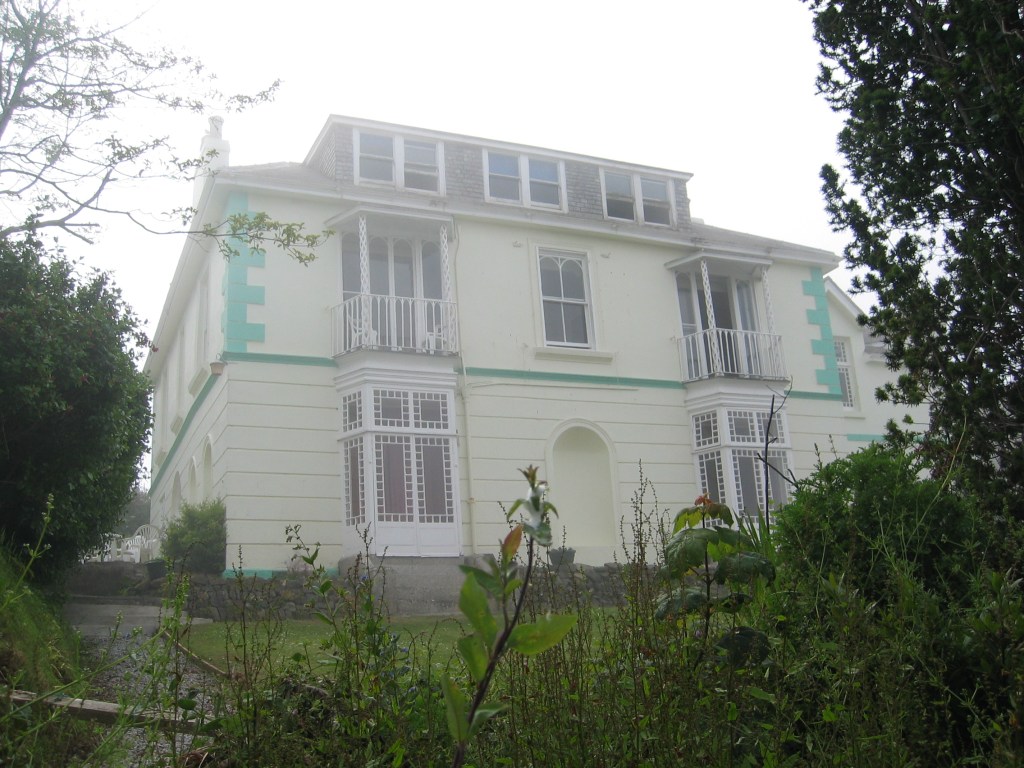
After hiking up to St. Nicholas Chapel, we visited Talland House, which is located right above the local railway station and which is nowadays, unfortunately, encircled by quite ugly blocks of summer apartments. Luckily, the house is now in the hands of Chris and Angela Roberts who try to renovate the house and re-create the garden in its original spirit. You can read about their praiseworthy effort on a sign attached to the wall of the house.

Woolf talks about her father’s discovery of the house in “A Sketch of the Past” as follows:

Father on one of his walking tours, it must have been in 1881, I think – discovered St. Ives. He must have stayed there, and seen Talland House to let. He must have seen the town almost as it had been in the sixteenth century, without hotels, or villas; and the Bay as it had been since time began. It was the first year, I think, that the line was made from St Erth to St Ives – before that, St Ives was eight miles from a railway. Munching his sandwiches up at Trengenna perhaps, he must have been impressed, in his silent way, by the beauty of the Bay; and thought: this might do for your summer holiday, and worked out with his usual caution ways and means.

Main shopping street in the town centre
Talland House – the steps below the left French window are those where the Stephens used to take their family photo
Sign about the current owners’ aim for Talland House garden
Talland House garden

View from the garden

Even though the house is not opened to the public to admire its Victorian beauties, we were still able to appreciate the view from the garden – Godrevy Lighthouse in the distance, which made Leslie Stephen move his London household to St. Ives every summer until 1894. We visited the garden in an inappropriate season so we could not see its blooming flowers.

However, we were able to see the steps below the left French window of the house where the family used to sit and have their family pictures taken. Moreover, the window directly makes you think of the window from the novel To the Lighthouse which symbolised the distance and seemingly impassable boundary between the house and the lighthouse, or the private life of the family and the outside.

Quite surprisingly, despite the distance from the ocean, the breaking of waves was still audible from the garden of Talland House, as well as from our hotel room, with the same intensity as Woolf describes in the following quotation from “A Sketch of the Past”:

If life has a base that it stands upon, if it is a bowl that one fills and fills and fills – then my bowl without a doubt stands upon this memory. It is of lying asleep, half awake, in bed in the nursery at St Ives. It is of hearing the waves breaking, one, two, one, two, and sending a splash of water over the beach; and then breaking, one, two, one, two, behind a yellow blind.

The view of the Lighthouse from Talland House garden

The fact that Woolf places this memory of St Ives and at the base of her life-experience bowl reveals how much she was influenced by the place. As she mentions later in the same memoir, “In retrospect nothing that we had as children made as much difference, was quite so important to us, as our summers in Cornwall”, by which she admits the formative effect of the Stephens’ holidays on the Cornish coast. It was so overwhelming to stand in front of the house to which Woolf pays tribute in To the Lighthouse, but sadly, without being able to talk to the Stephens.

To the lighthouse . . . sort of

The following day we decided to pursue James’s childish wish to visit the lighthouse. Owing to windy weather conditions and rough sea we were forced to abandon the idea of making a boat trip and we went by bus to Upton Towans (line T2 for those who would like to do the same) and from there we followed the Coastal Path to Godrevy Beach and the headland providing the best view of Godrevy Lighthouse.

The scenery along the path was astonishing and it was exciting to approach closer and closer the lighthouse which is the main source of the novel’s symbolism. The inner voice in my head was repeating Mr. Ramsay’s excuse “It won’t be fine” and Nancy’s and Lily’s concern about “What does one send to the Lighthouse?”

When we got to the closest viewpoint on the mainland, we sat on a bench and observed waves breaking on the little island’s shore. It is a pity that today you cannot see the lighthouse’s rotating “yellow eye” because it has been replaced by LED light mounted on a platform nearby the original lighthouse.

I must frankly admit that after two days of harsh wind and rain, after getting soaked while watching seals in a cove, I started to be more sympathetic to Mr. Ramsay’s scathing sentence “It won’t be fine” – was he just the more rational one? Did my own journey to the lighthouse reconcile me with the man?

Coastal path to Godrevy Lighthouse
Godrevy Lighthouse

I would recommend visiting St. Ives to all those who are deeply in love with Virginia Woolf and her writing because it is great to get a sense of the place that I had been imagining in my head for at least a decade.

More Cornish coast magic to explore

Unfortunately, we did not have time to visit surrounding villages such as Zennor where Woolf lived when she returned to the town as an adult woman. I am convinced that this visit to St. Ives is not our last one and that we will continue exploring the magic of the Cornish coast and landscape. We definitely need to make a boat trip from St. Ives to the lighthouse, which must be really enjoyable in the summer.


Read Full Post »

I have one foot in each of two literary worlds–Virginia Woolf and creative nonfiction–and am always pleased when I find crossover between the two, as in this remembrance of Louise DeSalvo in Brevity: “Losing Louise, Finding Joy: The Death of a Mentor and the Afterlife of Her Legacy.”

She died Oct. 31, 2018, in Montclair, N.J., at the age of 76.


Read Full Post »

« Newer Posts - Older Posts »