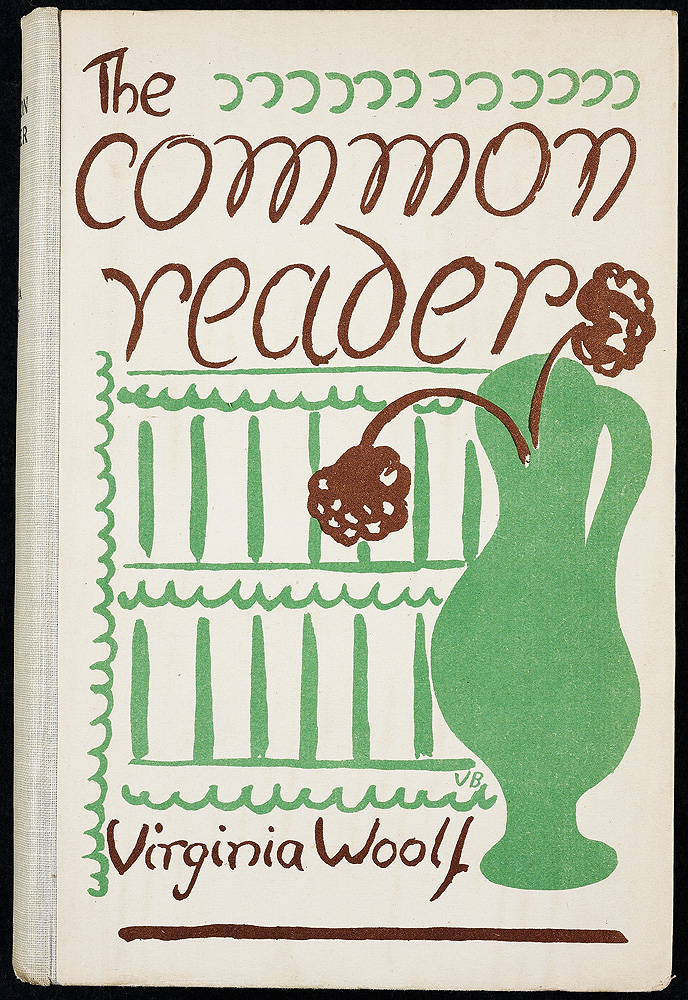
The Common Reader, Virginia Woolf’s book of essays published in 1925 with a jacket design by her sister Vanessa Bell, was provisionally titled Reading.
In it, she planned to revise some of her previously published essays and add some new ones, according to Mark Hussey in Virginia Woolf A to Z. Among its most important essays are “On Not Knowing Greek,” “Modern Fiction,” and “How It Strikes a Contemporary.”
One hundred years ago today, in her Sept. 5, 1923, diary entry, Woolf fills the half hour before dinner with her thoughts about beginning to write her book of collected essays:
A cold douche should be taken (& generally is) before beginning a book. It invigorates; makes one say “Oh all right. I write to please myself,” & so go ahead. It also has the effect of making me more definite & outspoken in my style, which I imagine all to the good. At any rate, I began for the 5th but last time, I swear, what is now to be called The Common Reader; & did the first page quite moderately well this morning. After all this stew, its odd how, as soon as I begin, a new aspect, never all this 2 or 3 years thought of, at once becomes clear; & gives the whole bundle a new proportion. To curtail, I shall really investigate literature with a view to answering certain questions about ourselves–Characters are to be merely views: personality must be avoided at all costs. I’m sure my Conrad adventure taught me this. Directly you specify hair, age, &tc something frivolous, or irrelevant, gents the book –Dinner! – Diary 2, 265.
Note: The deadline for paper proposals has been extended to Jan. 31, 2024.
California State University, Fresno, in Fresno, Calif., will host the 33rd Annual International Conference on Virginia Woolf: “Woolf, Modernity, Technology,” June 6-9, 2024, and the call for papers has gone out.
Call for papers
Organizers invite paper, panel, workshop, and exhibition proposals that engage with the 2024 theme, “Woolf, Modernity, Technology.” Technological innovation regularly inspires a social, cultural, artistic, and political revolution.
Though evolving artificial intelligence programs are the most recent iteration of this, epistemological and ontological crises underwritten by technics reverberate through modernity. This conference embraces the expansive, cosmopolitan, and transnational turn in modernist studies to trace the interaction of networks with the aesthetics, techniques, and vocabulary of modernisms and the way in which these modernisms are indebted to modernity’s technological ruptures and innovations.
Accelerating technological climates force us to ask, what does it mean to be human? If a machine can make and replicate art and literature, and possibly even innovate in the arts, where does that leave space for us as creators and contributors? Do human-agent interactions redefine relations again, redoubling what Woolf said in 1924, that “All human relations have shifted,” which leads to “a change in religion, conduct, politics, and literature”?
Where do we locate the nexus of the “little daily miracles, illuminations, matches struck unexpectedly in the dark” that Woolf wrote about in To The Lighthouse? Is it (can it be?) contained in the output of an algorithm?
“Woolf, Modernity, Technology” brings into relief relations and tensions between literature, art, technology, modernity, and humanity that modernism broadly, and Woolf specifically, has long negotiated. Here, we define both modernity and technology in their most expansive and loosest expressions: modernity invites historical, political, economic, cultural, and theoretical approaches – among many others – and technology invites thinking on technê and technics, technology, technicity, technique, tool, on art, writing, and praxis as technologies.
Possible topics might include: -gender, race, sexualities, and relationships in the rise of modernity and an age of innovation -modernity and/or technology and ontology, metaphysics, ethics, epistemology -technê, tech, technics -technology’s and modernity’s relation to nature or the natural -digital humanities, critical digital pedagogy, or pedagogical experiments with technology -writing, communication, or travel technologies -extended, augmented, and virtual realities -aesthetic innovation, poiesis, art and artistic production, art and AI -technologies of peace -technologies of war, imperialist expansion, or capitalism -explorations of what it means to be human, animal, or machine -medical humanities and scientific approaches -technologies of printing and publishing -neural networks, network theory, collaboration, loops, and circuits -human-agent interaction -modernist technologies and temporality
While this list offers suggestions or possible entrances into a conversation, we welcome all ideas and approaches and seek to traverse disciplines and time periods. Anyone interested in presenting is invited to submit a proposal for a paper, panel, roundtable, workshop, or exhibition on Woolfian or Bloomsbury topics.
Exhibitions could be digital (as in digital humanities projects) or could include displays of crafts or material objects related to the conference theme. Interactive workshops of 90 minutes will also be offered throughout the conference and we welcome submissions for non-traditional formats.
Please specify in your proposal if you are submitting:
An interactive workshop (abstract of 500 words)
Panel or Roundtable (abstract of 500 words for the entire panel or roundtable)
A paper (abstract of 250 words)
A digital/material object exhibition or display (abstract of 250 words)
A non-traditional form of presenting (abstract of 250-500 words)
Pre- and post-conference activities will be held June 5 and 9, with trips to Yosemite National Park and Sequoia/Kings Canyon.
Got questions?
Email conference organizer Ashley Foster, associate professor at CSU, Fresno, at foster@csufresno.edu or at woolf2024@mail.fresnostate.edu with any questions.
In August of 1923 Virginia Woolf was in the middle of writing the novel that would eventually be published in 1925 under the title Mrs. Dalloway. After writing in her diary that she was “battling for ever so long” with the novel — tentatively titled The Hours — on the following day, she spelled out the stream of consciousness technique she planned to use in her groundbreaking work.
In this oft-quoted passage written on Aug. 30, 1923, she describes the process as digging out “beautiful caves” behind her characters. This is what she wrote:
You see, I’m thinking furiously about Reading & Writing. I have no time to describe my plans. I should say a good deal about The Hours, & my discovery; how I dig out beautiful caves behind my characters; I think that gives exactly what I want; humanity, humour, depth. The idea is that the caves shall connect, & each comes to daylight at the present moment — Dinner! –Diary 2, 263.
Later in the year, on Oct. 15, she describes the process a bit differently:
It took me a year’s groping to discover what I call my tunnelling process, by which I tell the past by installments, as I have need of it. – A Writer’s Diary, 60.
One hundred years ago today, on Saturday, 29 August 1923, Virginia Woolf wrote in her diary about the novel she was writing. Originally titled The Hours, it would be published in 1925 as Mrs. Dalloway.
I’ve been battling for ever so long with ‘The Hours’, which is proving one of my most tantalising & refractory of books. Parts are so bad, parts so good; I’m much interested; can’t stop making it up yet — yet. What is the matter with it? But I want to freshen myself, not deaden myself, so will say no more. Only I must note this odd symptom; a conviction that I shall go on, see it through, because it interests me to write it. — Diary 2, 262.
Academic tomes are usually quite pricey. But today the good news is that The Oxford Handbook of Virginia Woolfis now available in paperback, bringing the price down to $50.
The book is edited by Anne Fernald, professor of English and Women’s, Gender, and Sexuality Studies at Fordham University. Its 39 original chapters written by internationally prominent scholars do the following:
Consider Woolf’s career chronologically and places her novels in the context of her life, world events, and the non-fiction she wrote alongside them to highlight the centrality of essay-writing and reviewing to her career
Assume her feminism and examines its many facets and broadens our vision of Woolf’s world beyond Bloomsbury by looking at her many circles of women friends, her engagement with women’s education and the suffrage movement, and the role of Hogarth Press in the larger context of publishing
Include a wide range of chapters on Woolf’s afterlives.