I can’t take credit for these non-fiction Woolf sightings. That goes to Benjamin Hagen, president of the International Virginia Woolf Society, who posted them on Facebook.
From Ann Patchett
First comes Ann Patchett’s “Eudora Welty: An Introduction,” in which Patchett describes her encounters with Welty in writing and in person.
It begins with Woolf and with Welty’s foreword to To the Lighthouse (1927) and leads into a reflection on first encounters and later returns.
The piece is included in These Precious Days, a 2021 collection of Patchett’s essays.
From Brian Dillon
Second is critic and essayist Brian Dillon’s “Vagueness” in Affinities, just out in paperback (2023), which includes a chapter on the proto-modernist photographs of Julia Margaret Cameron, Woolf’s Victorian great-aunt.
Hagen wrote that he was “Surprised to find this lengthy essay on Julia Margaret Cameron, which begins with her stunning photograph of Julia Jackson (later Stephen), Virginia Woolf’s mother. Woolf gets some attention here too.”
Thanks for being on the lookout, Ben.
Ben Hagen’s Aug. 6, 2023, Woolf sightings Facebook post, complete with photos of pertinent pages from the two books he mentions.
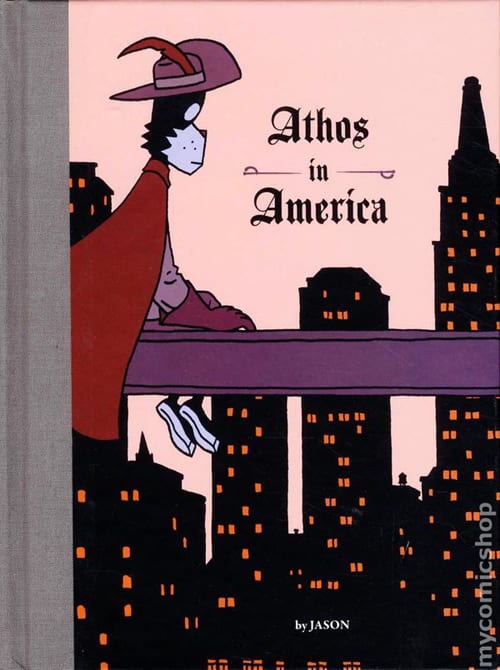
In his full-color graphic novella, Athos in America, Norwegian cartoonist Jason include the story “The Brain That Wouldn’t Virginia Woolf,” a mash-up of The Brain That Wouldn’t Dieand Who’s Afraid of Virginia Woolf, told in reverse chronological order.
Described as the volume’s “most heartbreaking tale” and as the peak of the artist’s “love of classic cinema and genre-bending,” the story may be a disappointment as a Woolf sighting. That is because it connects with the film made from Edward Albee’s play rather than Woolf herself, either as an author or a person.
The 2012 volume also includes five other stories, with the title story providing a prequel to Jason’s 2008 graphic novel, The Last Musketeer.
Shopping online for books devoted to Virginia Woolf, the Bloomsbury group, and the Hogarth Press? I have two sources for you. One, I have written about before. The other is new to me, although its proprietor is not.
York Harbor Books
Jon and Margaret Richardson are not newcomers to the world of Woolf. They have made hunting down the works of Virginia Woolf and the Bloomsbury group their mission since opening York Harbor Books in Maine more than 25 years ago.
The Richardson duo put out a list of “Virginia Woolf and the Bloomsbury Group” offerings each summer. This August’s list includes 27 pages of items, including the following:
First edition of Virginia’s The Common Reader (1925) with the Vanessa Bell cover,
Signed copy of the first American edition of Leonard’s Downhill All the Way, An Autobiography of the Years 1919-1939 (1967),
Julie Singleton’s A History of Monks House and Village of Rodmell, Sussex Home of Leonard and Virginia Woolf (2008) from Cecil Woolf Publishers,
First edition of Vita Sackville-West’s Passenger to Teheran (1926),
Very scarce first edition of David Garnett’s Never Be a Bookseller (1929).
Second Wind Books
Second Wind Books is the brainchild of Leslie Arthur, who is also not a newcomer to the world of Woolf. Leslie and I met at past Woolf conferences when she was in the midst of learning the craft of bookselling at the William Reese Co.
She now has an online shop of her own. Recently she has been “off buying new stock and furiously cataloguing it” and attending a rare books seminar in Minnesota and Rare Books School in California, according to emails to Blogging Woolf that announce her new site.
The way I see it, there are several connections between Greta Gerwig, her blockbuster film Barbie, and Virginia Woolf. Here we go:
One of Gerwig’s all-time favorite books is Woolf’s To the Lighthouse (1927). It is, she notes, “A classic for a reason. My mind was warped into a new shape by her prose, and it will never be the same again. The metaphysics she presents in the book are enacted in a way that allowed me to begin to understand that corner of philosophy.”
In A Room of One’s Own (1929), Woolf writes that “a woman must have a room of her own” in order to write fiction. In Barbie, all of the Barbies have entire dream houses of their own — and they find such ownership essential to their independent, feminist lifestyles.
An NPR story on the film includes this quote: “But Barbie could fend for herself. Like Nancy Drew, she drove her own roadster and lived in her own dream house — Virginia Woolf’s room of one’s own painted in pastels.”
From Second Wind Books comes this Facebook post that lists the similarities between Woolf and Barbie:
From Woolf scholar and novelist Maggie Humm comes this Twitter post:
Obligatory Barbie photo. Loved the artifice (like Asteroid City my last movie outing) pic.twitter.com/yzETjzw79J
NKP Theatre Company’s production of a 50-minute adaptation of Eileen Atkins’ play “Vita & Virginia” will be on stage at the Edinburgh Fringe at 21:20 Aug. 7-12.
The play was recently staged for members of the Virginia Woolf Society of Great Britain and received a wonderful endorsement from Claire Nicholson, society chair:
This is an assured, touching and poignant production; a beautifully sensitive portrayal of a remarkable love story.
About the show
Ticket price: £12 (£10 concessions) Booking: Book here. Location: The Edinburgh Fringe, theSpace@Niddry Street, Edinburgh Get more information.
About the play
This abridged version was created for an intimate setting by NKP Theatre Company. In it, Virginia Woolf meets fellow author Vita Sackville-West in London in the 1920s. The two embark on a 20-year relationship that inspires one of Virginia’s most famous novels, Orlando. Abridged from the original play by Eileen Atkins, Vita and Virginia deftly brings to life the real letters and diaries of the two women, revealing deep friendship, wit and passion between the literary genius and the aristocratic yet middle-brow poet.