Feeds:
Posts
Comments

Archive for the ‘21st century Woolf’ Category

Did Virginia Woolf land on the moon? Only in the imagination of a two-year-old.

The toddler’s mother posted the photo as “breaking news” on her blog. Makes me wonder what other interesting photos I could pose if I just had a small Woolf doll.

Thanks to Fernham for sharing the news on Facebook.

Read the details.

Read Full Post »

Since completing Beyond the Icon: Virginia Woolf in Contemporary Fiction, a monograph in Cecil Woolf Publishers’ Bloomsbury Heritage Series, I find that I’m still drawn to and fascinated by the discovery of more Woolf references and influences in both newly published books and going back a few decades.

I recently discovered a “new” writer, Jane Gardam, and am have been burrowing through her work with delight and, initially, with no thoughts of Woolf. Gardam is well known in Britain, having published more than 20 novels since 1971, but relatively obscure to American readers. That may change since the New York Times Book Review praised her latest, The Man in the Wooden Hat.

This book and its 2004 prequel, Old Filth (which stands for “Failed in London, Try Hong Kong”), are panoramas of two lives and a marriage from different points of view, startlingly so, as it turns out. Gardam writes vividly and beautifully, her characters are eccentric and fascinating, and the way she plays with time reminds me of Woolf, allowing past and present to weave through the narrative. Of course I started wondering what influence Woolf may have had on her writing and what she thought of Woolf.

Wanting to read more of her work, I picked up a couple of her earlier novels, and the link was established. Gardam’s name-dropping hints at a playful homage to Woolf as well as recognition of her prominence in the respective contexts of novels taking place during Woolf’s lifetime.

In Faith Fox (1996), a major character is Thomasina Fox. A confused woman refers to her as Thomasina Woolf, remarking that “She wrote The Waves, you know.” Crusoe’s Daughter (1985) starts with an epigraph from The Common Reader: “The pressure of life when one is fending for oneself alone on a desert island is really no laughing matter. It is no crying one either.”

Virginia and Leonard Woolf appear as guests at a Garsington-like manor house with gatherings of artists and aesthetes. The narrator observes new arrivals: “A melancholy brooding man and a very thin woman in old expensive clothes with the hem coming down, who was beautiful. Even her raggedness looked queenly. She was rather wild about the eyes which were in very deep caves in her face, and the corners of her mouth turned down in a desperately forlorn and anxious, yet sweet way.” They were identified as the famous Mr. and Mrs. Wolf (sic) and later referred to as the “dotty” Olympian Wolves.

I have a big stack of summer reading to occupy the months ahead, including more Jane Gardam. And part of the fun is that I never know when and where Virginia Woolf will appear.

Read Full Post »

The Virginia Woolf Society of Great Britain is holding an essay competition in memory of acclaimed Woolf scholar and member of the society’s Executive Council, Julia Briggs. Briggs died in August 2007.

The competition for the Julia Briggs Memorial Prize 2011 is open to members and non-members (except for the Executive Council and Editorial Committee of the society, the judges and their families.

Entries should be sent to Ruth Webb, 15 Southcote Rd., London SE25 4RG, to arrive by 10 January 2011.

The competition rules and entry form are provided below. (more…)

Read Full Post »

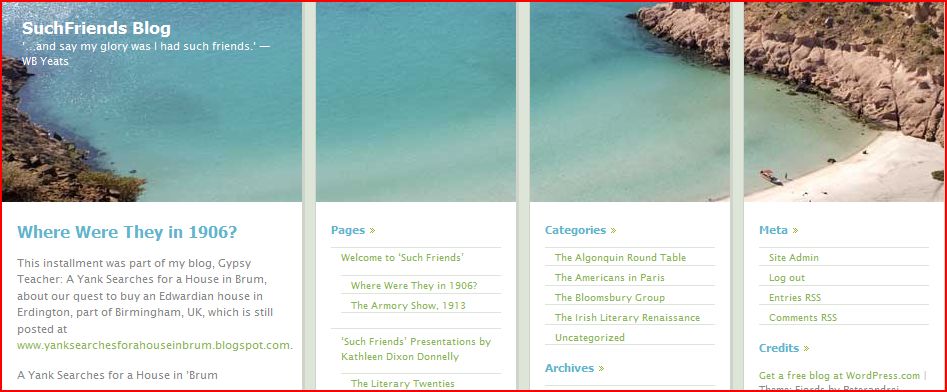
Kathleen Dixon Donnelly posted a comment on Blogging Woolf that led me to look at her SuchFriends Blog. I am glad I did.

SuchFriends is a lovely looking blog that posts daily updates of what particular writers were doing, saying or writing on that day in their history. In fact, Donnelly promises that on May 1, she will use her blog to discuss how Virginia Woolf felt when her half brother George Duckworth died in 1934.

The blog also includes other interesting information, including some about Virginia Woolf and the Bloomsbury Group. 

Here is a sampling of brief posts on SuchFriends that connect to Woolf:

  • A listing of Bloomsbury Group members.
  • Details about her presentation on Bloomsbury painters.
  • A post on Bloomsbury, London in October 2006 and 1907 in which Donnelly talks about her experiences at a travel writing workshop where she walks around Bloomsbury for inspiration before writing a somewhat fictional account of a Bloomsbury Group’s evening.
  • A post on her trip to St. Ives, Cornwall, while simultaneously rereading To the Lighthouse.
  • A post about literary travel that includes a trip to Sussex, England, and Monk’s House, the Woolfs’ summer home.
  • Reading, video and travel tips for the Bloomsbury Group.

Read Full Post »

I had the best of intentions, but I didn’t give myself enough time. That is why I have not finished my re-read of Virginia Woolf’s The Waves.

As a result, I won’t be able to plunge into the Woolf in Winter discussion of the novel led by Clare on Kiss a Cloud. But I can stick my toe in the water. So here it goes.

During the past few days, I worked my way through the early years of Woolf’s six characters: Jinny, Susan, Rhoda, Neville, Bernard and Louis.

When I left them last night, all six were on their way home from boarding school for the summer holiday. Each was looking forward to something different. Susan was longing to be back in the country. Jinny was picturing herself as an independent young woman. Louis fancied himself a poet. And so on.

What struck me so far was how beautifully and accurately Woolf captured the minds and moods of children on their way to being grown-ups. The innocence, the complications, the wretched insecurities, the brave dreams, the pleasures and the pains of childhood can all be found in Woolf’s poetic words.

In the novel, Woolf outlines each character. Then she fills in the details in the same way that the pointillist painting provided by Kiss a Cloud does.

From a distance, the dots in a pointillist painting may seem alike. But up close, each one is different. In a similar way, young children may seem alike from a distance. But up close, each one is unique.

Woolf looks at her six children up close. She bends her knees to look at the world from their perspective. She tells their six stories from the shifting vantage points of children on their way to adulthood. She understands the way they think and feel.

What I take away from these first few chapters of The Waves is that despite her own childlessness, Woolf got kids in a way that few adults do. That’s just one more thing to like about her.

Read Full Post »

« Newer Posts - Older Posts »