 In some ways, Virginia Woolf’s novel Mrs. Dalloway is about voices. Voices from the past. Voices from the present. Voices of the novel’s main characters. Voices of those passing by. Voices of war and voices of peace. Sometimes the voices seem to drift. Sometimes they overlap. Sometimes they warm you. Sometimes they stop you cold.
So it is fitting that the stage adaptation of Septimus and Clarissa, running through Saturday at the Baruch Performing Arts Center in New York City, is the product of many voices as well.
The play’s the thing
I was in the front row at last Saturday’s show. And like others who have reviewed the play written by Ellen Mclaughlin, I found myself overwhelmed by the power of Woolf’s words, the way they transformed the stage, and the way the stage adaptation made them ever more luminous and lyrical.

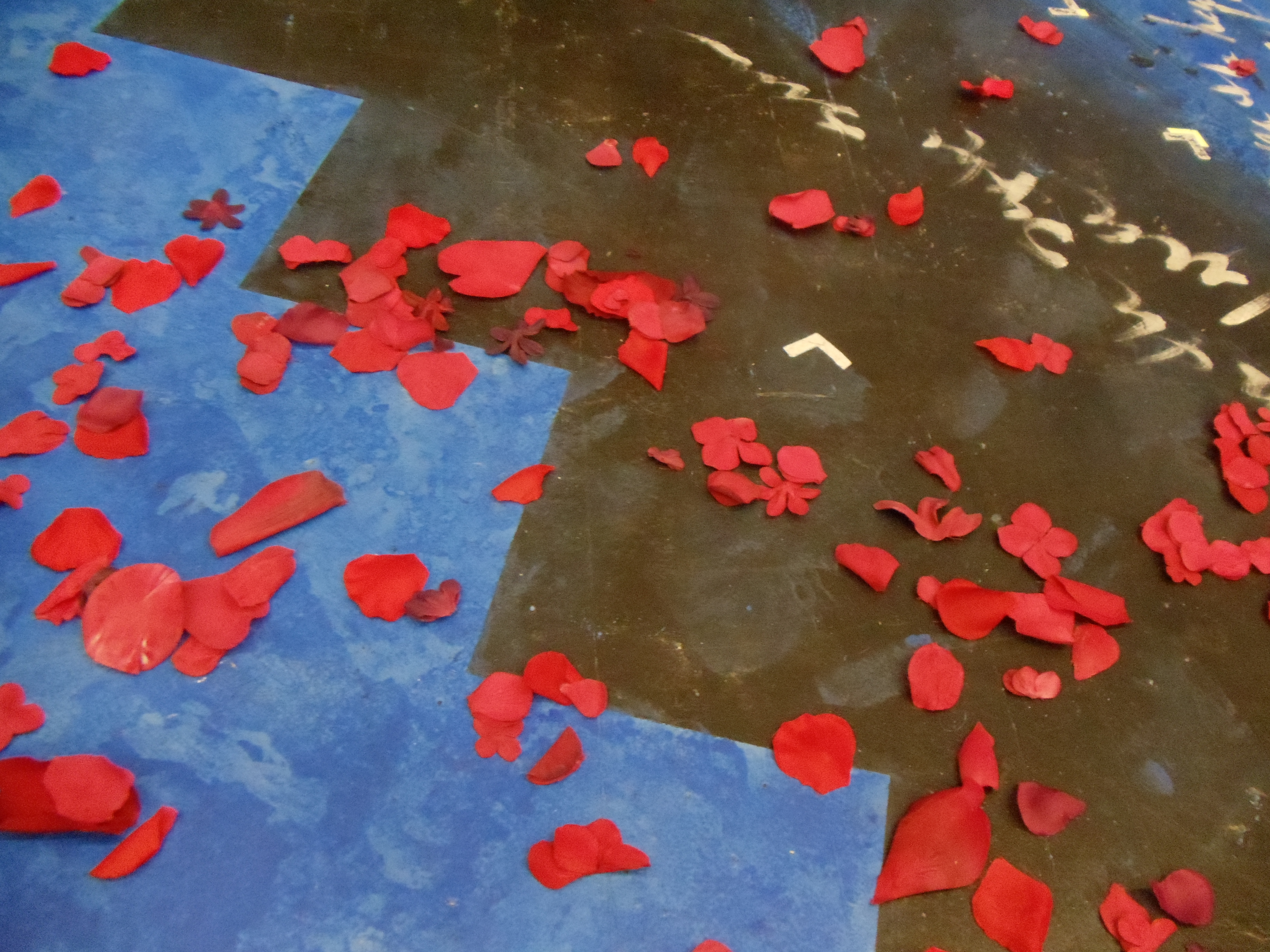
The starkly simple set features a mottled blue floor and wall with the words “Fear no more.”
Like many readers of Woolf, I have read her 1925 stream of consciousness novel multiple times and have written about it as well. So I wouldn’t have thought that a staged adaptation of the novel could keep me spellbound, could make me wonder what might happen next, could bowl me over with its emotional power. But that’s exactly what this production did.
Others have already done an excellent job of reviewing Septimus and Clarissa, commenting on its superb acting; its excellent blend of music, ambient sound and dialogue; its relevant anti-war message; and the way it captures the spirit and meaning of Woolf’s novel.
So I will do something a bit different here. I will talk about how another group of voices — the many voices of the performers, directors, writer and crew — shaped what appeared on the Baruch stage this fall.
The after-show conversation
I learned a bit about the shaping process at an after-show conversation held on stage Saturday evening. It was headlined by best-selling author and Barnard professor of English Mary Gordon. She settled in on stage with Rachel Dickstein, director; McLaughlin, who wrote the script and played the title character; Tommy Schrider, who played Septimus; and Miriam Silverman, who played both Lucrezia and Elizabeth Dalloway.

Mary Gordon, Rachel Dickstein and Ellen Mclaughlin
The shaping process was a long one that involved multiple workshops, with each workshop adding or subtracting things from the production up until the play’s formal opening in September. And everyone involved played a part that went beyond the one acknowledged in the formal program.
The actors, for example, helped work out the choreographed movements they make while voicing Woolf’s lyrical words in song, choreography that changed as the play progressed.
They also collaborated on the set design. When Dickstein brought a batch of large rectangular frames to the set, thinking they might add something interesting to the production, the actors experimented with them until they worked. And in the final production, three of the frames are moved around on stage, almost like dancing partners, to represent a changing array of doors and windows, with people going out and through and around them.
The idea for the moveable staircase itself, the most prominent element in the set design, came from Dickstein and set designer Susan Zeeman Rogers, but the actors suggested ways of using it, as well as other set pieces and props. Actor Schrider, a Septimus of power and emotional force, did improvisations on another staircase before the large black metal staircase became a part of the final set design. The large black metal staircase is a focal point throughout the play, as it serves as a platform for Mrs. Dalloway as hostess and both a battlefield and suicide site for Septimus.

Miriam Silverman and Tommy Schrider among the rose petals that drift over guests during the party scene
The significance of a house within a house
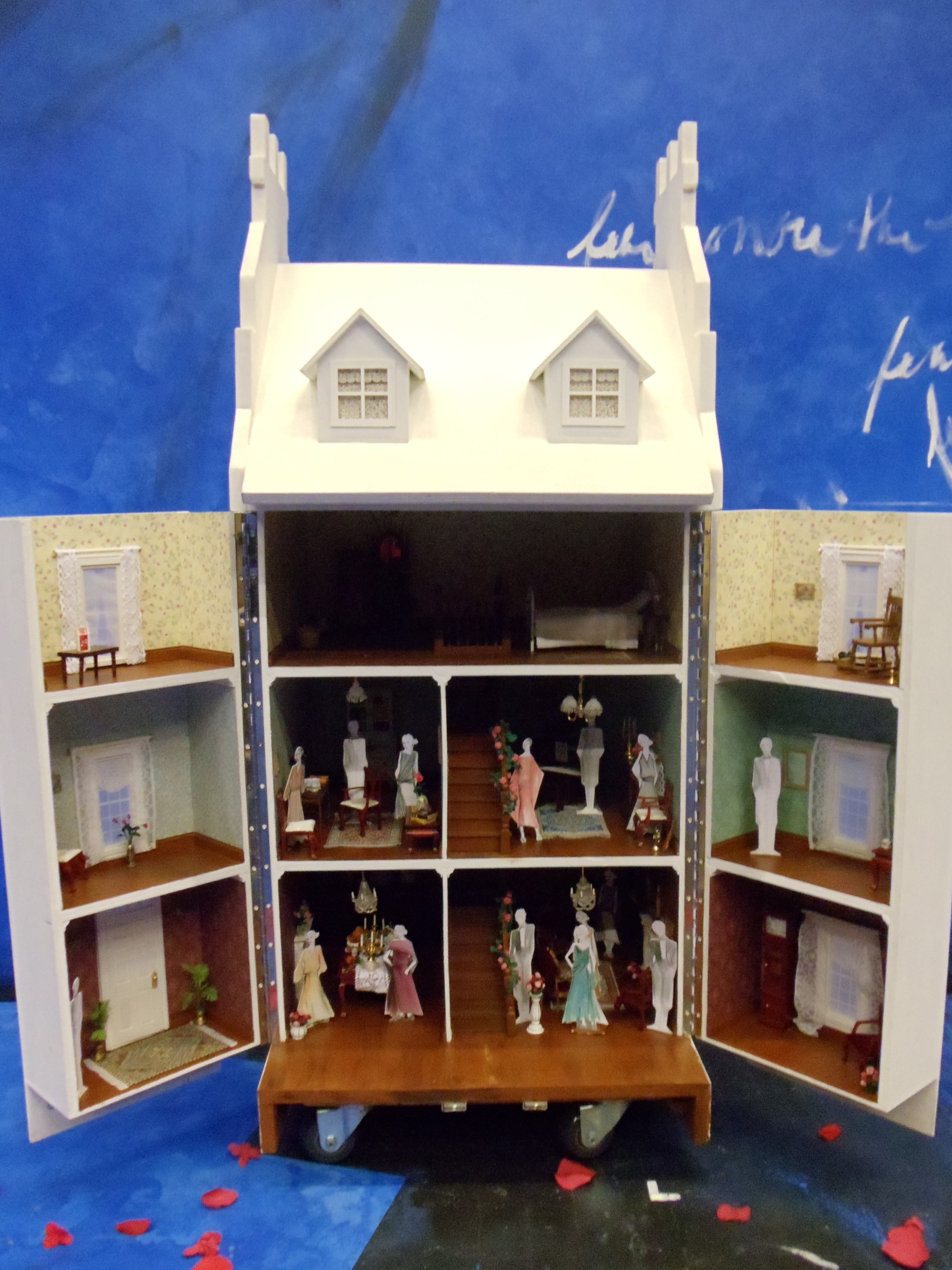
Also on the simply set, stark stage throughout the play are three white wooden houses about four feet high. They are rolled around the set on wheels to symbolize Clarissa’s country home of Bruton as well as the homes she and other characters see along the streets of London.
But one of the three is special, and here is where director Dickstein gives voice to her child self. She recalled encountering an elaborately detailed furnished dollhouse as a young girl, one that she could never afford. It was a memory and an image that stuck in her mind, and she asked set designer Zeeman Rogers to create a more modest version of such a house — Clarissa’s London house — for the play.

The Clarissa Dalloway dollhouse
The interior of this lit-up house, complete with the novel’s characters as free-standing paper dolls, is revealed during the scene that recreates Clarissa’s party. The symbolism of the dollhouse opening up to reveal its interior to the audience just as Clarissa opens her home to her guests has a certain magical charm with subtle but significant meaning.
Links to some reviews of Septimus and Clarissa
Read Full Post »
 Vera Sackcloth-Vest, a writer, gardener and transvestite.









 Alice Lowe
 Catherine
 Kaylee Baucom
 Leanne Oden
 Paula Maggio
 Stefano Rozzoni
 seanmcphail
 suzannebellamy1
 veronikakra
 Vara Neverow
 William Patrick Wend
 Zoe Wolstenholme


