I don’t always watch the evening news, but when I do, I watch PBS Newshour. I watched yesterday, and I am glad I did. Why? Because they included a feature on The Life of Violet, edited by Urmila Seshagiri, which I wrote about Tuesday.
The segment is part of their art and culture series, Canvas, and includes an interview with Seshagiri. It also takes us to Longleat House in Wiltshire, England, where Seshagiri discovered the typescript in the archives.
The good news is that you, too, can watch the segment about this newly discovered collection of three short stories by Virginia Woolf when she was just 25 years old. It is available online.
The Life of Violet, edited by Urmila Seshagiri and just out today from Princeton University Press, is the newly discovered revised typescript of three early short stories by Virginia Woolf based on the life of her friend and mentor Violet Dickinson.
Witty, whimsical, lighthearted, and just plain fun, the book is an important discovery that I hope helps dispel the myth that Virginia Woolf was a sad, humorless writer beset by depression and suicidal thoughts.
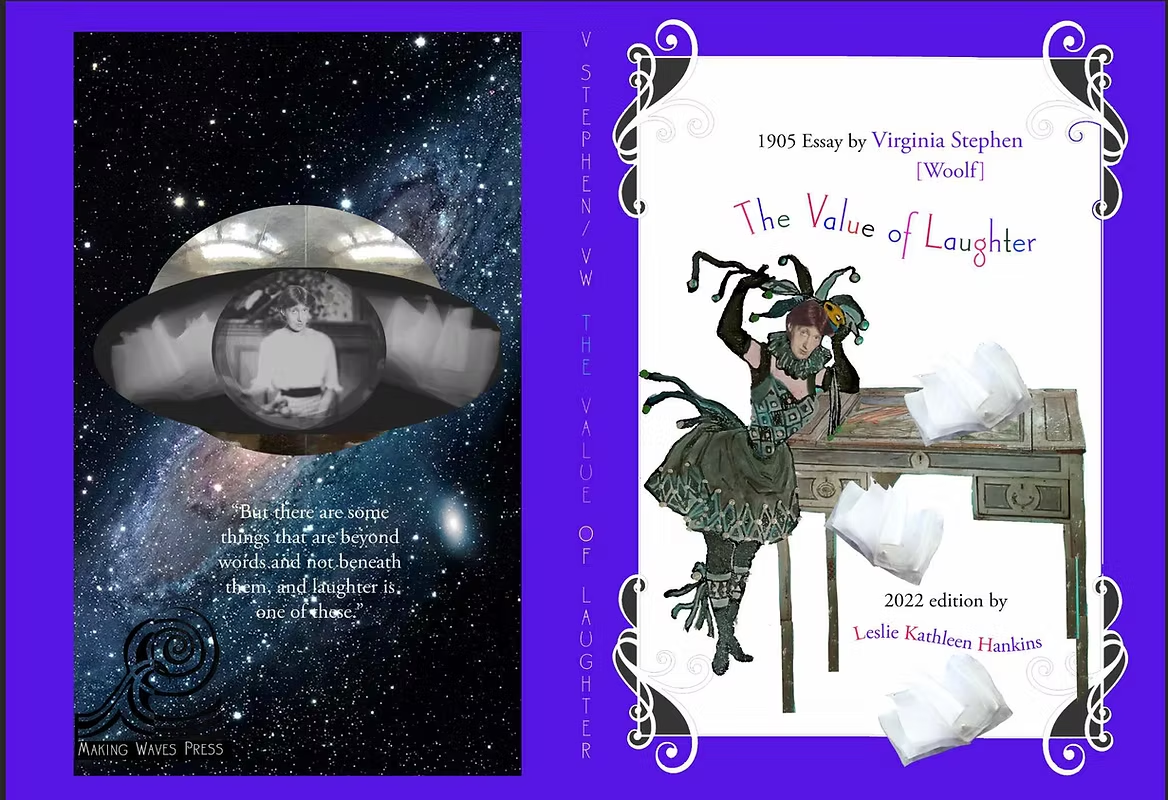
It should be no surprise that Woolf’s humor is often overlooked. That is often the case, and something Woolf recognized in her 1905 essay, “The Value of Laughter,” which was originally published in The Guardian.
Humour, we have been told, is denied to women. They may be tragic, or comic, but the particular blend which makes a humorist is to be found only in men.
Its history
Woolf drafted the three comic stories that make up The Life of Violet in 1907, at the age of 25. Before leaving to spend several weeks in Playden, Sussex, just north of Rye, she sent Dickinson the draft she had “very hastily polished off” (A Passionate Apprentice, 367).
That version, typed in violet ink and titled “Friendships Gallery,” is housed today in the Berg Collection at the New York Public Library. Until lately, it was considered the only version in existence.
But in 2022, Seshagiri discovered a professionally typed revision—with corrections Woolf made by hand in 1908—at Longleat House in Wiltshire, England, after learning about its existence via email several years earlier. It had sat in the Longleat House archives for 80 years, after disappearing into the collection of Dickinson’s papers.
About the book
The Life of Violet is a three-part mock biography of Mary Violet Dickinson (1865-1948). It uses three whimsical, comic, interrelated stories—”Friendships Gallery,” “The Magic Garden,” and “A Story to Make You Sleep” to relate Dickinson’s fanciful life as a giantess (the real Violet was six feet two) who defies the societal norms of English life.
She has a full social life without marrying and inspires others to “have a fire” of creativity within them (12). She lives in a cottage of her own that “was the beginning of the great revolution which is making England a very different place from what it was” (24). And she becomes a giant sacred heroic princess, who brings “[a]ll the most delightful things you can think of” (35) to a Japanese village, which she saves from monsters by laughing and waving her umbrella.
Foreshadowing
The Life of Violet also foreshadows literary things to come from Woolf. As a mock biography, it is a harbinger of Orlando (1928). With its focus on Violet’s cottage of her own in “The Magic Garden,” we see the original stirrings of ideas leading to A Room of One’s Own (1929). But most of all, its overall use of language, its wit, its whimsey, and its feminist thought, both sound and feel like Woolf.
A quote from Anne Fernald, editor of Mrs. Dalloway: A Norton Critical Edition, speaks to The Life of Violet’s thematic importance:
The stories are lighthearted, but in them we see how, as early as 1907, Woolf was concerned with the major themes of her career: the need for a room of one’s own, the value of an ordinary woman’s life, and the imperative to remake the way fiction is written.
In this new volume, Seshagiri stays true to Woolf. She incorporates Woolf’s handwritten edits, which incorporates edits suggested by Dickinson. And she reproduces the page layout, language, spacing, and spelling of Woolf’s revised transcript.
The extras
By including detailed “Explanatory Notes,” she also makes it easy for readers who may not be familiar with Woolf or the social and historical context of her time.
The volume also includes a preface, an afterword that provides a detailed explanation of the history of these early short stories, as well as photographs.
Recent talk on the VWoolf Listserv and a post here on Blogging Woolf involved Virginia Woolf and recent news about her use of purple ink. Both raised further comments — and questions.
Here is the background
Craft workshop participant at a Woolf conference using a manual typewriter but no purple ink.
The news was that Virginia’s writing in her trademark purple pen had been discovered by Esther Folkersma, a research internist for the digital Modernist Archives Publishing Project. Virginia used purple ink when writing on the stock cards of the Hogarth Press archives up to February 1940, Folkersma found.
That news raised the following questions — and probably more I haven’t yet heard.
The questions raised
Is Virginia the only one who wrote in purple ink on Hogarth Press documents?
Did Virginia ever use a purple typewriter ribbon?
All Woolf writers using purple ink please stand up
Is Virginia the only one who wrote in purple ink on Hogarth Press documents?
This is fascinating, but there is one small hiccup—much of that writing in purple ink is in Leonard’s hand. – Matthew Holliday
I would like to have more details about that claim, so I invite any one who knows more about Leonard’s use of purple ink to please chime in by posting a comment below.
What I do know is that Esther Folkersma’s post on the MAPP blog clearly states that she has identified the handwriting in purple ink that she found as Virginia’s.
Virginia’s purple typewriter ribbon
Did Virginia ever use a purple typewriter ribbon?
That question was posed to the list, and Bryony Randall, professor of modernist literature at Glasgow University, provided this information in reply:
Many of Woolf’s short stories – or early drafts thereof – were typed in purple ink, from as early as ‘[A Dialogue Upon Mount Pentelicus]’ to as late as what we previously knew as ‘Gypsy, the Mongrel’, but thanks to Stuart Clarke we now know was published as ‘The Little Dog Laughed’. So certainly a favourite colour in any writing medium! I’ve been able to verify the type colour of those typescripts held in the Monk’s House Papers, but not (yet) those at the NYPL, pending a research trip. – Bryony Randall
Catherine Hollis of UC Berkeley added this information:
“Friendship’s Gallery” (1907-8) was typed in violet ink and bound in violet leather (via Matthew Clarke’s recent essay “My Poor Intimate: Virginia Woolf and Violet Dickinson”).
Feel free to add to this discussion in the comments section below.
Virginia Woolf’s short story “The Mark on the Wall,” published in 1917, was one of the first two stories printed and published by Virginia and her husband Leonard when they started the Hogarth Press. A new experimental short film, now available online, brings her first published story to life.
Anderson Wright’s evocative and experimental short film is described as capturing the essence of Woolf’s stream-of-consciousness narrative, in which a seemingly insignificant mark on the wall triggers the exploration of memory, identity, and the passage of time.
I watched it and found it hauntingly beautiful, with the final words of the film echoing Woolf’s own, minus her words about war.
If you have three minutes and forty-four seconds at your disposal, you can watch it, too.
Among other intriguing rare finds, Jon S. Richardson Rare Books is offering a previously unknown version of Virginia Woolf’s short story “The Mark on the Wall” in French.
“The piece is accompanied by a short essay on Woolf’s breakthrough style and a review of her novels through her short story collection Monday or Tuesday by one P.C. [presumably Paul Colin, one of the editors).”
The catalogue explains that “this translation is not noted in Kirkpatrick, it is three years earlier than the earliest known appearance of Woolf in the French language” and there is “no mention in Leonard’s autobiography of this translation or Mende.”
More about the volume
As for the volume’s condition, the “book is bright, solid and VG for age with minor wear from age and soil, unusual to be in this condition because paper has acidified slightly.” The price is $275.
Jon and Margaret Richardson are not newcomers to the world of Woolf. They have made hunting down the works of Virginia Woolf and the Bloomsbury group their mission since opening York Harbor Books in Maine more than 25 years ago.
The Richardson duo put out a list of “Virginia Woolf and the Bloomsbury Group” offerings quarterly. They issued their previous list in the summer.
More French connections to Woolf’s “Mark on the Wall”
For more on the French connections to Woolf’s “Mark on the Wall,” read Blogging Woolf’s post from Oct. 20, 2010, “The French connection to ‘The Mark on the Wall.'” It explores similarities, parallels, and differences between Woolf’s short story and novels by Marguerite Dumas and Alain Robbe-Grillet.