Feeds:
Posts
Comments

Archive for the ‘Virginia Woolf’ Category

Editor’s Note: Woolf scholar Kristin Czarnecki contributed this post about her creative experience with Mrs. Dalloway and erasure poetry.

A year or so ago, on the recommendation of a friend, I bought Sarah J. Sloat’s Hotel Almighty, a book of erasure poems born from Stephen King’s novel Misery. Each page bears not only Sloat’s erasures but also her beautiful, evocative art and collages.

I read it repeatedly and became curious about the potential of erasure poetry. As Sloat says in her introduction to Hotel Almighty, “The form leaves room for chance.”

I suspected the form was something I’d enjoy, and as I so often do, I turned to my shelves of Woolf books for inspiration.

Right away, my eye went to the Eastern Press edition of Mrs. Dalloway I’d found years ago in a Lexington, Kentucky, bookstore. It was bound in genuine leather in a glorious, saturated shade of green, my favorite color, and I snapped it up.

And there it sat on a shelf for years until, in a fit of purging, I brought it to Half-Price Books to see what I could get for it in trade. Not much, but I easily let it go, confident it would wind up with someone who would appreciate it.

A book returns

Fast forward a few months, when an English major at the college where I was teaching stopped by my office one afternoon. She and her girlfriend had taken several classes with me, including modern British literature, which of course had Mrs. Dalloway on the syllabus.

That day in my office, she reached into her bag, drew out a book, and proudly handed me the Eastern Press edition of Mrs. Dalloway I’d recently given away.

“We found this at Half Price Books!” she said, “And we knew we had to get it for you.”

I was deeply moved by the gesture and thought, “Well, I’m clearly meant to have this book.”

I kept it in my campus office, and when my husband and I moved across the country, it of course came with us.

Having fun with Mrs. Dalloway

Looking at the book recently, I began to wonder how I might do justice to
Woolf’s words, to my students’ thoughtful gift, and also to the physical thing. I wondered how it might manifest into a different type of aesthetic object, and I wondered if I might fall under Woolf’s spell once again if I approached her writing in a different way.

Since leaving academia nearly four years ago, I’d been losing interest in Woolf, a sad and unsettling experience I hoped was only temporary.

“Mostly, I set out to have fun,” Sloat writes towards the end of her introduction to Hotel Almighty. I set out to do the same when creating erasure poetry from Mrs. Dalloway.

I sought combinations of words that would reflect Woolf’s concerns in the novel, like the vagaries of time and fluctuating relationships. Sometimes, I sought to counteract the unbearable sadness on the page, like Septimus Warren Smith’s suicidal despair. Sometimes, I tried not to overthink it and just remain alert to any words or phrases that might jump out.

I decided to create 51 erasures, Clarissa Dalloway’s age in the novel.

Adding art to the words

As for the art, some of the erasures called out for a particular color or striking color combination. For a few, I wanted strips of paper to cover all but the circled words. For added visual interest, I cut out some of my drawings and paintings from other notebooks and pasted them in.

I appreciate anew, or differently now, her writing to a rhythm, her threading of specific motifs throughout the novel, her aversion to verbs (!), and her insights into the multitudes of human experience.

The process of running a paint brush, colored pencils, or pastel crayons across the lines, a repetitive and meditative action, found me absorbing and thinking about words I hadn’t singled out.

Selecting from among Woolf’s words and adorning them with art made for a unique and enjoyable creative experience. I appreciate anew, or differently now, her writing to a rhythm, her threading of specific motifs throughout the novel, her aversion to verbs (!), and her insights into the multitudes of human experience.

I like to believe we created these erasures together. And, it’s nice to have her back.

About the author

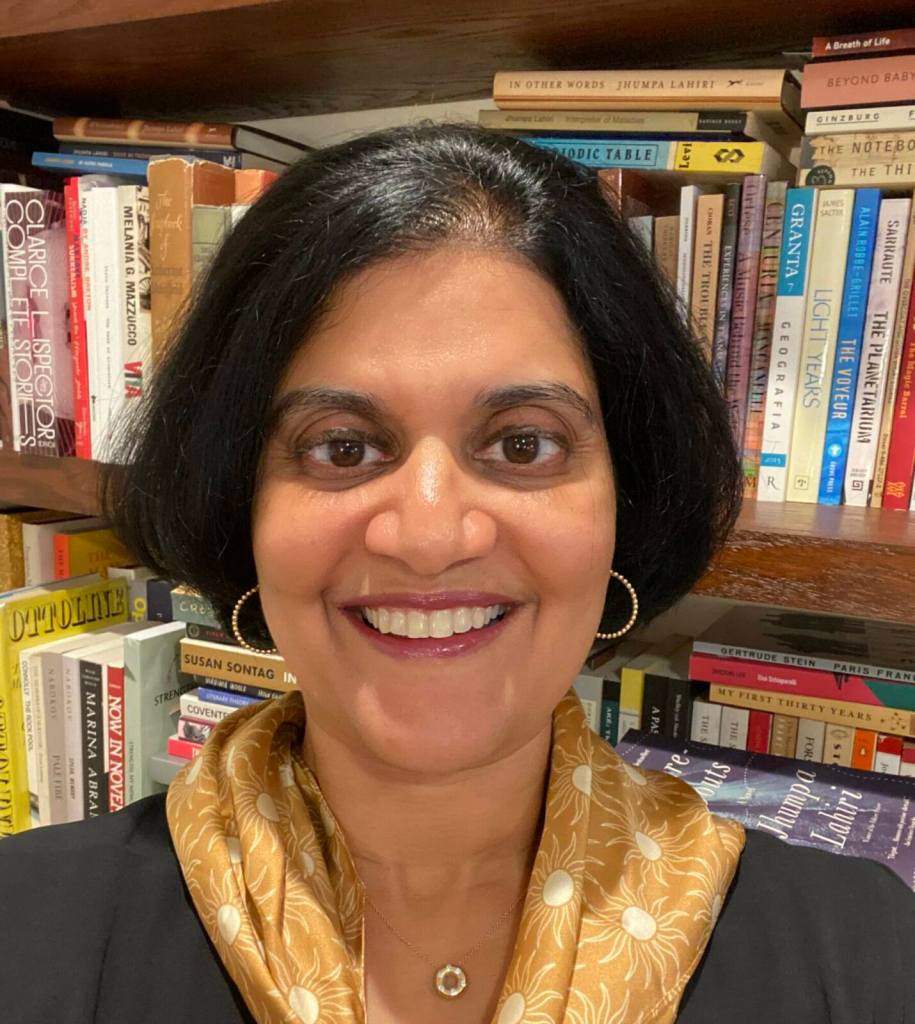
Kristin Czarnecki at the 2019 Annual International Conference on Virginia Woolf held at Mount St. Joseph University in Cincinnati, Ohio.

Kristin Czarnecki taught English in Georgetown, Kentucky, for many years and is now executive director of the Rockport Art Association & Museum in Rockport, Massachusetts. A former president of the International Virginia Woolf Society,  she has published literary criticism in Woolf Studies AnnualJournal of Feminist ScholarshipJournal of Modern Literature, the CEA CriticCollege Literature, and Journal of Beckett Studies as well as in edited volumes. She is also the author of two memoirs: Encounters with Inscriptions (Legacy Book Press, 2024), about the books inscribed and given to her by her parents over the years, and The First Kristin: The Story of a Naming (Main Street Rag, 2020), about the experience of being named after a deceased sibling. Her chapbook, Sliced, was published by dancing girl press & studio in 2023. Her next book, My Moomin Memoir: Reflections on Tove Jansson’s Classic Tales, is forthcoming from Legacy Book Press.

Erasure poems from Mrs. Dalloway by Kristin Czarnecki

The Sunlight by Kristin Czarnecki

The Dear Boy by Kristin Czarnecki

The Shaggy Dog by Kristin Czarnecki

She Made the Drawing Room by Kristin Czarnecki
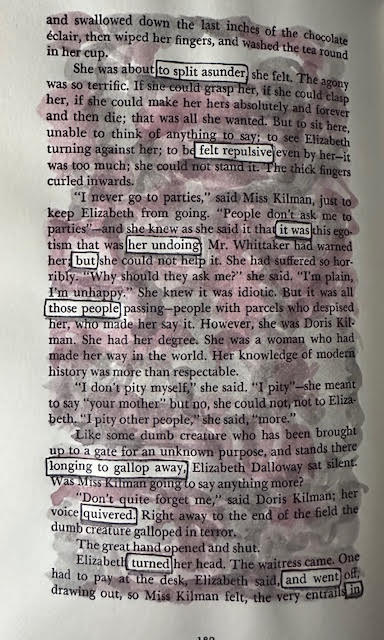
To Split Asunder by Kristin Czarnecki


Read Full Post »

Virginia Woolf and the Natural World will be the focus of this year’s Literature Cambridge summer course, which will be held twice — once online and once in person in Cambridge, England.

The live online course will run from Thursday, July 9, to Monday, July 13 (including the weekend). The in-person in Cambridge course is set for Sunday, Aug. 2 to Friday, Aug. 7, with an optional trip to Monk’s House and Charleston on Saturday, Aug. 8.

All of Woolf’s books are deeply interested in the natural world. This year’s course will explore her writing about the sea, woods, clouds, trees, gardens, birds, and much else in five of her great novels.

As always, there will be a rich program of lectures, supervisions, talks, and discussions, plus extra sessions for open discussion. In Cambridge, students will visit places of interest with talks by specialists.

Lecture list

Alison Hennegan, Women and Nature in Jacob’s Room (1922)
Karina Jakubowicz, Gardens in To the Lighthouse (1927)
Kate Eliot, Land and Sea in The Waves (1931)
Trudi Tate, The Weather in History: The Years (1937)
Ellie Mitchell, Earth and Sky in Between the Acts (1941)

Provisional list of talks

• Ann Kennedy Smith on “Woolf, Rupert Brooke and the ‘Neo-Pagans’”

• Harriet Baker on “Nature writing in Woolf’s Diary”

• Bonnie Lander Johnson on “Vanishing Landscapes: Saffron”

• Claudia Tobin on “Monk’s House garden”

• Launch of Karina Jakubowicz’s book on Gardens in the Work of Virginia Woolf (2026)

…and more

Links for additional information

Live online course

Course in Cambridge

Day trip to Monk’s House and Charleston

Read Full Post »

It was Christmas 1933 and Ottoline Morrell gave Virginia Woolf an embroidered silk shawl as a gift. It still exists today as the only remaining piece of Woolf’s clothing, and the National Trust is soliciting funds to help restore it.

Here is a letter of thanks Woolf wrote to Morrell in 1933:

Dearest Ottoline, You are a wonderful woman—for many reasons; but specially for sending a present—a lovely original wild and yet useful present—which arrived on Christmas day. I love being ‘remembered’ as they say; and I hung it on a chair, when the Keynes’s lunched here, and boasted, how you had given it me. What a snob I am aren’t I! But I cant help it. It was a very nice Christmas, as it happened; I had my shawl, and the turkey was large enough and we had cream, and lots of coloured fruits, and sat and gorged—Maynard Lydia Leonard and I. – Monks House, Rodmell, 31 Dec 1933 Letter from Virginia Woolf to Ottoline Morrell

About the shawl repair

Over the years, the fringed shawl was displayed on the back of a wooden chair in Woolf’s bedroom at Monk’s House. Fragile, faded, stained, and in need of restoration, it was removed in 2023. Last year, the National Trust began raising money to repair it in honor of the centenary of Mrs. Dalloway.

As part of the process, the trust plans to clean the shawl, provide conservation stitching, and add a silk and net lining to add stability. The work is expected to take nearly 400 hours of conservation work at a cost of £26, 000.

About the fundraising

That’s where we come in. Anyone can donate to restore Virginia Woolf’s shawl at this link. I am not certain how long the fundraising will go on, but I know it will be in place until at least the end of February.

The National Trust says it feels “confident that with the addition of a silk lining and carefully considered stitching the planned conservation will strengthen and improve the longevity of the textile, thus slowing its deterioration.”

To be on the safe side, you may also want to send an accompanying email specifying that your donation is for the shawl. The email should be sent to supporter.relations@nationaltrust.org.uk, addressed to Steve Lawrence, Supporter Relations Officer.

At left, draped over a chair, is Woolf’s embroidered shawl, the only remaining piece of her clothing, pictured in her bedroom at Monk’s House in July 2019.

Virginia Woolf’s bedroom at Monk’s House, showing the fireplace with tiles decorated by her sister, Vanessa Bell. Notice the lighthouse motif in the center tiles at the top.

Read Full Post »

Developers are at it again. As in 2015, and 2003, they are planning a multi-million dollar flat project that would obstruct the view from Talland House in St. Ives, Cornwall, which was the setting and inspiration for Virginia Woolf’s 1927 novel To the Lighthouse.

Professor Maggie Humm, vice-chair of the Virginia Woolf Society of Great Britain, and Councillor Johnnie Wells, Deputy Mayor of St. Ives at the Talland House plaque unveiling on Sept. 11, 2022. Photo: St. Ives September Festival

The last time, in 2015, developers proposed building a six-story, 10-flat project that would hide the view of Godrevy Lighthouse and the St. Ives coast.

This time, the project submitted to St. Ives Town Council by R.L. Southern, Ltd. is for 12 flats and again threatens to obstruct the view of the lighthouse, as well as of the Heritage Plaque installed on Talland House on Sept. 11, 20022, which will no longer be visible from a public highway, a requirement of any Heritage Plaque.

A parking garage will also be part of the multi-story project developed by R.L. Southern, Ltd., which incorporated in 2019 and appears to have no website of its own. Its director is Robert Mark Lane, 146 High Street, Billericay, Essex, United Kingdom, CM12 9DF. No other contact information is listed online.

Woolfians called to action

In 2015, Woolfians around the world fought back against the project that threatened the view of Godrevy, and the development was halted.  Now, Woolf scholars and readers are being asked to take up the fight again by posting comments objecting to the plan on the St. Ives Town Council website at this link. Registration is required before commenting.

Background

Woolf and her family summered at Talland House for the first 12 years of her life. Godrevy Lighthouse, which she could see from her summer home plays an integral role in her famous novel To the Lighthouse (1927).

Maggie Humm announced this sad news and gave some background on previous development plans:

“For the first application I garnered objections from around the world including from Cecil Woolf, Leonard and Virginia Woolf’s nephew, now sadly deceased. The planning application was denounced in the Observer and other media. (At that time, Cecil posted this comment: ‘About the proposal to build a block of six flats and a car park in front of Talland House, which should, of course, be protected by English Heritage — I am appalled. This is sheer vandalism and should be stopped now.’)

“The [2025] application hardly differs from the original application which received objections from around the world.”

The application for the development, PA25/07750, can be accessed online, along with planning documents, a map, and more.

Maggie shares her objections

  • The view from Talland House of Godrevy Lighthouse was central to VW’s imagination and appears in her novels Jacob’s Room, To the Lighthouse and The Waves, and “Sketch of the Past.” Woolf even called her first Sussex home in Firle Little Talland House. The development would obstruct that view.
  • Tourism, a vital industry in St Ives, relies on writers/artist connections to the town. World-wide visitors come to St Ives to see their houses. This development would constrain visits to Talland House and diminish the number of tourists.
  • A plaque celebrating Woolf’s connections with St Ives, supported by the VWSGB and St Ives Council, and donations from Woolf scholars from around the world, was unveiled on 11 September 2022 by the Deputy Mayor and Maggie. It was part of the St Ives Festival programme that year, and praised on BBC Radio Cornwall, the Observer and by other media. A St Ives spokesman said at the time “this will mark our connection to important writers who also left their mark on west Cornwall.”
  • Woolf’s family made a huge contribution to the town. Julia Stephen, Woolf’s mother, nursed and raised money for a trained nurse; Leslie Stephen gave prizes at the Regatta; and they joined the St Ives Arts Club. The Heritage Plaque celebrates that contribution.

Post objections now

Maggie urges all of us to forward our objections to the development as soon as possible, as the final decision on the new application will be made on 6 February 2026.

Map of the proposed development that would obstruct the view of the coast from Talland House in St. Ives, Cornwall. Talland House is to the left and below the development area, which is outlined in red.

Read Full Post »

Two Virginia Woolf events will take place this week, one on Thursday, one on Friday, and both on Zoom. In the first, Maria Oliviera discusses the reception of Woolf’s A Room of One’s Own (1929) in Brazil. In the second, Amy Smith considers Woolf’s critical engagement with Platonism in her 1919 novel Night and Day.

A Room of One’s Own in Brazil” seminar

Who: Maria Oliviera, professor, Federal University of Paraiba
What: This first session of the “A Room of One’s Own Around the Globe” seminar will discuss the reception of Woolf’s 1929 polemic in Brazil. Presented in English.
When:  6 p.m. CTE; noon EST on Thursday, November 20. Check your time zone.
Where: On Zoom. Free and open to all.
Get more details: Get the Zoom link in order to attend.

About the project: The A Room of One’s Own : Echos and circulation research project offers to take up Virginia Woolf’s landmark essay A Room of One’s Own (1929) and explore its full potential. One question it attempts to answer is what echo chambers has A Room of One’s Own opened up nearly a century after its publication?

Led by Valérie Favre (Université Paris 1 Panthéon-Sorbonne) and Anne-Laure Rigeade (Université Paris Est Créteil), this project will continue until 2029, the centenary of the publication of A Room of One’s Own, and will include seminars, a conference, and a collective publication.


“‘Dreams and Realities’: Woolf’s Revisions to Plato in Night and Day — a talk

Who: Amy Smith, associate professor of English at Lamar University and author of Virginia Wool’s Mythic Method.
What: A talk for the Virginia Woolf Society of Turkey titled “‘Dreams and Realities’: Woolf’s Revisions to Plato in Night and Day. Presented in English.
When: 7 p.m. Turkey time on Friday, November 21.
Where: On Zoom. Free and open to all.
Get more details: Register online for the event in order to attend. The Zoom link will then be provided.

About the talk: The intellectual significance of Night and Day in Woolf’s development as a writer and thinker has long been overlooked. In her talk, Amy considers Woolf’s critical engagement with Platonism in the novel, where it appears both as a genre model and as a reservoir of imagery, to which Woolf makes polyvalent references that disrupt Platonic idealism. Woolf’s active wrestling with Plato suggests that she is processing and separating from early philosophical influences just as she is from her inherited models of love, marriage, and the correct life for a woman, and also from conventional models of writing in her emerging in her modernist stories and aesthetic theory. Equally important as the aesthetic and personal revolutions Woolf makes at this moment is her philosophical revolution, and wrestling with Plato is a necessary step in her development of a unique, mature philosophy of her own.

About the book: Amy’s book, Virginia Woolf’s Mythic Method, is also now available in paperback. Use code SMITH at http://www.ohiostatepress.org for 40% off the hardcover or paperback.

Read Full Post »

Older Posts »