Feeds:
Posts
Comments

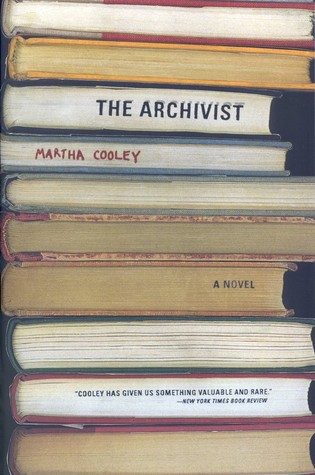
archivistMeandering through the bounteous bookshelves of a writer friend in Seattle for whom I was recently house-sitting, I zeroed in on The Archivist, a 1998 novel by Martha Cooley.

The story revolves around a cache of letters from T.S. Eliot to Emily Hale that Hale bequeathed to a university library (unnamed in the novel) in 1965, with the stipulation that they not be opened until 2020. This is true; the letters are at Princeton, sealed until 2020. The archivist’s wife is a poet, and they share an interest in Eliot. After her death he takes the university position right around the time of the bequest and meets a graduate student who is interested in the letters.

Eliot’s work weaves in and out, as do issues of Jewishness, war atrocities, conversion, and identity. Eliot’s life with and abandonment of his first wife Vivienne comes into it but not so much their London milieu, with a few exceptions, including this:

Roberta (the student) to Matthias (the archivist):

I was just remembering how Virginia Woolf once said Eliot was sordid and intense. Did you know that when he was still married to Vivienne, he occasionally wore face powder when they went to dinner parties? Can you imagine? I guess he couldn’t resist the temptation to dramatize his suffering—God knows Vivienne wore hers on her sleeve.

English: T. S. Eliot, photographed one Sunday afternoon in 1923 by Lady Ottoline Morrell (Photo credit: Wikipedia)

Of course I had to see if that was accurate (Woolf’s description, not the face powder) and found it in Woolf’s Diary, Nov. 12, 1934, about a performance of Eliot’s uncompleted verse drama, “Sweeney Agonistes”: “The acting made more sense than the reading but I doubt that Tom has enough of a body & brain to bring off a whole play: certainly he conveys an emotion, an atmosphere: which is more than most: something peculiar to himself; sordid, emotional, intense—a kind of Crippen, in a mask: modernity & poetry locked together.”

Seems to me she’s talking more about the play and his approach to it than Eliot himself. While she does implicate Eliot’s character and craft with her curt observations, the quote, out of context, strikes me as a bit too convenient for Cooley, the Woolf citation too dishy to resist. Still, it was a fascinating novel.

You can join the waiting list for Nights Out: Drinks with Virginia Woolf, an evening in a secret Hampstead apple orchard that includes a conversation with Woolf biographer Alexandra Harris. But the July 30 event is sold out.

The author of Romantic Moderns “will share her favourite ideas and themes from Woolf’s writing on pleasure, love, sorrow, wonder and London” and guide participants “through a menu of conversation topics she has designed especially for us around Woolf’s life and work.”

The event, which begins at 7 p.m. and costs £35, takes place at Fenton House Garden. Fenton House in Hampstead, central London, is a seventeenth-century merchant’s house, garden and orchard managed by the National Trust.

Harris, a literature professor at the University of Liverpool, is currently writing a cultural history of the English weather. It will, of course, include Woolf.

A couple of Woolf-related tidbits for you today.

  • You will find Virginia and Leonard in this slideshow of 16 famous authors on their wedding day. They are last, but not least.
  • If you missed Mrs. Dalloway’s London walk on June 16, you can still read the report on Andrew Whitehead’s blog. The Women’s History Group, along with the Literary London Reading Group, organized the walk. Participants gathered in Dean’s Yard behind Westminster Abbey, headed across St. James’s Park,walked the whole length of Bond Street and of Harley Street and through Regent’s Park.

The International Virginia Woolf Society is pleased to host its fourteenth consecutive panel at the University of Louisville Conference on Literature and Culture Since 1900, scheduled for Feb. 20-22, 2014.

The group invites proposals for critical papers on any topic concerning Woolf studies. A particular panel theme may be chosen depending on the proposals received.

Please submit by email a cover page with your name, email address, mailing address, phone number, professional affiliation (if any), and the title of your paper, and a second anonymous page containing a 250-word paper proposal to Kristin Czarnecki, kristin_czarnecki@georgetowncollege.edu, by Friday, Sept. 13, 2013.

Panel Selection Committee:

  • Beth Rigel Daugherty
  • Jeanne Dubino
  • Mark Hussey
  • Jane Lilienfeld
  • Vara Neverow
If you are within range of East Sussex, you can still book a seat on the bus to Rodmell for a Saturday, Sept. 21, trip to Monk’s House and Berwick Church sponsored by the Virginia Woolf Society of Great Britain.

Virginia Woolf’s writing Lodge at Monk’s House

Here are the details:
  • Cost: £12.50, including the coach travel and Berwick Church visit. The price excludes entry to Monk’s House at £4.10 (group rate; or free to National Trust members);  lunch at the Abergavenny Arms in Rodmell; and train travel to Lewes (advance return from London to Lewes costs £10).
  • Seats Available: Thirty places are available.

The arrangements are as follows:

  • Departure: Coach at Lewes station at 11 a.m. (to meet the 9:47 a.m. train from London Victoria); to Monk’s House for a private guided tour
  • Lunch: Approximately 1–2 p.m.
  • Berwick Church: Coach takes guests to Berwick Church for a guided visit to the murals by Anthea Arnold
  • Return: Coach leaves Berwick at 3:30 p.m. for Lewes station (for 4:20pm train to London).
Please note that, because of restricted coach access, there will be a small amount of walking. To secure a place, please email Lindsay Martin at lindsay@lindsaycmartin.co.uk.