Feeds:
Posts
Comments

Woolf scholars, oft known as Woolfians, cannot be easily divided into two camps when it comes to gender studies.

According to Madelyn Detloff of Miami University, there are no hard and fast lines drawn between ‘lesbian and gay studies’ Woolfians and ‘queer studies’ Woolfians.

She made her point during a recent discussion about the topic on the VWoolf Listserv.

The discussion was kicked off by a question from Ann Marie Lindsey, student at the CUNY Graduate Center. As a student in Mary Ann Caws’ Art and Literature in Bloomsbury course, Lindsey asked how current queer studies scholars view Virginia Woolf and/or the Bloomsbury set.

The resulting conversation became a bit heated at times. But in between, the following contributions to a bibliography on the topic were offered by participants.

And organizers of the 2010 Annual International Conference on Virginia Woolf promise to continue the discussion at the June 3-7 gathering at Georgetown College in Georgetown, Ky.

  • Julie Taddeo, “A Modernist Romance?  Lytton Strachey and the Women of Bloomsbury.” Unmanning Modernism: Gendered Re-Readings. Eds. Harrison and Peterson (1997).
  • Karyn Sproles. Desiring Women:  The Partnership of Virginia Woolf and Vita Sackville-West. U Toronto P. 2006.
  • Tirza Latimer and Jane Marie Garrity. “Queer Cross Gender Collaborations.” The Cambridge Gay and Lesbian Companion to Literature. 2010.
  • Robert Martin and George Piggffford, eds. Queer Forster. U of Chicago Press. 1997.
  • Christopher Reed. Bloomsbury Rooms:  Modernism, Subculture, and Domesticity.  New Haven: Yale University Press, 2004.
  • ____. “Bloomsbury Bashing:  Homophobia and the Politics of Criticism in the Eighties.”  Genders 11 (1991):  58-80.
  • ____. “Making History:  The Bloomsbury Group’s Construction of Aesthetic and Sexual Identity.”  Gay and Lesbian Studies in Art History.  Ed.  Whitney Davis.  Binghamton: Haworth Press, 1994. 189-224.
  • Georgia Johnston. The Formation of 20th-Century Queer Autobiography:  Reading Vita Sackville-West, Virginia Woolf, Hilda Doolittle, and Gertrude Stein. 2007.
  • Brenda Helt. “Passionate Debates on ‘Odious Subjects’: Bisexuality and Woolf’s Opposition to Theories of Androgyny and Sexual Identity.” Twentieth-Century Literature. Expected publication date: 2010.
  • Anne Hermann. Queering the Moderns. Palgrave Macmillan. 2000.
  • Kathryn Simpson. “‘Queer Fish’: Woolf’s Writing of Desire Between Women in The Voyage Out  and Mrs Dalloway.”  Woolf Studies Annual  9 (2003). 55-82.
  • Erica Delsandro, “‘Myself—It was Impossible’: Queering History in Between the Acts.” Woolf Studies Annual 13 (2007). 87-109.
  • D. A. Boxwell, “‘In the Urinal’: Woolf Around Gay Men.”  Virginia Woolf and Her Influences: Selected Papers from the Annual Conference on Virginia Woolf. Ed. Jeanette McVicker & Laura Davis (Pace UP 1998). 173-78.
  • David Eberly, “Talking it All Out: Homosexual Disclosure in Woolf.”  Virginia Woolf: Themes and Variations. Selected Papers from the Second Annual Conference. Ed Vara Neverow-Turk & Mark Hussey (Pace UP 1993).
  • Madelyn Detloff. The Persistence of Modernism: Loss and Mourning in the Twentieth Century. Cambridge UP. 2009.

Copyright © 2010 Hauser & Wirth

The Ida Appelbroog exhibition, Monalisa, draws parallels between the artist and Virginia Woolf’s A Room of One’s Own, according to the blogger at Art Kvetching

And Appelbroog reportedly found refuge — and inspiration — in the bathroom. 

The figure in Appelbroog’s art is described as challenging “us to keep looking.” Woolf does the same with her writing. By going inside the minds of her characters, she challenges us to look inside ourselves. 

Read the Art Kvetching post about the Bronx-born artist’s work, then check out the exhibition Web site

Meanwhile, The Guardian reports on a writers’ charity that is offering a female writer the chance to get out of the bathroom and into rent-free accommodation in Church Cottage in leafy Clifford Chambers, near Stratford-upon-Avon.

The Hosking Houses Trust, the provider of the grant, was also inspired by Woolf’s A Room of One’s Own. Besides a completely equipped cottage in rural England, the trust’s award includes £750 a month and use of a rowboat.

The offer is open to women age 40 and over who write in English. April 12 is the application deadline. Read more.

“Wolfing down” Woolf

I’ve never had the opportunity to study Woolf in the classroom, and I only find myself in the company of other Woolfians at the annual conference.

So when Bonnie Kime Scott invited me to sit in on her graduate seminar at San Diego State University, I jumped at the opportunity.

The curriculum includes all of the novels except Night and Day and The Years, plus selected stories, essays and diary entries. The students—mostly graduate students in literature and a couple from women’s studies—are required to write reaction papers to their reading plus do class presentations, a book report and a final paper.

As a class auditor, 20-plus years out of graduate school, I’m just challenged trying to keep up with the reading. Over the years I’ve read the novels two or three times each, all of the diaries and letters, and continue to burrow through the essays, a seemingly endless project.

But my Woolf reading has, until now, been in bite-sized pieces, digesting it at my leisure, swishing passages around to savor the flavor. Now I have to wolf it down, consuming large portions at every sitting, to keep up in order to follow the discussions.

And what a feast! I find this immersion a fascinating experience. The arc of her writing is more evident, transitions from one work to another more apparent; I feel that I have a better sense of her goals and her pursuit of them. And we’re only half-way through the semester, having just completed Mrs. Dalloway and preparing for To the Lighthouse next week.

The greatest pleasure is the class discussions, the luxury of delving into the works as a group. Most of the students are new to Woolf, but they’re intelligent, thoughtful, and game—they’re coming up with interesting interpretations, asking challenging questions and bringing a freshness to it that I find so welcome.

It isn’t about whether or not I agree, but rather opening up my thinking and confronting the material with new eyes, coming away with food for thought every week.

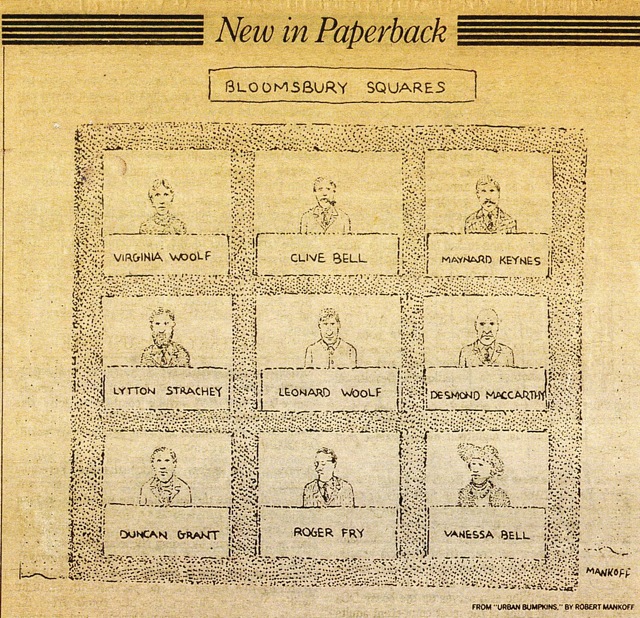
This all started with a series of e-mails from the VWoolf Listserv about a New Yorker cartoon.

The cartoon, pictured at left and titled “Bloomsbury Squares,” was an obvious parody of the American TV show “Hollywood Squares” and the British program “Celebrity Squares.

Information from list subscriber Sarah M. Halls told us that Robert Mankoff, the artist who created the cartoon, is also cartoon editor of The New Yorker and editor of The Complete Cartoons of The New Yorker (Black Dog & Leventhal), the best-selling coffee-table book for the 2004 holiday season. It features all 68,647 cartoons ever published in The New Yorker since its 1925 début.

It seems the cartoon appeared in the book Urban Bumpkins, a softcover book published by St. Martin’s that Mankoff wrote.

Of course I had to visit The New Yorker archive. And I had to search for Bloomsbury items. That is when I discovered that the cartoon is not the only New Yorker parody of Bloomsbury. Here is what I found:

There are other items about Bloomsbury as well. Take a look and see.

I had the best of intentions, but I didn’t give myself enough time. That is why I have not finished my re-read of Virginia Woolf’s The Waves.

As a result, I won’t be able to plunge into the Woolf in Winter discussion of the novel led by Clare on Kiss a Cloud. But I can stick my toe in the water. So here it goes.

During the past few days, I worked my way through the early years of Woolf’s six characters: Jinny, Susan, Rhoda, Neville, Bernard and Louis.

When I left them last night, all six were on their way home from boarding school for the summer holiday. Each was looking forward to something different. Susan was longing to be back in the country. Jinny was picturing herself as an independent young woman. Louis fancied himself a poet. And so on.

What struck me so far was how beautifully and accurately Woolf captured the minds and moods of children on their way to being grown-ups. The innocence, the complications, the wretched insecurities, the brave dreams, the pleasures and the pains of childhood can all be found in Woolf’s poetic words.

In the novel, Woolf outlines each character. Then she fills in the details in the same way that the pointillist painting provided by Kiss a Cloud does.

From a distance, the dots in a pointillist painting may seem alike. But up close, each one is different. In a similar way, young children may seem alike from a distance. But up close, each one is unique.

Woolf looks at her six children up close. She bends her knees to look at the world from their perspective. She tells their six stories from the shifting vantage points of children on their way to adulthood. She understands the way they think and feel.

What I take away from these first few chapters of The Waves is that despite her own childlessness, Woolf got kids in a way that few adults do. That’s just one more thing to like about her.