Bloomsbury Books is a quiet, dusty, tradition-bound London bookstore that has persisted and resisted change for a hundred years, run by men. But in 1950, it’s a new world, and at Bloomsbury Books, the girls in the shop have plans.
This is from the dustcover promo in my serendipitous sale table acquisition,Bloomsbury Girls, a recently published novel by Natalie Jenner, author of the international best-seller The Jane Austen Society.
My first reaction was to cringe at the title, but it’s true, we were all still girls, regardless of age, in 1950. The novel is a coming-into-their-own story about three women challenging the set-in-stone hierarchy at a fictional bookstore in Bloomsbury.
Real-life personages—Daphne du Maurier, Peggy Guggenheim, Samuel Beckett—appear as characters in the novel, but you can’t be in a Bloomsbury bookshop without the spiritual presence of and references to Virginia Woolf.
When Vivien is named acting manager during a temporary shake-up, the first thing she does is create a prominent display of classic women authors. Woolf, she observes, is “the only woman whom the male stiff did not seem to mind taking up valuable shelf space,” but she moves them all front and center:
Anne Bronte would gain her rightful place next to her sisters, Katherine Mansfield would join her longtime pen pal Virginia Woolf, and Elizabeth Gaskell would emerge from the Victorian shadow of Dickens, Thackeray, and Trollope.
Vivien is a closeted writer, too. After one of her stories is plagiarized by a male colleague, she expresses her frustration to a friend in Queen Square, near the store. Returning to the shop,
she knew she was angrily stomping the very ground where T.S. Eliot had worked as an editor, Virginia Woolf had drawn inspiration for her novel Night and Day, and Thackeray had set his earliest chapters in Vanity Fair.
Evie, doing research in the store’s archives, rues the many lost and forgotten books and wants to reprint the important ones: “Typeset and print it, just like Virginia Woolf ‘n’ her husband did … with a handpress, in her drawing room!”
Light and just a bit frothy, but entertaining. Woolfians could do worse than transplant ourselves to an earlier time in a Bloomsbury square.
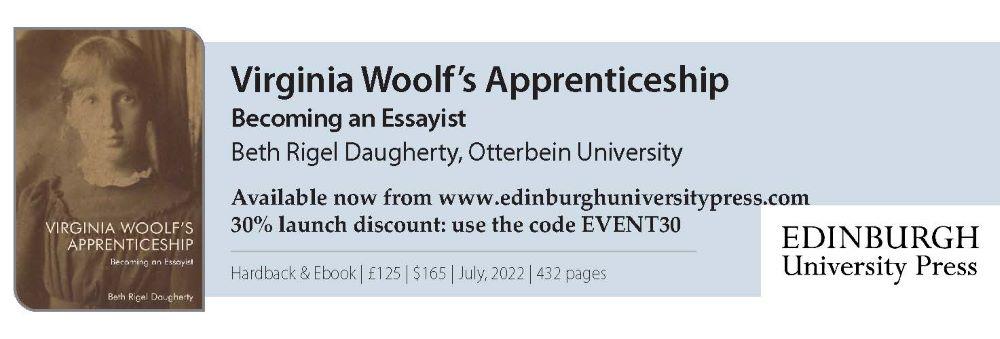
Beth Rigel Daugherty is beloved in Virginia Woolf circles for both her scholarship and her down-to-earth approach to Woolf studies. Her latest book, Virginia Woolf’s Apprenticeship: Becoming an Essayist, out his month, is available at a 30 percent discount from the Edinburgh University Press. Just enter the code EVENT30 when you checkout and you can share her brilliance at a discount.
What’s in the book
The most comprehensive portrayal of Virginia Woolf’s education to date
Examination of the link between Virginia Stephen’s education and Virginia Woolf’s essays
A focus on Woolf’s nonfiction and her early work
Two holograph draft lectures by Virginia Stephen for the first time
A compilation and organization of archival material in appendices for future researchers.
According to the publisher:
This study takes up Woolf’s challenge to probe the relationship between education and work, specifically her education and her work as an essayist. It expands her education beyond her father’s library to include not only a broader examination of her homeschooling but also her teaching at Morley College and her early book reviewing. It places Virginia Stephen’s learning in the historical and cultural contexts of education for women, the working classes and writers in the late nineteenth and early twentieth century.
About Beth Rigel Daugherty
Beth Rigel Daugherty (at far left), Leslie Hankins and Diane Gillespie presented a panel on “Portraying and Projecting Age, Ageism, and Activism” at the 19th Annual International Conference on Virginia Woolf, with its theme of social justice, at the University of Mount Saint Joseph in Cincinnati in June of 2019.
Recently retired from Ohio’s Otterbein University, Beth Rigel Daugherty taught modernist English literature, Virginia Woolf and Appalachian and Native American literature along with many thematically focused writing courses, for 36 years.
Beth fell in love with Virginia Woolf and her essays while at Rice University and has been presenting and publishing on both ever since. Her peer-reviewed articles have appeared in edited collections; editions of the “How Should Read a Book?” holograph draft and Woolf’s fan letters in Woolf Studies Annual; and, with Mary Beth Pringle, the Modern Language Association teaching volume on To the Lighthouse.
A review
Drawing on deep research into the social history of women’s lives and of education, Daugherty shows with superb attention to detail how Virginia Stephen’s early experiences of teaching and of being taught nourished the seeds that flowered as Virginia Woolf, “an essayist compelled to teach.” This is impeccable and important scholarship.
A roundtable on “Biography, Biofiction and Ethics” was a highlight for me at the June 9-12 Annual International Conference on Virginia Woolf. The panelists, all knowledgeable on the topic, included two authors of Woolf biofiction who defended the genre.
Two views of Keynes
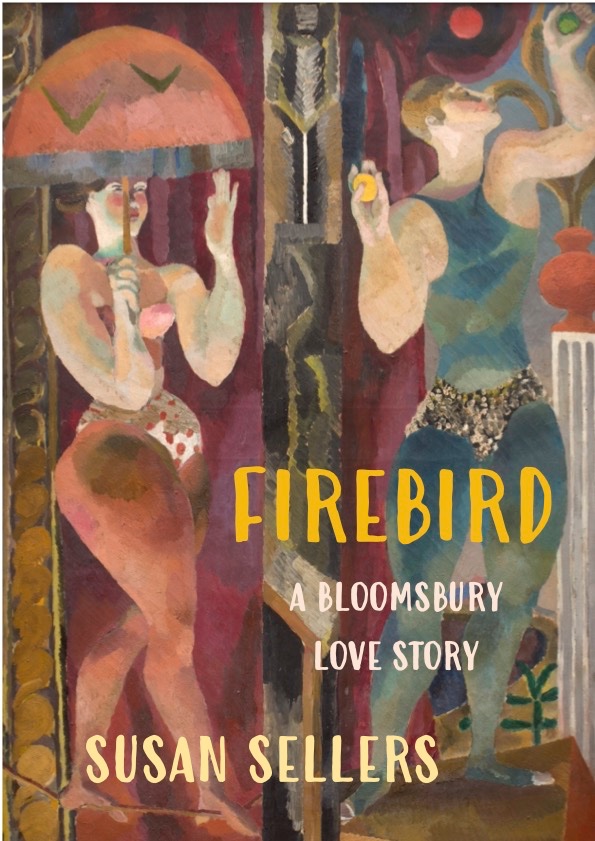
Susan Sellers, author of the 2008 Vanessa and Virginia and the recently releasedFirebird: A Bloomsbury Love Story (about Maynard Keynes and Lydia Lopokova), pronounced fiction as “the ideal medium for exploring the tangle of personal history” and “an ethical arena in which to speculate and imagine in the gaps of what the historical record can tell us.”
Emma Barnes also chose Maynard Keynes as the subject of her 2020 novel, Mr. Keynes’ Revolution. She said: “Fiction is a lie, by definition. But it’s also a lie in pursuit of some essential truths, or should be. If we recognize the practical and aesthetic constraints imposed on us as writers, we can try to write fiction about real people with integrity.”
The devil’s advocate on the panel was Mark Hussey, Woolf scholar extraordinaire and author of the recent biography, Clive Bell and the Making of Modernism. For Mark, a novelist’s changing facts raises an ethical red flag: “The shift of emphasis from the biographical subject of a biofiction to the writer of that biofiction’s own ‘vision of life and the world’ strikes me as a bit of rhetorical sleight of hand.”
A view from the fence and more
As a selective and skeptical reader of biofiction, I’m on the fence. What’s fact and what’s fiction? Should I care? (I do.) Can and should a novelist distort the facts to embellish the fiction?
For the reader, perhaps it’s a case of caveat emptor: she knows she’s reading fiction and she can enjoy it as such, consult factual sources to verify facts. I’ve read biofiction that the author appends with a list of references and comments about her fictionalizations. That works for me.
In addition to those mentioned above, other biofiction novels mentioned or referenced include:
A print from Suzanne Bellamy’s “Virginia Woolf Series”
Tributes to Suzanne Bellamy, artist, writer, scholar, Australian feminist pioneer, and quintessential free spirit, are flooding social media and email inboxes since she passed away early on June 20 in her native Australia.
Conferences and art
I didn’t know Suzanne well, though many Virginia Woolf scholars did. I met her in 2007 at the 17th Annual International Conference on Virginia Woolf at Miami University of Ohio. I was a newbie to Woolf studies, and it was my first conference.
Suzanne had a table of her artwork at that event, as she often did, and that year she was right across the aisle from Cecil Woolf, whom I had just met for the first time. I must have said something that indicated I was a Woolf novice, because in her own inimitable fashion, Suzanne made sure that I knew exactly to whom I was speaking — THE Cecil Woolf!
Suzanne had a generous spirit. In 2011, she wrote a post for this blog that explained her painting “Woolf and the Chaucer Horse,” which she created for the 21st Annual International Conference on Virginia Woolf. Over the years, she gave me many prints of her art that featured Woolf. One of them, that I framed and hung in my home, is pictured above. I plan to frame more.
Scholar, artist, feminist, and more
Suzanne was a published scholar of both Woolf and Gertrude Stein. But she was much more than that. She was an essayist. She worked in visual music and abstraction and lesbian modernism. Her work also included word jazz and ecology and water, according to her website.
Her first large solo U.S. show was at the Northampton Center for the Arts in Massachusetts in May/June 2003, and she was artist in residence at Smith College during the 2003 International Virginia Woolf Conference.
In London at the 2004 conference, she was a featured presenter with a jazz visual text improvisation called “Am I Blue?.” This was her scat word and visual painting interpretation of three Woolf experimental short fictions about war with large canvas paintings as set.
In 1969, Suzanne was also part of the first group of Women’s Liberation in Sydney. She taught Women’s Studies and Politics at Macquarie University from 1974 to 1980, a period she called “the great feminist years.” She was National Convenor of the First Women and Labour Conference in 1978 and she worked on all three Australian Women’s Commissions.
Below is just one of the many tributes to Suzanne that has been shared. This one was sent by Benjamin Hagen, president of the International Virginia Woolf Society. It is based on information shared by Suzanne’s dear friend, collaborator, and fellow Woolf scholar Elisa Kay Sparks.
Tribute from Ben Hagen, president of IVWS
I write now, however, with the sad news that Suzanne Bellamy, a friend and spiritual traveling companion to so many in the international Woolf community, passed away peacefully a little after midnight, this past Monday morning, Australian time.
Suzanne was particularly delighted that she had been able to participate in a panel at this year’s Woolf conference with Elisa Kay Sparks, Davi Pinho, and Maria Oliveira. Those of us who attended that virtual panel were struck by the power of the work she shared with us that day.
Though very ill, she was able to stay at home until last Wednesday. She was “completely present,” a friend reports, until Saturday, discussing lists of people to notify and what to do about artwork, etc. before she slipped into a quiet coma from which she did not wake up.
Suzanne was born 22 September 1948. Her friends in Australia are making sure that her property is secured and her artwork taken care of, fulfilling the requests in her will. They will gather together for a major celebration of Suzanne’s life in September, around her birthday and the solstice. As some of you know, much of Suzanne’s work—journals, artworks, and films about the Australian women’s movement—have already been sorted and placed in the Australian National Archives.
On behalf of the IVWS, I send condolences to all members who knew Suzanne, treasured her friendship and guidance, and benefited from the light she brought with her wherever she traveled. To those who did not know Suzanne, I hope you will have a chance in the coming weeks and months and years to learn about her artwork, her Woolf scholarship, her political activism, her goodness, her power, and her love.
Tribute from Claire Nicholson, chair, Virginia Woolf Society of Great Britain
On behalf of all members of the Virginia Woolf Society of Great Britain, I’d like to extend our deep condolences to the family, friends and colleagues of Suzanne Bellamy. An inspiring artist and scholar, Suzanne was an unforgettable presence at International Virginia Woolf Conferences. Her artistic vision, wide-ranging knowledge and warm sense of humour livened up many conference proceedings and she was held in real affection by Woolfians from all over the world. She will be much missed indeed, but leaves a wonderful legacy of her work which will be enjoyed for many years to come. Rest in peace, Suzanne.
“Woolf and the Chaucer Horse” by Suzanne Bellamy
Honoring the passing of salon denizen, scholar, adventurer, artist, activist, trail blazing feminist, and friend #SuzanneBellamy. What a glorious star. Travel lightly, make beautiful trouble. Grateful for your incredible life. Thank you. Thank you. pic.twitter.com/L0Ctf4G4pM
— woolfsalonproject (@woolfsalonproj1) June 21, 2022
Woolfians around the globe celebrated Dalloway Day last week, a day commemorating Clarissa Dalloway’s walk to “buy the flowers herself” in preparation for her party that evening.
The official date, as established in 2018 by both the Virginia Woolf Society of Great Britain and the International Virginia Woolf Society, is the third Wednesday in June, which this year fell on June 15. But events celebrating Virginia Woolf’s 1925 novel Mrs. Dalloway are not usually restricted to one day, and this year was no exception.
Here is a rundown of some of the events that took place this year, along with a few notable #DallowayDay tweets, some of which share interesting resources.
— Louisa Albani artist (@louisa_albani) June 16, 2022
Today’s the day! For #DallowayDay, we will be releasing the first half of our new issue on Twitter throughout the day. The full issue is going live now! #WritingCommunity#fiction
— L’Esprit Literary Review (@LEspritLit) June 15, 2022