What color were Virginia Woolf’s eyes? That has turned out to be a puzzling question that has me still searching for the answer, while begging forgiveness for the pun.
“Jane Austen’s Book Club” puzzle by eeBoo, which depicts Woolf (front, far right, as a blue-eyed blonde)
The question occurred to me after completing a 1,000-piece eeBoo puzzle titled “Jane Austen’s Book Club.” Woolf, along with Austen, Mary Shelley, George Eliot, and Zora Neale Huston, are pictured sipping tea, alongside some of their famous titles.
Wasn’t she a brown-eyed brunette?
The puzzle was fun to put together and I was happy to add it to my collection of Woolf puzzles. I am even planning to frame it. But it left me wondering why artist Jennifer Orkin Lewis pictured Woolf as a blue-eyed blonde.
All of the paintings and photos I have seen of Woolf depict her with dark hair. And although her father, Leslie Stephen, is said to have had steely blue eyes, I have never seen her described that way.
In the famous color photos of Woolf by Gisele Freund, taken in her Tavistock Square home in London just before World War II broke out in 1939, Woolf’s eyes appear to be brown. It was the last portrait taken of Woolf and the only one in color. I have also seen Woolf’s eyes described as grey, although that source does not seem reliable. But never blue.
So I have emailed the artist to ask for some insight into her color choices. I’ll let you know what I hear.
“Thinking is my fighting,” wrote feminist icon Virginia Woolf in her 1940 essay “Thoughts On Peace in an Air Raid.” That is more powerful than ever today, as we honor and remember another feminist icon, Ruth Bader Ginsburg, who passed away two days ago, on Sept. 18.
Known as Notorious RBG, tributes to the Supreme Court justice continue to pour in from around the world.
Published last year, Smyth’s memoir tells the story of her own family, of discovering her parents as people, and of her father’s alcoholism and death. She does it all while weaving in literary criticism of Virginia Woolf’s To the Lighthouse.
By doing so, critics say she creates the perfect medium for reflecting on grief, loss, and marriage, on the way family morphs as you age, on memory and the difficulties of trying to understand who your parents are, and who they once were. Wow. That’s an armload to take on in one book.
The memoir’s title comes from the poem “Luriana Lurilee” by Charles Elton that Woolf references in To the Lighthouse.
That Gordon ties Woolf’s semi-autobiographical novel to her memoir is quite fitting, as Woolf focused her work on her own parents in the roles of Mr. and Mrs. Ramsay.
This is a transcendent book, not a simple meditation on one woman’s loss, but a reflection on all of our losses, on loss itself, on how to remember and commemorate our dead. – Charlotte Gordon, The Washington Post
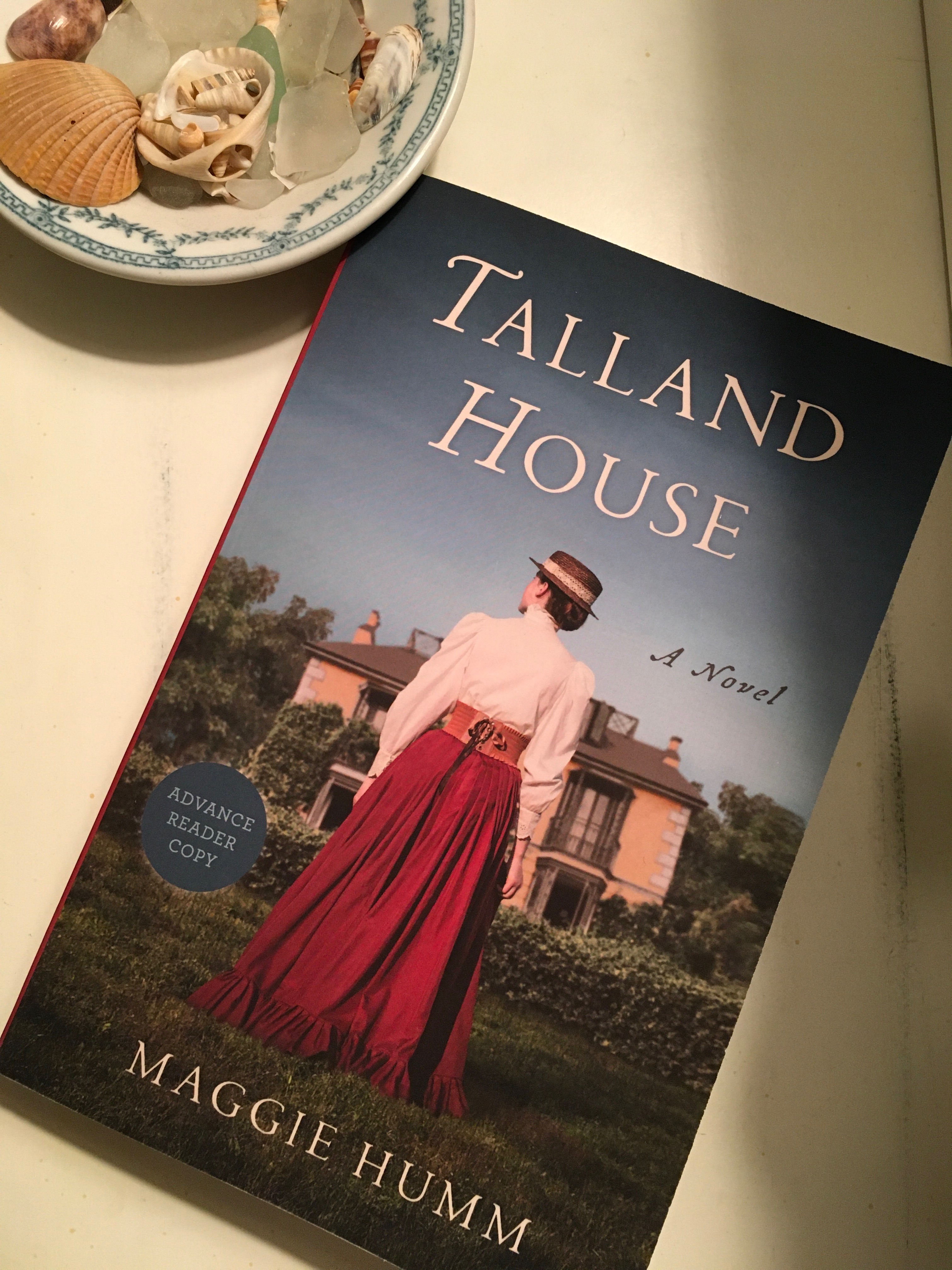
When I first heard that renowned Virginia Woolf scholar Maggie Humm was writing a novel featuringLily Briscoe and based on Woolf’s semi-autobiographical novel To the Lighthouse (1927), I couldn’t wait to get my hands on a copy.
The opportunity came in March, when I saw on Facebook that Maggie had advance reader’s copies in her grasp. After meeting Maggie at many Woolf conferences, I consider her a friend. So I contacted her and asked for a copy. She immediately promised to send one.
Pandemic realities on both sides of the pond
A few hours later, pandemic reality hit her. Recalling that the coronavirus had pretty much grounded all international flights, thereby shutting down international mail delivery, Maggie realized that a copy mailed from England would be unlikely to reach me. She put me in touch with her U.S. publicist to obtain a copy stateside instead.
The book arrived quickly, and I expected to jump right in. But my pandemic reality meant I had difficulty focusing on Maggie’s book — or any book — until recently. That made me late finishing the novel and late posting about it here as well. But since it is now available on Amazon, better late than never. So here goes.
Talland House fills in and illuminates
Maggie, emeritus professor of cultural studies at the University of East London, is the author or editor of 14 books, with the last three focused on Woolf and the arts. So it is only natural that in her first novel, Talland House, Maggie focuses on artist Lily Briscoe from To the Lighthouse.
To that end, Talland House fills in Lily’s back story — the death of her mother, her art studies in Paris and St. Ives, her work as a nurse during the Great War, and her involvement in the suffrage movement. Set between 1900 and 1918 in both Cornwall and London, it also provides a prequel to Woolf’s novel and reimagines that work from Lily’s perspective.
That reimagining includes Mrs. Ramsay’s demise. Her death, mentioned briefly and parenthetically in Woolf’s novel, is “discovered” or explained in Maggie’s novel. But I will include no spoilers here.
While conducting research to write the novel, Maggie pored over old photos of St. Ives, as well as Cornish newspapers, artists’ memoirs, and art journals to get a feel for the seaside town and its art community during the years the novel covers.
St. Ives Bay, June 2004
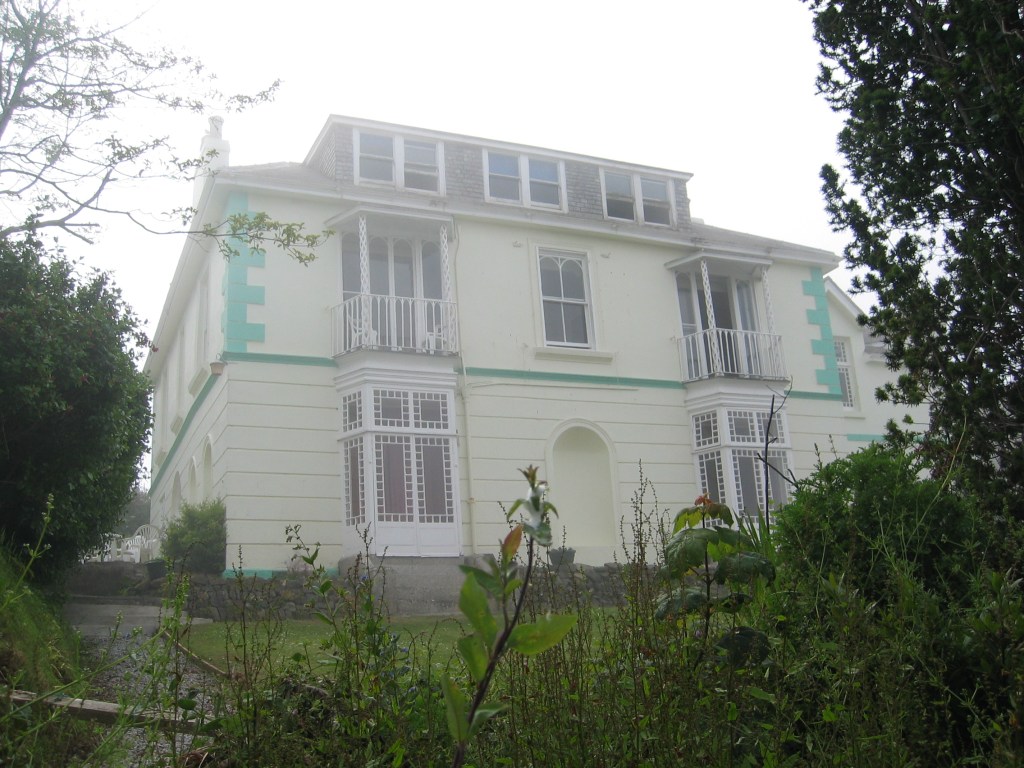
The extent of her research shows in her luminous prose that paints a compelling and colorful picture of St. Ives and its charms, the location of all of Woolf’s novel and much of Talland House. The picture is so complete — from the view of the lighthouse from Talland House to the fishing boats in the harbor — that one is transported back in time to the cobblestone streets of the Cornish town.
References slipped into a must-read
Woolf scholars and readers will delight in catching the specific references to Woolf’s work that Maggie slips into this historical novel.
Lily makes note of Mr. Ramsay’s boots and his recitation of Tennyson’s poems. She recalls moving the salt cellar at dinner and describes the animal skull on the nursery wall and the tapping sound of the window blind’s acorn on the nursery floor. And in a fresh take-off on Woolf’s famous line in “Thoughts on Peace in an Air Raid” (1940), “Thinking is my fighting,” Lily proclaims that painting is hers.
If you are a fan of Woolf, this is a must-read. If you are not, it will make you want to become one, just so you can connect this enchanting novel to Woolf’s works.
More on the novel
Talland House was shortlisted for the Impress and Fresher Fiction prizes in 2017 (as Who Killed Mrs. Ramsay?) and the Retreat West and Eyelands prizes in 2018.
Maggie Humm has brilliantly filled in the edges beyond Woolf’s canvas; she has a deep, awe-inspiring understanding of the role of the visual in Woolf’s work, and here she reveals that she also has a novelist’s gift to create something new, that has its own imaginative life, from that understanding. -Lauren Elkin, author of the award-winning Flaneuse
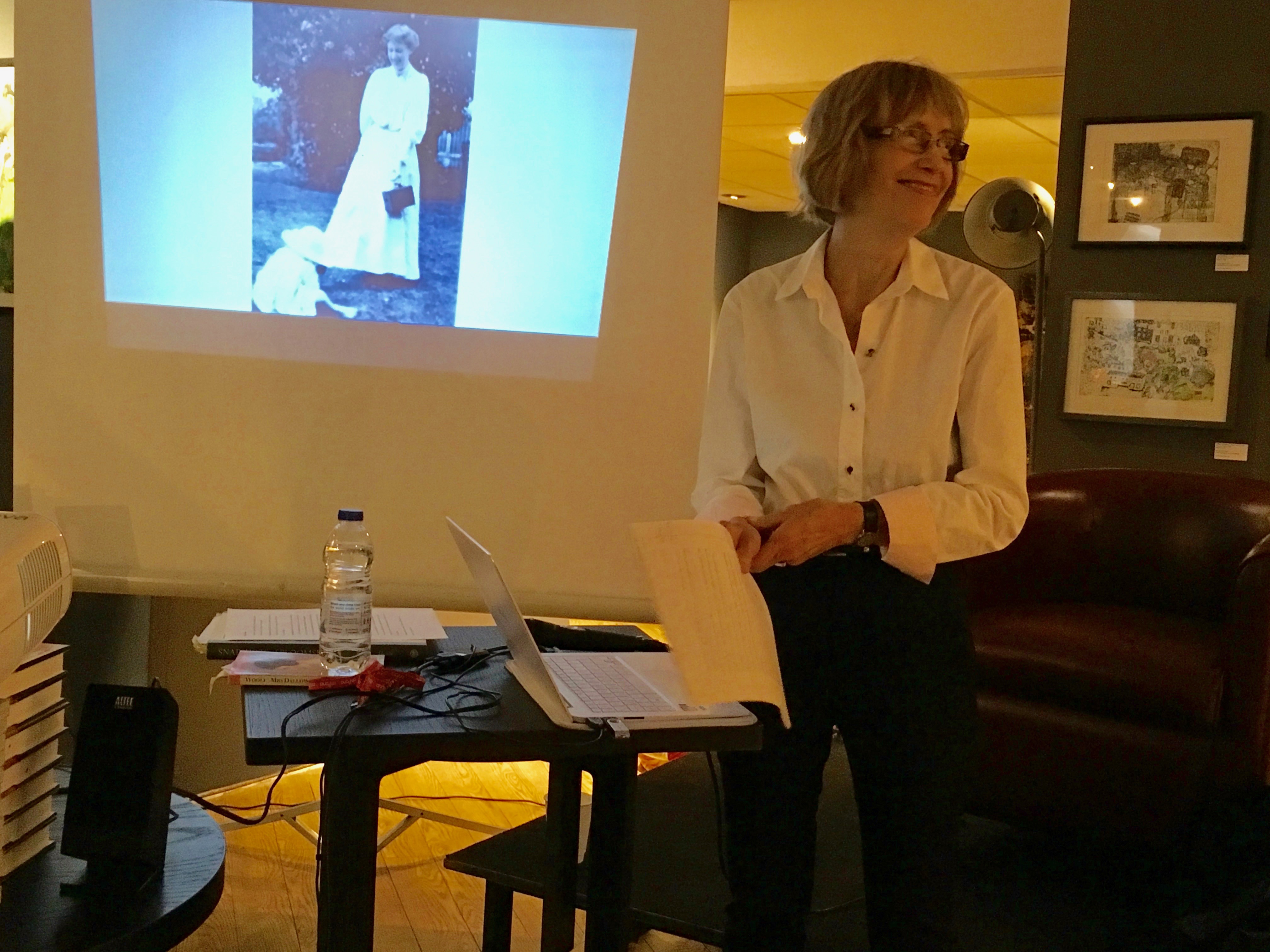
Maggie Humm talking about Virginia Woolf and her photo albums at Waterstone’s Gower Street during Dalloway Day celebrations in London in 2018.