Feeds:
Posts
Comments

Posts Tagged ‘books’

Happy World Book Day from Virginia Woolf, who authored so many wonderful ones.

photo (8)

https://twitter.com/bluebleakembers/status/591257093308452864

Read Full Post »

She had the will to write as a woman. And I had read that in no other book.

—Ruth Gruber on Virginia Woolf

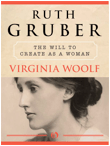
Ruth Gruber’s groundbreaking study of the work and legacy of Virginia Woolf—an enduring feminist analysis pairing two of the twentieth century’s most extraordinary writers is now out as an ebook published by Open Road Integrated Media.

Here’s the back story. In 1932, Ruth Gruber earned her Ph.D.—the youngest person ever to do so—with a stunning doctoral dissertation on Virginia Woolf. Published in 1935, the paper was the first-ever feminist critique of Woolf’s work and inspired a series of correspondences between the two writers. It also led to Gruber’s eventual meeting with Woolf, which she recounted six decades later in Virginia Woolf: The Will to Create as a Woman.

Described by Gruber as “the odyssey of how I met Virginia Woolf, and how her life and work became intertwined with my life,” Virginia Woolf is a clear and insightful portrait of one of modern literature’s most innovative authors, written by one of America’s most remarkable journalists.

Ruth Gruber at Woolf and the City

Gruber is the author of 19 books, including the National Jewish Book Award–winning biography Raquela (1978). She also wrote several memoirs documenting her astonishing experiences, among them Ahead of Time (1991), Inside of Time (2002), and Haven (1983), which describes her role in the rescue of 1,000 refugees from Europe during World War II, and their safe transport to America. Gruber lives in New York City.

Extra content includes:

•  Behind-the-scenes videos and author commentary at www.openroadmedia.com/authors/ruth-gruber.aspx   

•  An illustrated biography in each ebook, including never-before-seen photographs and documents from Gruber’s personal life and distinguished career

The ebook is available from Amazon.com, Apple iBookstore, Barnesandnoble.com, Google eBookstore/IndieBound, Kobo Books, Sony Reader Store, and OverDrive.

Read Full Post »

Alexandra Harris. Her name is on my lips for good reason.

Romantic Moderns, which just won the Guardian First Book Award, arrived on my doorstep last week. I am itching to read it, but things keep getting in the way. Things like grading fall semester essays. The holidays. Prepping for spring semester. And the overwhelming desire to read something light that won’t strain my incredibly tired brain.

And now I read that Harris has been signed by Thames and Hudson to produce two more books. The first, a short biography of Woolf titled Brief Lives: Virginia Woolf, will be published in spring 2011. Yeah for that.

The second, titled The Weather Glass, will discuss the British preoccupation with weather. That made me gasp right out loud. And I am not exaggerating.

Reading of her plan to write about the British interest in weather made me realize that Verita Sriratana and I are not the only ones  interested in reading the skies — as they relate to Woolf and other writers.

For her doctoral thesis, Verita is writing about weather in The Years. In Reading the Skies, I discuss Woolf’s use of weather in Mrs. Dalloway, To the Lighthouse, and Orlando. And Harris plans to begin her study with Beowulf and work her way up — hopefully to Woolf. 

Meanwhile, here’s another fun weather read — especially at this time of year in places where snow is likely. It’s called The Wrong Kind of Snow: The Complete Daily Companion to the British Weather.

Read Full Post »

A Paradise Built in HellAnyone who was charmed and challenged by Rebecca Solnit’s keynote speech at Woolf and the City will want to read the New York Times review of her latest book, A Paradise Built in Hell: The Extraordinary Communities That Arise in Disaster.

In the book, the award-winning author takes the reader through five major North American disasters, from the 1906 earthquake in San Francisco to 9/11 and Hurricane Katrina in New Orleans.

There is a lot of commentary about the book available online, including this piece in The Guardian. Discussions with the cultural historian are available as well. They include:

You can also listen to Solnit reading from her new book, courtesy of Vanity Fair.

Read Full Post »

women writers at workI love to read writers talking about their lives, their work, their influences.

A 1989 Paris Review collection, Women Writers at Work, includes interviews from the 1960s to the mid-1980s with Isak Dineson, Lillian Hellman, Dorothy Parker, Nadine Gordimer, Joan Didion, and others. Not surprisingly, Virginia Woolf pops up a few times.

Katherine Anne Porter (1890-1980) cites three “almost perfect novels:” A High Wind in Jamaica by Richard Hughes, A Passage to India by E.M. Forster and To the Lighthouse by Virginia Woolf. “Every one of them begins with an apparently insoluble problem, and every one of them works out of confusion into order. The material is all used so that you are going toward a goal. And that goal is the clearing up of disorder and confusion and wrong, to a logical and human end.”

Eudora Welty (1909-2001) says of Woolf: “She was the one who opened the door. When I read To the Lighthouse, I felt, Heavens, what is this? I was so excited by the experience I couldn’t sleep or eat. I’ve read it many times since, though more often these days I go back to her diary. Any day you open it to will be tragic, and yet all the marvelous things she says about her work, about working, leave you filled with joy that’s stronger than your misery for her.”

Several interviews discuss the troublesome label of “woman writer.” The always acerbic Mary McCarthy (1912-1989) names Woolf, Katherine Mansfield and Elizabeth Bowen as what she calls “a certain kind of woman writer who’s a capital W, capital W.” These signify “sensibility,” whereas she advocates for “sense,” represented by Katherine Anne Porter, George Eliot and possibly Eudora Welty.

Katherine Anne Porter, by the way, calls McCarthy “one of the wittiest and most acute and in some ways the worst-tempered woman in American letters.”

Read Full Post »

« Newer Posts - Older Posts »