Feeds:
Posts
Comments

Posts Tagged ‘pandemic’

Virginia Woolf’s numerous experiences with illness led her to write the essay On Being Ill, published in 1930 by the Hogarth Press. Inspired by this work and the  coronavirus, Norwegian typesetter Ane Thon Knutsen has turned her spontaneous homage to the essay into book form.

Here’s how it came about.

In March of 2020, as lockdowns due to the COVID-19 pandemic spread around the globe, Ane already had two other projects focused on Woolf under her belt — A Printing Press of One’s Own and The Mark on the Wall.

Working from her private letterpress studio at home, Ane started a third. She printed one sentence from “On Being Ill” on one sheet of paper every day. Her project ran from March 23 to Aug. 29, 2020, and she shared those pages on Instagram. She also shared her thoughts about the project with Blogging Woolf.

Through this process, she shaped a diary in response to the COVID-19 pandemic and allowed for research on pandemics by creating an artist book.

The book merges Woolf’s sentences with with my reflections on covid, pandemics, isolation, escaping reality through literature, waiting, time, art, love, protests, feminism, typesetting, printing, family, small stuff, big stuff. – Ane

The publication also contains reflections on teaching during the pandemic in the spring of 2021, along with insights and works by master’s students in graphic design and illustration at The Oslo National Academy of The Arts, using Woolf’s essay as a mirror for their own pandemic experiences.

The digital book edition

With an introduction by Mark Hussey, the book is available as a digital book edition of 150. It is now available through several independent bookshops, which are handling distribution. They include the following:

Copies will also be available at the 33rd Annual International Woolf conference in June.

Support and gratitude

The publication is supported with research funds from The Oslo National Academy of The Arts. Graphic design was done by Tiril Haug Johne and Victoria Meyer.

Ane expresses special thanks to the Oslo National Academy of the Arts Class of 2022: Araiz Mesanza, Embla Sunde Myrva, Kristine Lie Øverland Emil Holmberg Lewe, Ruth Emilie Rustad, Nicolo Groenier, her former professor Alan Mackenzie-Robinson, former president of the International Virginia Woolf Society Dr. Benjamin Hagen, the Woolf community, her husband Truls and her son Pil.

Ane Thon Knutsen in her home printshop with a volume of On Being Ill, her pandemic project originally shared on Instagram.

About Ane Thon Knutsen

Ane is internationally known for her letterpress-focused installations and artists’ books. The associate professor of graphic design at the Oslo Academy of the Arts has won numerous awards for her work. She owns and works from her private letterpress studio in Oslo.

Ane Thon Knutsen at her exhibition “Printed Works: Adaptations of Virginia Woolf” at the 32nd Annual International Conference on Virginia Woolf at Florida Gulf Coast University, Jun3 8-11, 2023.

She also debuted her installation, “Printed Words: Adaptations of Virginia Woolf,” at University Archives and Special Collections at the Florida Gulf Coast University library during the 32nd Annual International Conference on Virginia Woolf: Virginia  Woolf and Ecologies, June 8-11, 2023.

In “Printed Works,” the self-taught typesetter who has exhibited other letterpress projects and installations related to Woolf, adapted a selection of Virginia Woolf’s self-published short stories. The exhibit focused on Woolf’s poetic short stories “Blue” and “Green.” The printed pages were collected and are being stored in book form in FGCU Bradshaw Library’s Archives and Special Collections.

More coming up

In addition, Ane will display another installation, Woolf’s “Kew Gardens,” May 16 – June 11 for the 33rd International Virginia Woolf Conference. The adaptation of Woolf’s short story consists of 1,514 letterpress-printed sheets of kozo.

According to Ane, it is an “organic book allowing you to walk through the pages, like insects in a flowerbed.”

Read Full Post »

This Devastating Fever, a new novel by Sophie Cunningham, follows the story of novelist Alice Fox and her struggles to write about Leonard Woolf as he deals with what he and Virginia would do if Hitler invaded England.

The novel, shortlisted for a Victorian Premier’s Literary Award, links Leonard and Virginia’s past dilemmas to those of the present, as Alice deals with the COVID-19 pandemic.

About the author and the talk

Cunningham, a member of the Order of Australia for her literary contributions and the author of nine novels, spent 15 years writing her latest.

If you can get to Sydney, Australia, you can hear Cunningham talk about her novel at Castle Hill Library 11 a.m. – noon on May 27, as part of the Sydney Writers’ Festival.

Complex, darkly funny and deeply moving,– a dazzlingly original novel about what it’s like to live through a time that feels like the end of days, and how we can find comfort and answers in the past.

Read Full Post »

Norwegian multidisciplinary artist Ane Thon Knutsen is at it again — at combining Virginia Woolf and the letterpress, that is.

This time, the Oslo Academy of the Arts professor has debuted her installation, “Printed Words: Adaptations of Virginia Woolf,” at University Archives and Special Collections at the Florida Gulf Coast University library.

The Feb. 23 opening reception introduced the installation, which will be on display from now through the 32nd Annual International Conference on Virginia Woolf:
Virginia  Woolf and Ecologies, June 8-11. Registration opens in March.

In “Printed Works,” the self-taught typesetter who has exhibited other letterpress projects and installations related to Woolf, adapts a selection of Virginia Woolf’s self-published short stories.

“Knutsen’s artistic research aims to point out the influence typography, particularly typesetting, might have on the content of the text. It speaks to the power of designing and publishing one’s own work,” notes the FGCU Special Collections and Archives website.

Her first Woolf project: a book

In “A Printing Press of One’s Own,” which premiered at the 27th Annual International Conference on Virginia Woolf” at the University of Reading, England, in 2017, Ane produced a hand-set volume that includes Ane’s personal essay about her experience finding a space of her own in which she could pursue her passion — typesetting.

Ane Thon Knutsen with her hand-printed volume introduced at the 2017 Woolf conference, “A Printing Press of One’s Own”

According to Ane, “The book is an essay referring to A Room of One’s Own (1929) by Virginia Woolf. The essay reflects upon women’s role in letterpress, and the importance of a room of one’s own in artistic practices.

“In this book I am investigating the first books printed by Virginia Woolf at the Hogarth Press, both in practice and in the written ‘dialogue’ between Virginia Woolf and myself, as we are both self-taught typesetters.”

Her second: up on the walls

In the winter of 2019, Ane had a major installation of Woolf’s first short story, “The Mark on the Wall,” (1917) in Kunstnernes Hus, an art institution in the centre of Oslo.

As described by Nell Toemen, who visited the exhibit and shared her thoughts with Blogging Woolf, Woolf’s story was “handprinted on I don’t know how many papers, white and off-white, neatly arranged so as to fill all the walls. If you would walk the room in eleven rounds you would be able to read the whole story. Reading it this way is an absolutely different experience than reading the story in a book.”

Page 2 of the “On Being Ill” project

Her third: via Instagram

In March of 2020, as lockdowns due to the COVID-19 pandemic spread around the globe, Ane used her printing press to print one sentence on one sheet of paper every day from “On Being Ill,“ Woolf’s 1930 essay.

She shared each page on Instagram and she shared her thoughts about the project with Blogging Woolf.

At the time, she said she was using her printing press to print one sentence on one sheet of paper every day from “On Being Ill” “until we can go back to normal. I hope I will not make it through, as we’re counting about 140 sentences, and the paper is restricted to leftovers from my stock.”

About Ane Thon Knutsen

Ane is internationally known for her letterpress-focused installations and artists’ books. The associate professor of graphic design at the Oslo Academy of the Arts has won numerous awards for her work. She owns and works from her private letterpress studio in Oslo.


Read Full Post »

Virginia Woolf would have been 140 today. So today, as we near the end of year two of the COVID-19 pandemic, it seems fitting to look at the moody diary entry she wrote a day after her fifty-ninth birthday in 1941, when she, Leonard, and the rest of the world were living through year two of the Second World War.

Her diary entry of Sunday, Jan. 26, 1941, shows that despite the difficult state of the world, she slogs on with her work as she battles depression and vows that “[t]his trough of despair shall not, I swear, engulf me.”

She bemoans the solitude and the smallness of her current life at Monk’s House in Rodmell and details her “prescription” for survival:

Sleep & slackness; musing; reading; cooking; cycling; oh & a good hard rather rocky book – p. 355, The Diary of Virginia Woolf, Volume 5.

Woolf’s words convey pandemic feelings

To me, so much of this entry pertains to our pandemic state in the present day. We work. We battle uncomfortable feelings. We refuse to be engulfed by despair. We see our current lives as smaller — much smaller — than they once were.

But we go on anyway, doing whatever necessary in this “cold hour.” We sleep. We think. We read, we cook, we cycle. We surf, we Google, we Zoom.

We press our noses to the closed door, hoping it will open soon.

Here is Woolf’s diary entry for the day after her 59th birthday in its entirety.

1941

Sunday 26 January

A battle against depression, rejection (by Harper’s of my story & Ellen Terry) routed today (I hope) by clearing out kitchen; by sending the article (a lame one) to N.S.: & by breaking into PH 2 days, I think, of memoir writing.

This trough of despair shall not, I swear, engulf me. The solitude is great. Rodmell life is very small beer. The house is damp. The house is untidy. But there is no alternative. Also days will lengthen. What I need is the old spurt. “Your true life, like mine, is in ideas” Desmond said to me once. But one must remember one cant pump ideas. I begin to dislike introspection. Sleep & slackness; musing; reading; cooking; cycling; oh & a good hard rather rocky book–viz: Herbert Fisher. This is my prescription. We are going to Cambridge for two days. I find myself totting up my friends lives: Helen at Alciston without water; Adrian & Karin; Oliver at Bedford, & adding up rather a higher total of happiness. There’s a lull in the war. 6 nights without raids. But Garvin says the greatest struggle is about to come–say in 3 weeks–& every man, woman dog cat even weevil must girt their arms, their faith–& so on.

Its the cold hour, this, before the lights go up. A few snowdrops in the garden. Yes, I was thinking: we live without a future. Thats whats queer, with our noses pressed to a closed door. Now to write, with a new nib, to Enid Jones (354-355).

Google Doodle in commemoration of Woolf’s 136th birthday

Read Full Post »

Editor’s Note: Emma Morris, the author of this post, is a digital copywriter from Johannesburg, South Africa. She is also a self-proclaimed logophile and loves Virginia Woolf and the Bloomsbury Group. Emma spends her days writing engaging marketing copy for brands and her evenings immersed in literature and literature blogs. 

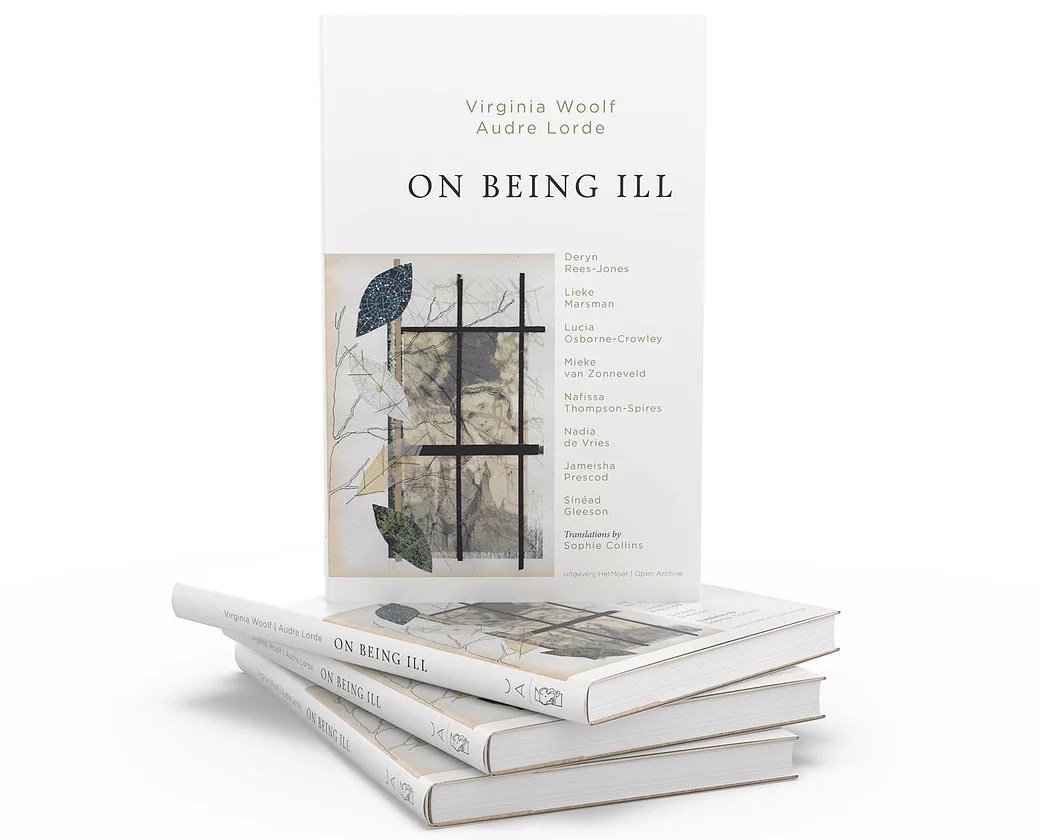
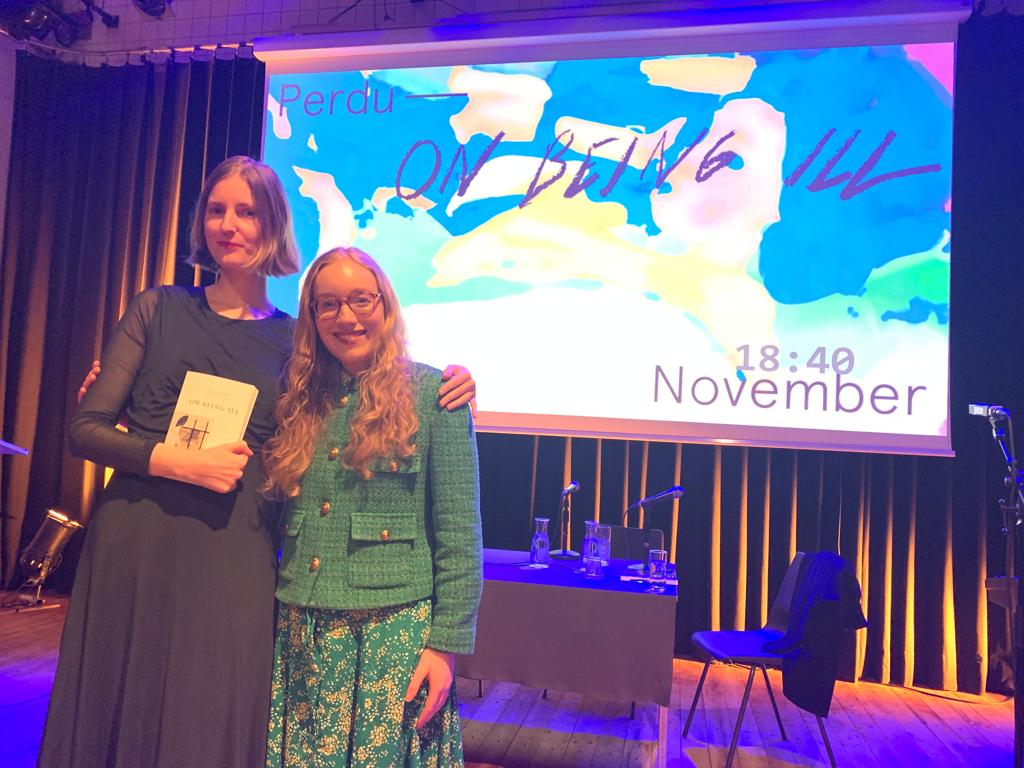
On Nov. 5, cultures and creators came together in Amsterdam and online to celebrate the publication of an anthology of essays, letters and poems which resonate with Virginia Woolf’s essay On Being Ill.

There was a diverse range of speakers at the hybrid event organized by the Perdu Literary Foundation. Both in-person and on Zoom, they spoke to the complexity of the theme. Speakers included Elte Rauch, Marielle O’Neill, Nadia de Vries, Lucia Osborne-Crowley, Deryn Rees-Jones, Sophie Collins and Mieke van Zonneveld, as well as superb live music from Ekster.

Pandemic allows identification

The timing of the publication date could not be more perfect. As the world limps out of isolation, we can most certainly identify with Woolf’s essay on illness itself and the resulting isolation, loneliness and vulnerability that comes with it.

The anthology examines the way illness and literature are dialectically connected to each other, and how the process from conceptualization to the publication of the anthology mirrors the stages of illness.

Connecting as writers

Elte Rauch from HetMoet

As Elte stated in her opening address at the launch, the people involved in this anthology didn’t know each other, but each of them was able to connect at varying points in the process.

This idea that connection can never be lost is pivotal, she said, explaining that while writing is a solitary action, publishing is done together. It is the time when writers, illustrators and musicians all come together.

In an evening that celebrates the relevancy of Virginia Woolf, and especially her “revolutionary act of empowerment,” as Marielle O’Neill stated in her essay, that by openly embracing such a taboo subject as mental health – especially at a time in our history when illness itself is a taboo subject, the anthology as well as the original essay by Woolf will resonate with post-lockdown readers.

When everyday moments become special

As Marielle stated in her essay, small everyday moments, like Mrs. Dalloway buying flowers, become special moments. For example, coffee with a friend becomes a special occasion.

Writer Nadia de Vries with Marielle O’Neill from the Virginia Woolf Society of Great Britain

This anthology shows us, as readers, how beautiful it can be to write about a subject that is, in all honesty, not beautiful.

As Woolf so describes in her essay, when adults are ill, it inevitably makes us feel like children again. Illness is not beautiful. It’s messy, it’s raw and it leaves us vulnerable. In some ways, being ill mirrors the act of writing and creating itself.

How often do we as artists, writers and musicians share some of the most secret parts of our souls when we put pen to paper or paint to canvas?

Literature and anthologies bring us together

As I close this blog piece, I will leave you with something that was repeated during the evening, and certainly echoes in the anthology itself. Just as literature succeeds in bringing people together, this anthology brought writers, creators, scholars, and musicians together for an evening. It even brought you and I together for an evening.

It helped us put aside the loneliness of lockdown, illness and a global pandemic and allowed us to just enjoy each other’s company and inner most thoughts and feelings.

When we talk about illness, we lay bare how naturally afraid of illness and the finality of death we are – almost on a primitive level. But one thing is certain, when we do discuss our vulnerabilities and share our fears, magic is created.

How to get it

The anthology is available now in Holland in English and Dutch editions, with a UK book launch planned for January 2022. For more information contact Elte Rauch at info@uitgeverijhetmoet.nl.

Read Full Post »

Older Posts »