Sounds. I heard many while I was in Istanbul, Turkey, for this year’s annual Virginia Woolf conference.

Street scene in Istanbul, as seen through a car window
I heard the sounds of the call to prayer, the sounds of traffic in the street, the sounds of conversations in many languages, as well as the sounds of music, voices, and dramatic comedy at the 35th Annual International Conference on Virginia Woolf: Woolf and Sound, which was held at Istanbul Bilgi University June 24-28.
Demet Karabulut Dede did an expert job of organizing the conference, attended by about 100 scholars and common readers from around the globe. She was assisted by a helpful team of student volunteers. They included Batuhan Kara, Deniz Lal Ildes, Ece Nas, Frances Elanur Sagman, Irmak Cibir, Mehlika Vardi, Özge Bozokly, Sule Yildiz, and Zeynep Özcçetin.
Sounds at the conference
I went to four days worth of brilliant keynotes, panels, and presentations. Here are just a few:
- Jean Moorcroft Wilson’s charming plenary on “Virginia Woolf and Music,”
- Anna Snaith‘s comprehensive keynote on “infrasonic Woolf,”
- Emma Sutton‘s keynote on “‘Music of a rustic kind’: Goats, Goat Music and Tragedy,”
- Urmili Seshagiri’s captivating keynote on her discovery of Woolf’s The Life of Violet,

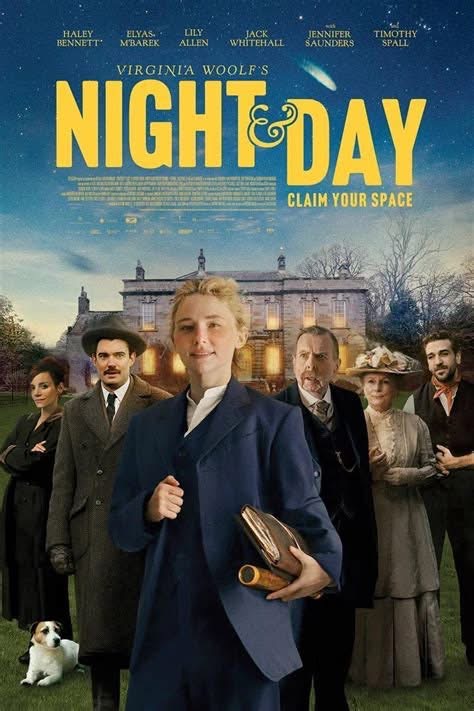
- a much-anticipated screening of Night and Day, the new film that delightfully strays from Woolf’s 1919 novel by the same name, and that included a discussion with Justine Waddell, producer, and Simon Goff, composer.
- a brilliant presentation by Nicea Helena de Almeido Nogueira on “The Poetic Role of Sound in Virginia Woolf’s Short Story ‘A Haunted House,’ which delighted me by aligning and expanding on my own presentation, “The Poetry of Sound in Virginia Woolf’s Orlando,” and
- a full-course Friday evening banquet at the fabulous Biz Istanbul’s rooftop restaurant with a breathtaking evening view of the be-jeweled ancient peninsula above the Golden Horn of the Bosphorus.


This was the view as evening fell at the conference banquet, held at the rooftop restaurant at Biz Istanbul. Comradarie and toasts were plentiful.
What lingers most is Istanbul itself

Woolf journaled about her 1906 trip, but did not write about her visit in 1910, as it was an emergency trip to help her sister, Vanessa, who had suffered a miscarriage.
Here are a few quotes from Woolf’s 1906 trip, as noted in Travels With Virginia Woolf (1993) by Jan Morris, a book I love and refer to often when I travel.
Woolf’s journal entries from her early travels, including her 1906 trip to Turkey, can be found in their entirety in A Passionate Apprentice: The Early Journals, 1897-1909 (1990).
The Golden Horn
Woolf traveled to Constantinople by ship in 1906. In this passage she describes her view of the Golden Horn of the Bosphorus from her ship’s cabin window.
Our conference hotel, the Movenpick, was located on the Golden Horn, so I had a different but similar view. I was told the buildings across the way in my view had mostly been built in the past 50 years, well after Woolf’s time.
The Golden Horn drives a broad blue wedge between two high banks of houses; so that, as some one says, a battle ship rides at anchor in the street before your door – p. 225

View from the city side of the Golden Horn of the Bosphorus, which shows as a tiny sliver beyond the greenery.
Hagia Sophia
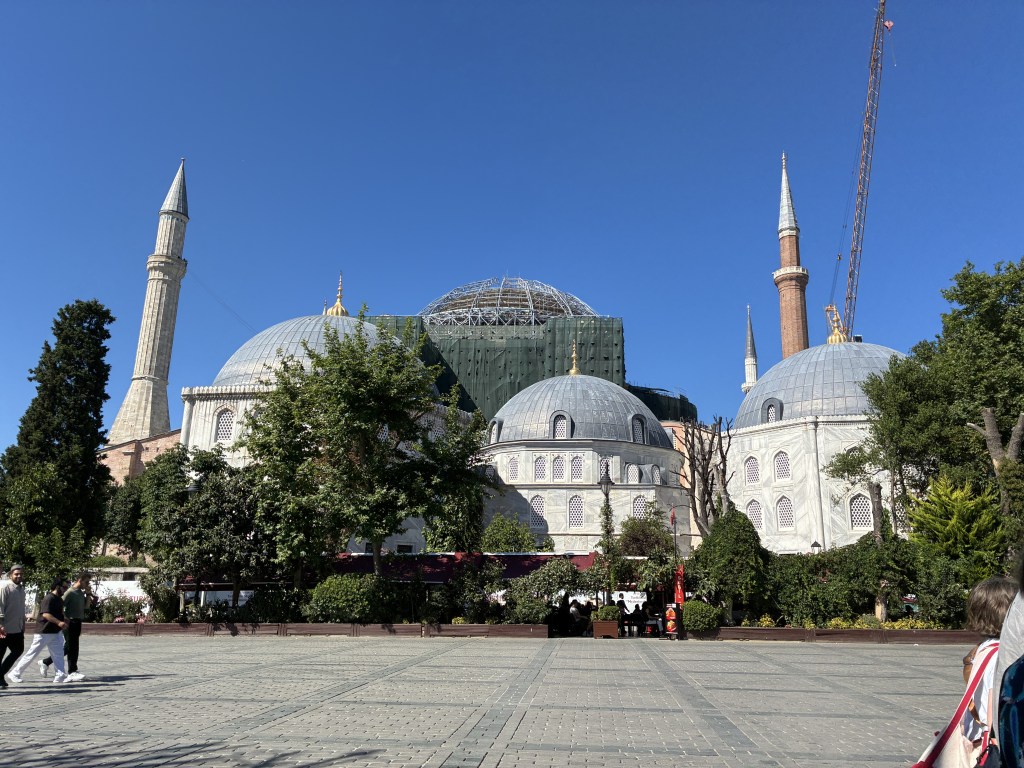
In this passage, Woolf describes seeing Hagia Sophia, which we visited on the last day of the conference. Her view was from the deck of a ship. Ours was from the ground.
there was St. Sophia, like a treble globe of bubbles frozen solid, floating out to meet us. For it is fashioned in the shape of some fine substance, thin as glass, blown in plump curves, save it is also as substantial as a pyramid. Perhaps that may be its beauty. – p. 224

Hagia Sophia with its “treble globe of bubbles”
Hagia Sophia, a Byzantine cathedral until 1453, was a mosque when Woolf visited in 1906 and remains a mosque today, after a short life as a museum.
While Woolf wrote that the Christian decorations of the earlier church “had been corrected & erased altogether till it has no virtue or vice left in it . . . sacred heads have been obliterated from the wall” (227), some have been restored and can be seen today.

Art depicting Christian figures in Hagia Sophia

Jesus Christ is depicted in the center of this piece, with royal figures on either side offering him gifts.
Woolf climbed to the gallery far above the main floor, and we did, too. Like her, we saw people milling about below. Instead of children, we saw adults. And instead of the people moving between the pillars, they were moving between the scaffolding, as the mosque is currently being renovated.
We climbed the long slant that leads to the top of the church . . . And when we looked down into the church there were troops of children, who played hide & seek among the august pillars, & chattered like monkeys as they ran. – p. 228

At the end of our climb, we were on the mezzanine or gallery, where we had a view of those far below.
Woolf admired the lights. We did as well.
Rings of hanging light made little island in the immense gloom; & gradually, as the lamps were lit all round the arches, a soft golden glow shone forth from ceiling & column, till the air seemed warmed to the core. – p. 228

The “Rings of hanging lights” of Hagia Sophia, as seen from the mezzanine.
The Grand Bazaar
On the fourth day of her trip to Constantinople in 1906, Woolf went to the Grand Bazaar. Many of us at the conference did, too, finding exotic teas and spices and other goods.
In Woolf’s day, the bazaar had around 7,000 shops “divided into streets & alleys;” it still does today. She bargained for the cloaks and silk and Turkish delight she purchased. I bargained for my goods as well. I also felt the same urgency she did to “find a Bazaar.”
We had to find a Bazaar, the Grand Bazar indeed, & in time . . . we took refuge in a great honeycomb of little shops, built beneath a single roof & divided into streets & alleys like the ways of a city of dwelling houses. – p. 229

One outdoor section of the Grand Bazaar

More of the Grand Bazaar
The fez
Woolf’s entries mention the fez, part of the national dress in 1906, several times.
Now in the purlieus of Constantinople a great deal of the Gorgeous East still runs warm; a vine was laced across the road, & a various torrent of red fezes, turbans, yashmaks, & European respectability came pouring down it, like a turbulent Highland water. – p. 229
A view does not by any means promise beauty of detail; & the streets were insignificant, & the national dress — a fez & a frock coat — is a disappointing comprise. p. 236
The men save for their red caps & an occasional nose like a scimitar, might be citizens of London – p. 233
I talked about the fez a lot, too. My 20-year-old grandson, a junior at Ohio State University, had requested I bring one back for him, so I asked nearly everyone at the conference where I might find one.
Worried that I would not be able to locate one for sale, since no one wears a fez in Turkey any more, I sent him photos of those I saw at the Topkaki Palace, another site we visited.
While he thought my photos were “awesome,” I knew they were a sorry excuse for the real thing. So I was ecstatic when, just minutes after I arrived at the Grand Bazaar, I found a tall stack of actual fezzes for sale.
My grandson is wearing his fez in the last rather poorly framed photo below. I apologize for the curtain pole appearing to stick out of both sides of his head. ♥

The clothing display at the Topkaki Palace showed several fezzes, including this one at the left, shown with a handsome tunic.

A fez from Turkey on a young man’s head in Ohio.