The International Virginia Woolf Society announces the Annual Undergraduate Essay Competition in honor of Virginia Woolf and in memory of Angelica Garnett, writer, artist, and daughter of Woolf’s sister, Vanessa Bell.
Undergraduate essays can be on any topic pertaining to the writings of Virginia Woolf. Essays should be between 2,000 and 2,500 words in length, including notes and works cited, with an original title of the entrant’s choosing.
Essays will be judged by the society’s officers: Benjamin Hagen (President); Amanda Golden (Vice-President); Susan Wegener (Secretary-Treasurer); and Catherine Hollis (Historian-Bibliographer). The winner will receive $400 and have the essay published in a subsequent issue of the Virginia Woolf Miscellany.
To submit an essay, please fill out the entry form, then send your essay to Benjamin D. Hagen at Benjamin.Hagen@usd.edu.
Here are two calls for papers for Modern Language Association (MLA) 2024. These sessions are not guaranteed, but Ben Hagen, president of the International Virginia Woolf Society, says the IVWS has “had very good luck the past two years getting more than one proposal accepted by the MLA program committee.”
100 years of Mrs. Brown: Human character may have changed on or about December 1910, but 2024 is the centenary of “Mr. Bennett and Mrs. Brown.” How do we understand Woolf’s theories of fiction now? Send abstracts to: mwilson4@umassd.edu.
Celebrating Virginia Woolf’s 18th Century: Beyond Woolf’s call to lay flowers on Aphra Behn’s grave or borrowing “Common Reader” from Johnson, we invite proposals considering Woolf’s engagement with eighteenth-century literary history, aesthetics, biography, fashion/decor, print culture & printing technologies, waxworks, politics. This is a joint proposal with the American Society for Eighteenth-Century Studies. Send abstracts to: mwallace@ncf.edu and engell784@duq.edu.
When: April 1-2, 2022 Where: University of Brighton, with hybrid delivery What: Outside/rs 2022 isa conference that platforms those researching and working with themes of sex, gender, queerness, community and exclusions. Who: If you are a postgraduate researcher, early career researcher, or live, work or create in a marginalised community, then please join the conference in April, either online or in-person at the University of Brighton. Register Call for Papers/Participants: Due Jan. 9, 2022
Conference Theme
For those who exist in queer, marginal, or dissident relations to normativity in its various guises, the ‘outside’ is a familiar place. As Virginia Woolf famously noted, to be locked out of or barred from spaces of privilege was, and still is, a common experience for women. This is also a common experience for queer, trans or LGBTQIA+ people, as well as BIPOC communities, disabled and neurodiverse people, working class and colonised populations, and many others.
Keynotes
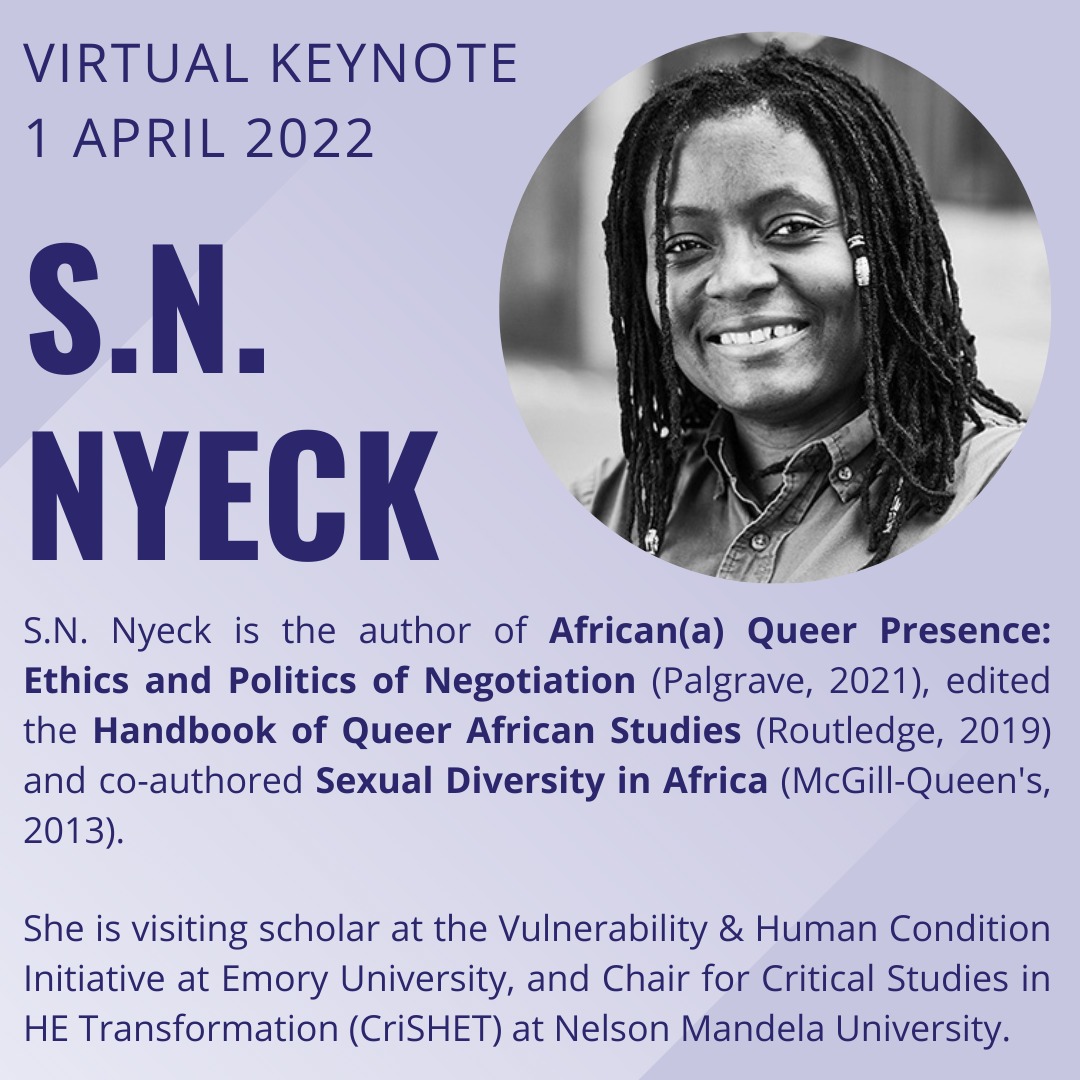
Dr. S.N. Nyeck, author of African(a) Queer Presence and the Routledge Handbook of African Queer Studies, virtual keynote
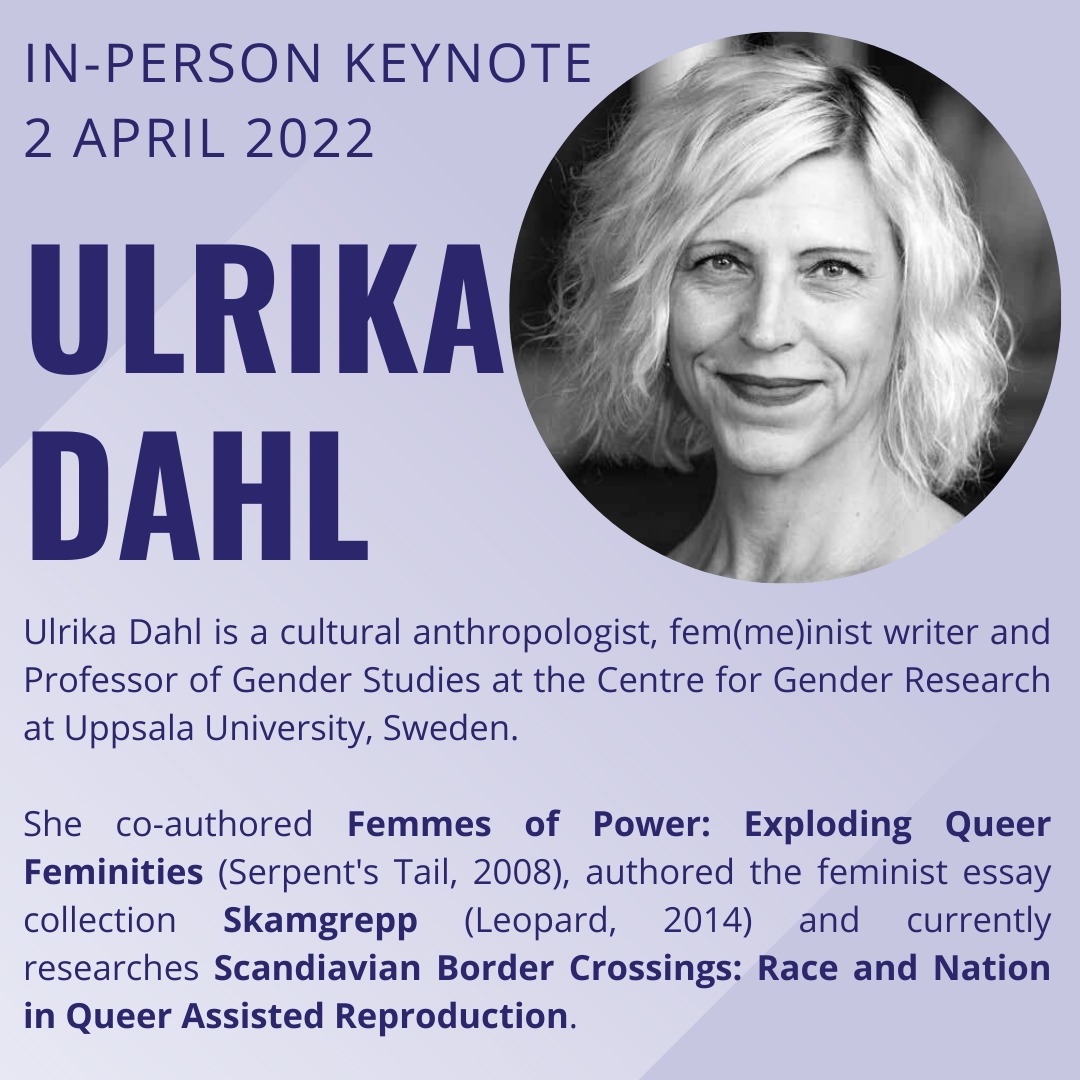
Ulrika Dahl, author of Femmes of Power: Exploding Queer Femininities, in-person keynote.
Queer Bloomsbury Panel
The conference will include a panel on Queer Bloomsbury. This will be an online panel on Friday, April 1, and will comprise three presentations (20 minutes each) followed by a half hour discussion/Q&A. The panel will include Madelyn Detloff (Miami University), Jane Goldman (University of Glasgow) and Samson Dittrich (University of Sussex) and will be chaired by Marielle O’Neill (Leeds Trinity University).
Submit an abstract
Conference organizers encourage postgraduate, early-career researchers, and community members to submit a paper on a topic of their choice relevant to one issue, or more than one, to look at, for example, the intersections of class, race and queerness. Read more about submission guidelines in the Call for Papers.
Please send abstracts of 300 words to outsiders2022@gmail.com. Abstracts will be reviewed anonymously, so include all personal information (e.g., name), in the body of the submission email only. Please also include whether you are submitting for the virtual or in-person conference, and your preference for which day. The deadline for the submission of abstracts and panel proposals is Jan. 9, 2022.
Get more information
For all enquiries and to join the mailing list, please email: outsiders2022@gmail.com
Now is the time to submit panel proposals on Virginia Woolf for the Modern Language Association Convention, scheduled for Jan. 5-8, 2023, in San Francisco. Submissions are due Dec. 17.
The International Virginia Woolf Society will have one guaranteed panel on Woolf at the 2023 Convention. The group can also submit one additional panel proposal (which is often accepted but not guaranteed). And it can also collaborate with another allied organization and submit a third panel proposal. These joint panels elicit especially lively, productive exchanges.
Guidelines for submissions
Note that this is a call for panel proposals, not individual paper proposals.
Please submit one topic only. The submission should include the following:
a maximum 35-word description (word count includes title)
the name(s) and contact information of the proposed organizer(s)
How to submit
Please submit your proposal to Benjamin Hagen, president of the IVWS, via email to Benjamin.Hagen@usd.edu with the subject line Woolf MLA 2023. The submission deadline is Dec. 17, 2021.
Once proposals are in, Hagen will send them out to IVWS members for a vote. Anyone who wishes to propose a session of their own outside of the IVWS process can visit the MLA website.
The 31st Annual International Conference on Virginia Woolf, with its theme “Virginia Woolf and Ethics,” has issued a call for papers, with 250-word abstracts due Jan. 31, 2022.
Next year’s conference, which will be held June 9-12, 2022, at Lamar University in Beaumont, Texas, aims to promote conversation about the topic across disciplinary boundaries. Conference organizers hope to explore Woolf’s engagement with specific ethical issues in her writing.
These may include, but are not limited to, war and pacifism, human rights, human–animal relations, environmental ethics, bioethics, fascism, empire, patriarchy,
racism and bigotry.
Woolf in relation to ethical approaches
The theme also suggests a reconsideration of Woolf in relation to various ethical approaches. For instance, participants may wish to read Woolf’s thought in conversation with care ethics, narrative ethics, moral psychology, moral imagination, moral luck, virtue ethics, deontology, utilitarianism, communitarianism, liberalism, religious or spiritual ethics (Christian, Quaker, Jewish, Buddhist, Indigenous, etc.), or other moral theories or concepts.
Papers might address the moral philosophy of Woolf’s milieu, including the thought of Russell, Moore or Leslie Stephen. Participants may wish to consider Woolf’s thought with continental theorists who address ethical concerns.
Organizers invite participants to consider Woolf in relation to broader ethical considerations, such as the relation of ethics to reading practices (or to literature); ethics of teaching, scholarly community and academic life; and secularism, religion and/or mysticism in Woolf’s thinking.
Woolf as an ethical theorist
Papers may also address reading Woolf as an ethical (or social or political) theorist. What might a Woolfian ethic look like? How might we read Woolf’s aesthetic practices in ethical terms (e.g. narrative indeterminacy and the cultivation of certain
forms of attention, moral imagination, or empathy)? How does Woolf navigate competing demands of justice, individual liberty and rights, and collectivity and social responsibility, in her fiction and non-fiction?
Non-English presentations welcome
The conference welcomes proposals for presentations in languages other than English to foster a more open exchange at this international conference. A few caveats: the organizers ask that all abstracts and proposals be submitted in English. Also, to ensure a more effective exchange among all participants, we ask that non-English presentations be accompanied by a handout of main points in English as well as (if possible) a PowerPoint presentation in English. Note that Q&A sessions will be conducted in English as well.
Where to send abstracts
Abstracts (250 words) should be sent to Virginia.Woolf@lamar.edu by 31
January 2022. Check the call for papers for more details.
Participants among the books at the Mercantile Library during a reception at the 29th Annual International Conference on Virginia Woolf, the last in-person Woolf conference before the pandemic hit.