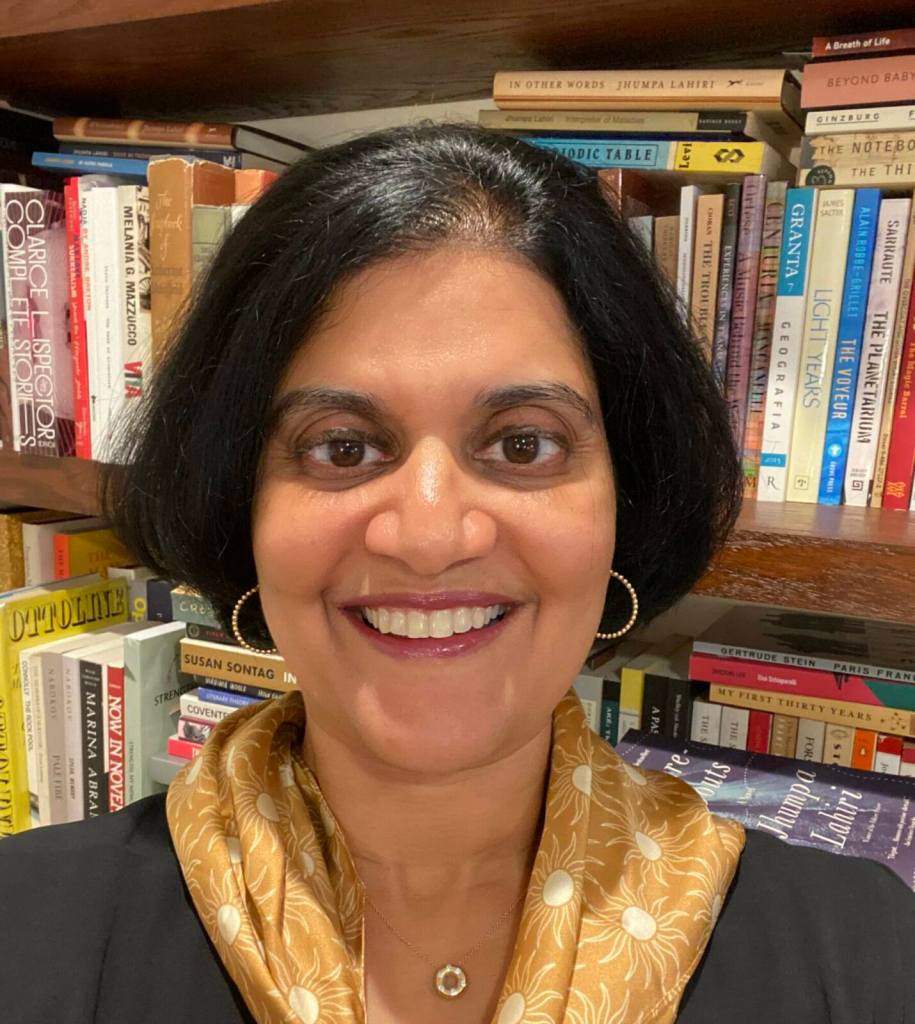
It was three years ago that Elisa Bolchi emailed me to ask if I would contribute a chapter to the project originally dubbed “Worldwide Woolf.” I was surprised. I was honored. I was ecstatic. And of course I quickly emailed a “Yes.”
Now this follow-up to The Edinburgh Companion to Virginia Woolf and Contemporary Global Literature (2021), edited by Jeanne Dubino, Paulina Pajak and Catherine W. Hollis, is out. So I am here to tell you more about this volume and its wonderful editing by Bolchi, Maria Rita Drumond Viana, Alice Davis Keane, Monica Latham, Sayaka Okumura, and Mine Özyurt Kılıç.
About the book
Besides a general introduction, Virginia Woolf and Transnational Perspectives kicks off with a special foreward — the republishing of Brenda Silver’s essay “World Wide Woolf,” in print for the first time.
The volume’s 31 chapters are divided into three sections that analyze the cultural mediation that has shaped how readers and viewers worldwide encounter Woolf’s images and works today.
The three sections:
Producing Woolf: Editing, Translating, Publishing
Thinking through Woolf: Legacy and Contemporary Influence
New Woolf, New Critical Perspectives
Research areas covered: rewriting, translation, dance, photography, fashion, contemporary art, digital humanities and drama
Areas represented by its writers: five continents including Africa, Asia, Europe, North and South America and 14 regions, including the U.S., Brazil, France, Italy, Turkey, Germany, the UK, Spain, Lithuania, Egypt, Israel, Japan, China and the Philippines.
More details
Pages: 488 Illustrations: 33 black and white
How to buy it
It is available at Edinburgh University Press. At $195 for a hardback or digital copy, the volume is pricey — as are most academic publications — so urge your institution’s library to purchase a copy. However, EUP offers a launch discount of 30 percent with the code NEW30 at checkout. I cannot guarantee the code is still viable, but it is worth a try.
About my chapter
My chapter, “Woolf on the World Wide Web: Creating a Community of Common and Scholarly Readers through Blogging Woolf,” is Chapter 31, the last in the volume. In it, I build on Silver’s insights as I explore the history of the blog, including its editorial content and its readership.
I also discuss its ability to foster collaboration among Woolf scholars and readers, as well as online and personal relationships.
“Arrange whatever pieces come your way”—Virginia Woolf, A Writer’s Diary
This first piece of our four-part reflection series on the 2024 Woolf conference introduces the ways in which we each found our paths to Woolf, and subsequently the approaches we respectively took going into the conference.
Leanne Oden, Serena Wong, and Jessica Kim, all first-time Woolf Conference attendees. Photo courtesy of Benjamin Hagen.
Though our interests may differ, there are common grounds in our experiences – Mrs. Dalloway has served as the starting text to our research as Woolfians, and we were both contemplating on notions of illness when first arriving at Fresno.
When we met on the first day of the Woolf conference, therefore, we found our interests enhanced by the nuances of each other’s research perspectives. The dynamic that emerged from our conversations, which led to a fast friendship, mirrors the vibrant cohesion that marks the Woolf community at large.
This collaborative series is a tribute to the generations of multifaceted Woolf exchanges that we hope our contribution will continue to add to and encourage.
For of course there is not one reflection but an almost infinite number” –Virginia Woolf, “The Mark on the Wall” (1917)
Leanne on encountering Woolf: illness vs. health
By Leanne Oden, Ph.D. Student, University of Rhode Island
Leanne Oden
As inspired by Sonita Sarker’s keynote presentation “Teks, Technê, Technology: Woolf as Modernist Icon,” I open this contribution with a reflection on who I need Woolf to be and the experiences I carry with me into my reading and research on her work.
Coming to Woolf
I came to Woolf in 2012 in the throes of an illness. In my sophomore year of undergraduate studies, reading Mrs. Dalloway — an assigned text for a course on “Fiction: Narrating Society and Self” — breathed new life into me and profoundly shaped my aspirations as a scholar. Her words captured what I felt, yet could not express.
When I think back to that first reading, an experience I wish I could have again, it is the feeling of recognition, of survival, of the courage to face seemingly insurmountable challenges, that calls me to Woolf and holds me there.
I recovered from the illness that gripped me in those earliest encounters with Woolf. However, illness would remain a driving force in my life and my reading of Woolf.
Taking a risk
In 2018, after the birth of my second child, illness would return to my life in the form of postpartum complications. The way I came to understand myself was permanently altered with the diagnosis that I received — a diagnosis that requires me to take medication for the rest of my life.
It took years for me to live a life reminiscent of the one I had previously enjoyed. In 2022, I took what I consider to be the risk of my life and applied to grad school years after determining that I now had to live out the rest of my life with a broken brain. In her 1926 essay “On Being Ill,” Woolf writes so brilliantly into existence:
It becomes strange indeed that illness has not taken its place with love, battle, and jealousy among the prime themes of literature.
While my doctoral work is just beginning as a first-year Ph.D. candidate, having just completed my master’s program in May, I am eager to bring my own encounters with illness into an investigation of the closure narrative of the illness versus health binary through Woolf’s writing, among other experimental modernist writers.
Woolf’s fiction and nonfiction alike have become my own survival narratives, and this is the lens through which I come to understand Virginia Woolf.
Serena on encountering Woolf: illness and an orientalist aesthetic
By Serena Wong, Ph.D. Candidate, University of Glasgow
Serena Wong
I came across Virginia Woolf in my undergraduate studies but was first truly enthralled by her work when doing my master’s in 2019, during which I joined a course titled “Woolf Writes Modernity” that covers all the novels in her oeuvre.
Woolf’s celebrated reputation in the modernist studies canon gave me high expectations of her texts that do not disappoint. Like many other new readers of Woolf, I found myself soon admiring the poetic flow of her writing and the feminism that abounds in her narratives.
Struggling with discomfort
Yet I also found myself struggling with some descriptions that the majority of my peers seemed not to notice. As one of the two Asian students in an overwhelmingly Caucasian cohort, Woolf’s aesthetic employment of “Chinese eyes” in Mrs. Dalloway and subsequently in To the Lighthouse was, and still is, a point of discomfort that I actively raise in the classroom. This observation led to my master’s dissertation, which went on to become my Ph.D. project.
My early encounter with Woolf and with modernist literature at large is then also intertwined with contemplations on illness. My illness, according to orientalist literature, is one that pertains to culture and race.
In 2023, within the Woolf panel of my first American conference at the Modern Language Association Convention, I gave a paper centered in “On Being Ill” that discussed an overlapping merge of illness with racialized, orientalist aesthetics in the works of Woolf and Thomas De Quincey.
As I compare my research interests with Leanne then — at the Woolf conference — and now — at the time of our collaborative writing — I am fascinated by how our respective positions drive us to see things uniquely, albeit in the context of the same texts and theme.
I am grateful for Leanne’s open-mindedness to my research project, and I hope I have been just as supportive of hers. Our exchanges – which, by happy coincidence or fate, began when we initially met in the first panel of the first day of the 33rd Woolf conference – reaffirmed for both of us the necessity of flexible and sympathetic communications in academic practices.
Keen to collaborate
As scholars in the early stages of our studies and careers, we are keen to collaborate on this entry as a testament to our inheritance of the shared efforts that have come before us, and as an example to those who will come after. Besides, Leanne is one of the many lovely people with whom I’ve engaged in broad and stimulating conversations at last year’s Woolf conference.
Here I must thank the members of the International Virginia Woolf Society and all others involved who have sustained the Woolf community as such a vibrant and forgiving space of exchange. It is no surprise, perhaps, that the Woolf community is working hard to encourage inclusive practices within its scholarship.
Woolf’s writing, though problematic, has always been radical in political thought and creative experimentation by the standards of its time. Though I am criticizing in parts her orientalism, I am by no means trying to extend harsh commentaries to the ensemble of her work. We are all products of our own time, and the generations that follow will continue to reorient the faults in our discourses.
In the meanwhile, however, the success of this intellectual legacy is dependent on a process that communicates from a multiplicity of perspectives and a diversity of forms.
Future posts in the four-part series
Our future posts for Blogging Woolf will record snippets of the panels, workshops, and keynotes at the 2024 Woolf conference that in their multifariousness together celebrate the accomplishments of this culture.
About the authors
Leanne Oden is a first-year Ph.D. student and an Instructor of Record in the English Department at the University of Rhode Island. In her forthcoming research, Leanne is interested in questioning the closure narrative of the illness versus health binary as challenged through Woolf’s writing among other modernists. In her role as an educator for the University of Rhode Island, she regularly teaches ENG 110: Introduction to Literature and WRT 106: Introduction to Research Writing.
Serena Wong is a Ph.D. Candidate in English Literature at the University of Glasgow. Her doctoral study situates itself at the crossroads of British modernisms and Chinese modernity, with a focus on the orientalism in Virginia Woolf’s stylistic and formal representations of China. Her research also looks at theoretical and creative studies of ornamentation, which she positions as an important dimension of orientalist thought.
Editor’s Note: Trudi Tate, director of Literature Cambridge, provided this piece for Blogging Woolf.
Wolfson College at the University of Cambridge
Woolfians are invited to join Literature Cambridge in summer 2020 for a rare opportunity to study Virginia Woolf’s Mrs. Dalloway (1925) alongside writing by some of her most interesting contemporaries.
Reading the 1920s, held July 26-31 at Wolfson College at the University of Cambridge, will provide a week’s intensive study, with lectures, seminars, supervisions, plus visits to places of interest in Cambridge.
Shaping the 20th century
Reading the 1920s explores some of the brilliant writers working after the First World War. The 1920s is a crucial period in the shaping of the entire twentieth century and its literature. It was an extraordinarily productive decade for Woolf: between 1922 and 1931 she wrote many of her greatest works: Jacob’s Room, Mrs. Dalloway, To the Lighthouse, A Room of One’s Own, The Waves, and more.
Woolf was familiar with the works students will study on this course. Some she knew very well, such as “The Waste Land” (1922) and A Passage to India (1924). She had mixed feelings about Lawrence, but admired the best of his work, noting as she finished The Waves that his writing gave her much to think about. We will study his powerful novella collection of 1923, The Fox, The Ladybird, and The Captain’s Doll, plus his joyous nature poetry in Birds, Beasts, and Flowers (also 1923).
Katrina Jacubowicz reads aloud at the summer 2019 Literature Cambridge course, Virginia Woolf’s Gardens.
Lecturers and topics
Alison Hennegan will discuss sexuality and censorship in the 1920s, focusing on The Well of Loneliness (1928). Why was this book by Radclyffe Hall censored while Woolf’s Orlando sold freely?
Peter Jones will explore the thinking of Forster’s Passage to India about India, Britain, and the campaign for Indian independence in the 1920s.
Trudi Tate will look at some powerful and poignant testimonies from the First World War.
Karina Jakubowicz will discuss Mrs. Dalloway and the social system that Woolf so criticized.
This course provides students with a great opportunity to study Woolf, Lawrence, Forster, and others together. The course aims to give a richer understanding of the writings of the 1920s, and of the turbulent history to which they bear witness.
Woolf’s Women July 19-24
Literature Cambridge also runs an intensive summer course on Woolf every year in July. In 2020, from July 19-24, the course will explore Woolf’s Women.
Along with others, I will be there July 14-19 learning about the importance of gardens to Woolf’s life and work, from her early story “Kew Gardens” (1917) to her last novel, Between the Acts (1941).
Other course readings include Jacob’s Room (1922), Mrs.Dalloway (1925), To the Lighthouse (1927), Orlando (1928) and A Room of One’s Own (1929).
Daily schedule
Each day starts with a lecture presented by a leading scholar. A seminar or a Cambridge-style one-hour supervision (tutorial) for students in groups of three or four follows, taught by lecturers and post-docs from the University of Cambridge to discuss the topic of the day, looking closely at that day’s text.
Lecturers include Suzanne Raitt, Gillian Beer, Alison Hennegan, Clare Walker Gore, Karina Jakubowicz, Oliver Goldstein, Trudi Tate, Kabe Wilson and Caroline Holmes.
Manuscript, excursions, and more
We will also get to view the manuscript of A Room of One’s Own held in Cambridge.
When the course ends, I’ll head out on two excursions — to Monk’s House and Charleston. I visited both sites in 2004 but am eager to go again.
Virginia Woolf’s writing Lodge at Monk’s House
We’ll also have time to explore Cambridge on our own, go punting, discuss literature with other students, and reflect, the website tells us.
Listen to Caroline Zoob’s podcast
Hear Caroline Zoob, author of Virginia Woolf’s Garden, interviewed by Literature Cambridge lecturer Karina Jukubowicz.
Editor’s Note: This post was written by Dr. Trudi Tate of the University of Cambridge.
Our Woolf course, ‘Virginia Woolf in Cambridge’, 18-22 July 2016, is filling up, but there are still a few rooms available at the favourable summer school rate.
Virginia Woolf in Cambridge 2016 looks at some of the best-loved of Woolf’s books (Mrs Dalloway, To the Lighthouse, and A Room of One’s Own) from fresh angles, putting them alongside contemporary creative work by Susan Sellers (Vanessa and Virginia) and Kabe Wilson (Of One Woman or So). Gillian Beer’s lecture on ‘Reading The Waves Across a Lifetime’ promises to be a highlight, giving us a way into this fascinating book for the 2017 Woolf course, in which we plan to study The Waves and other exciting and challenging Woolf works.
Our summer course gives students the experience of a Cambridge-style supervision (a tutorial). Two or three students spend an hour with an experienced Cambridge supervisor, discussing the work of the day, and engaging in careful close reading, in the tradition of Cambridge English since the 1920s.
We will explore some of the historical context of Woolf’s books, asking what they have to say about their own time, and how they speak to ours.